
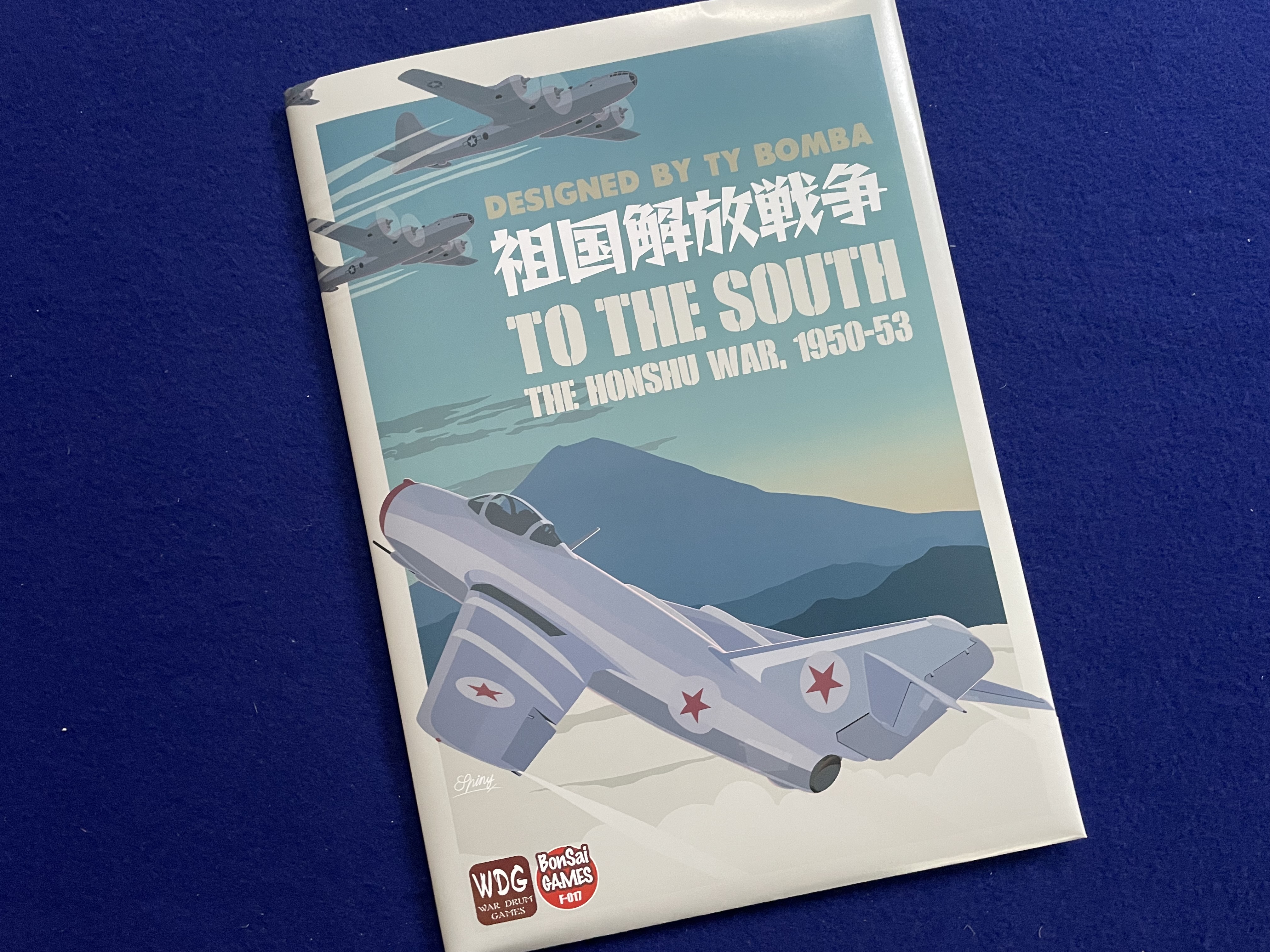
There are many different motivations for wargamers. I personally subscribe to the “Wargaming for History” clique that typically uses wargames to explore history and, especially, possible alternate outcomes. But what if the history itself—not the outcome—is where the alternate starts? Like that time in 1950 a Communist Asian country with a major Cold War power (and patron) to their north invaded their southern neighbor who was supported by the United States and the United Nations. Remember that three-year war and all the wargames depicting it? You remember the name: The Honshu War, right? What? You can’t remember that one? Well, that’s because the scenario never happened…except in a paper time machine from Bonsai Games in Japan named To the South: The Honshu War, 1950-53 by designer Ty Bomba that arrived in our timeline in 2025.
Tomorrow the World goes East
In 1989 designer Ty Bomba, then working with World Wide Wargames (3W), published Tomorrow the World: The Ultimate Nightmare (3W, 1990) which was a wargame set in a dark alternate history where Nazi Germany and Imperial Japan won World War II and then face off in 1948 in a new World War III. Ty Bomba went on to design at least two other wargames in 1990 using this setting; Mississippi Banzai (XTR, 1990) depicting “Stalingrad in St. Louis” and Black Gold (Texas Tea) (XTR, 1990) where the battlefield is the Middle East (interestingly, the game released around the same the the First Gulf War was fought). Bomba even designed an alternative Civil War title, Wahoo! The Battle of Washington July 8, 1863 (XTR, 1991), which covers the “Battle of Washington” after Robert E. Lee is victorious at Gettysburg.
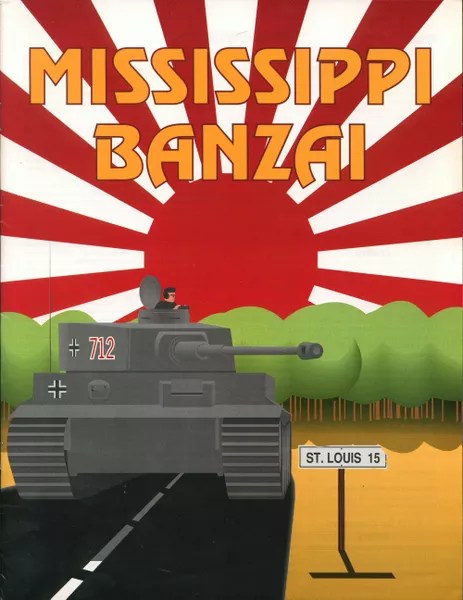
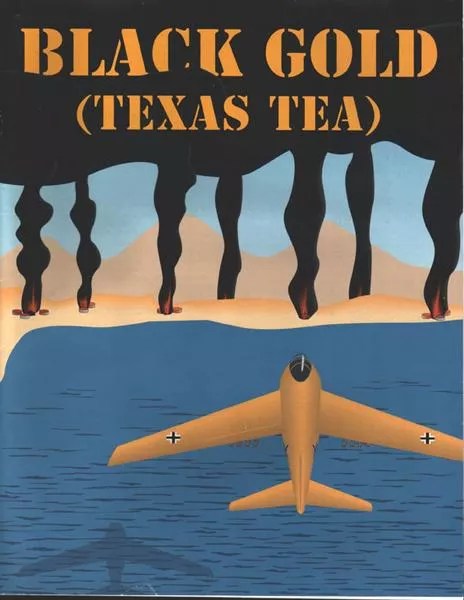


All of which is to say that alternate history is not really a new topic area for Ty Bomba; that is, until Bomba published the first version of To the South for War Drum Games from China in 2020. Now, come 2025, Bonsai Games of Japan brings us a new version of To the South which Bomba describes this way:
So far, I have designed games faithful to history, but I want to challenge myself with a “what-if” game, a world where the train runs on a different track. What if the United States had won the Battle of Leyte Gulf decisively? What if, because the war against Japan progressed as scheduled, the Soviet Union had invaded Manchuria at the same time as Sakhalin? What if, as a result, the Korean Peninsula, not Japan, had been divided into North and South? The possibilities are endless.
14.0 Design Note
The Honshu War
Bonsai Games, in collaboration with Ty Bomba and War Drum Games, in 2025 brought forth one of the latest “history gone sideways” wargames, To the South: The Hoshu War, 1950-53:
The Honshu War (original title: The Honshu War, 1950-53, hereafter THW) is a two-player hypothetical war game. As a result of World War II, Japan was divided into East and West—West Japan governed by the United States and East Japan by the Soviet Union. The “Republic of Japan” (ROJ) was established in West Japan, while the “Democratic People’s Republic of Japan” (DPRJ) was founded in North Japan. Both East and West Japan began their own distinct “postwar” paths. However, in 1950, North Japan (commonly referred to as “North Japan” rather than “East Japan” due to its capital being in Sakhalin) suddenly launched a military invasion of West Japan. Under the pretext of “protecting North Japan from imperialist aggression,” the “Soviet Volunteer Army” joined the conflict. In response, the United Nations forces, led primarily by the United States, intervened to defend the frontline of the “free world”—this is the situational premise.
The Communist player (North Japanese forces and Soviet Volunteer Army) aims to capture as many key locations in West Japan as possible. The UN forces player (Republic of Japan and U.S. forces) focuses on defense in the early stages, launching sharp counterattacks when the opportunity arises.
Designer’s Note: THW was published in Chinese by War Drum Games under the title To the South. This version introduced cards and Chinese People’s Volunteer Army units not present in the original. The Honshu War is the Japanese version of THW, with improvements made to address issues while minimizing changes to the game’s core components. Additionally, in homage to Daisuke Sato1, we couldn’t omit the inclusion of “battleships.” Indeed, THW was designed with inspiration from Seito (see Rule 14.0 for details on the designer’s historical alterations).
1.1 Overview
Island war in a folder
Many American’s likely would call The Honshu War a folio game as it comes in a magazine-sized baggie instead of a box. Bonsai Games, however, ships their folio games in a nice folder. The components for The Honshu War are not extensive; a roughly 33″ x 23.5″ map, 198 counters, two player aid cards, and a 24 page rulebook. Of the 24 rulebook pages, 15 are for the rules and the balance for an Extended Example of Play that is well illustrated. The map features a snaking hex map (40 kilometers per hex) and has many tables arranged for each player sitting opposite sides of the table (it is amazing how many US publishers are not able to arrange map boards that way).

Each game turn in The Honshu War represents about two months. The Sequence of Play is, in many ways, bog-standard for a wargame:
5.2 Game Turn (GT) Procedures
The procedures for each GT are as follows. This rulebook will, henceforth, explain the rules according to these procedures as much as possible.
Turn Procedures
A. Air Force Phase
- Air Superiority Determination Segment
- Air Force Marker Placement Segment
B. First Player Turn
- Airborne & Landing Operations Phase*
- Movement or Combat Phase
- Combat or Movement Phase
C. Second Player Turn
- Airborne & Landing Operations Phase*
- Movement or Combat Phase
- Combat or Movement Phase
D. Turn End Phase
- First Player Final Supply Determination Segment
- Second Player Final Supply Determination Segment
- First Player Replenishment & Reinforcement Segment
- Second Player Replenishment & Reinforcement Segment
- Armistice Negotiation Segment
- Administrative Segment
*The Communist Player Turn only conducts the Airborne Operations Phase.
The Honshu War is rated by Bonsai Games as “Medium” complexity and takes about 180 minutes (3 hours) to play. Experienced wargamers likely will find they can play a scenario a bit faster.
I’ve seen this before…sorta
Some wargamers are likely to call The Honshu War a gimmick wargame. In this case, the gimmick is Bomba taking our real-world Korean War and simply transporting it to the Japanese Islands to create a fictional, highly derivative setting that, the critics will say, simply plays out the same. To those critics I say, “Well, sorta small yes, but also really big no.”
The Honshu War actually has a fairly simple, yet important, set of supply and reinforcement rules. Both sides must husband their resources to ensure units are ready and available when needed. Movement rules are rather standard with a Terrain Effects Chart (TEC) and combat using a classic odds-based Combat Results Table (CRT). While that sounds very vanilla (and, honestly, it kinda is) the real interesting part is the variations that can be used, found in 13.0 Optional Rules:
The following are optional rules for playing THW in a more enthusiast-oriented way. When using optional rules, during initial setup, add three Greater Japan units marked with a ● in the upper left and three U.S. units marked with a ☆ to the reinforcement pool. Additionally, place 13 North Japanese units marked with a ★ in the upper left into a newly prepared Communist reinforcement pool. During each Communist Replenishment & Reinforcement Segment starting from GT 1, the Communist player can spend 1 VP to randomly draw one reinforcement unit. Unlike the UN forces, only one North Japanese reinforcement unit can appear per GT.
13.0 Optional Rules
There are 13 optional rules for The Honshu War in rule 13.0 Optional Rules. They are:
- Fog of War – Limited inspection of enemy stacks.
- Total Mobilization for the North – Gain extra reinforcements but at the cost of Vicotry Points.
- Devastation Impacts to Armistice – The more devastation markers the greater chance of Armistice.
- Combat Support – For better combat odds.
- Naval Battles and Battleships – Not only adds a simplified naval module but you can get South Dakota to sail alongside Yamato!
- Heavy Tank Battalion – Big guns on land.
- Ace Fighter Pilots
- B-29 Bombers
- Patton
- Partisans
- Daihatsu – Infiltration Boats.
- Comrade Premier’s Battle Supervision – Pesky Supreme Leaders always get in your way, eh?
- ‘Symbol of Showa’ – Fanaticism on the battlefield.
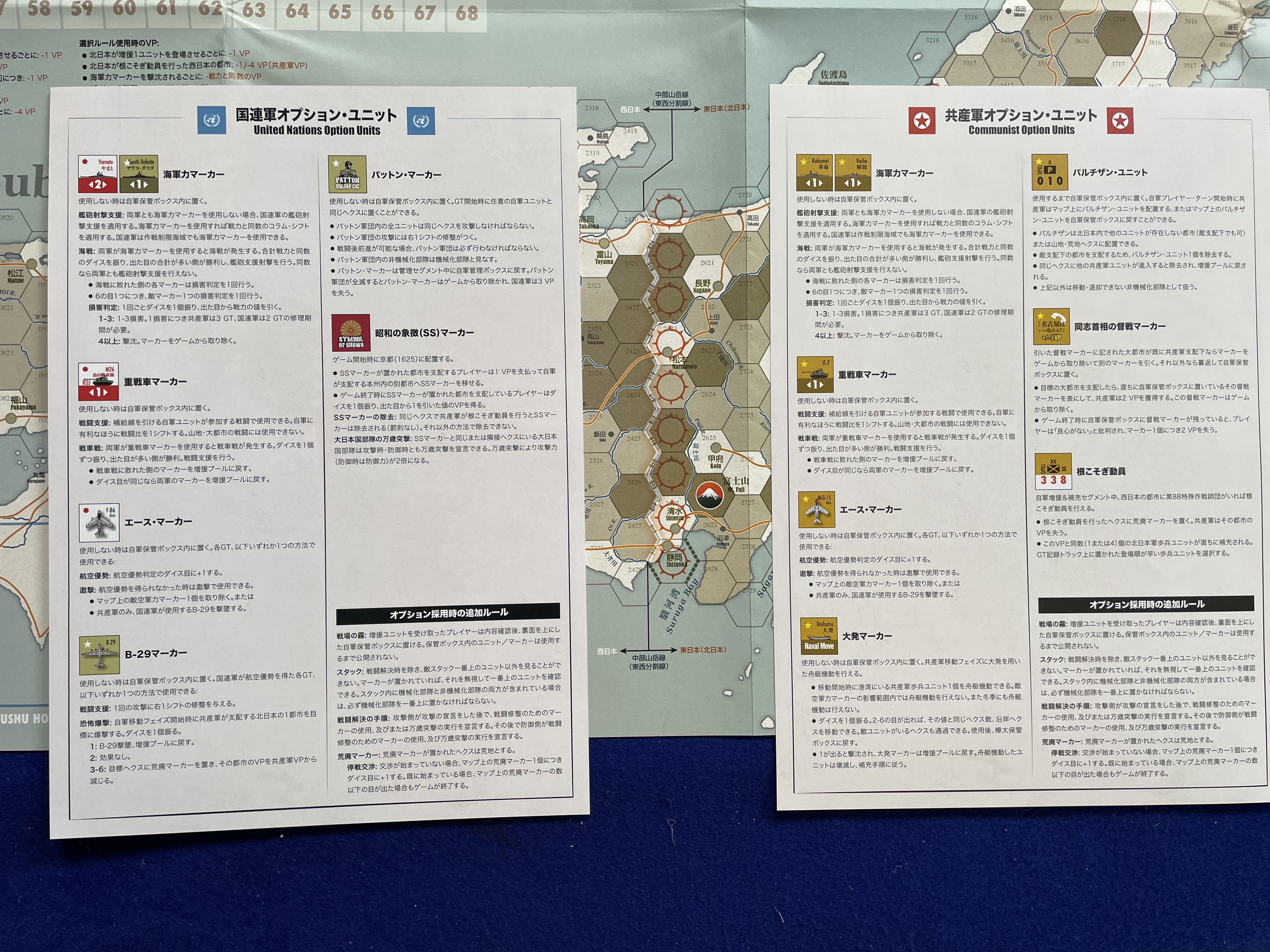
The thirteen different optional rules for The Honshu War is the chrome that makes this otherwise “bland” wargame “pop” with gaming potential. I mean, if we are already going for an alternate history, why not throw in many alternate options to explore all those alternate outcomes?
Alternate outcomes but same fun
As I admitted above, I am part of that “Wargaming for History” crowd. So why then do I find so much enjoyment playing The Honshu War that is certainly not historical? For a game that has a setting (theme?) very similar to our real Korean War, the different location and multiple options makes every game very much a unique experience. When playing, I often find myself subconsciously projecting what I “think” should be happening based on my Korean War knowledge but then find that “reality”—at least this alternate one—is much different. For instance, in The Honshu War the battleship USS South Dakota can sail alongside the Republic of Japan battleship Yamoto to oppose two Democratic People’s Republic of Japan (DPRJ) battleships; in our reality North Korea can only take credit for sinking USS Baltimore.2
All of which is a long-winded way of saying The Honshu War is a fun wargame. Not only “fun” in the sense of easy to learn and play, but “fun” in the sense that the narrative built through play is highly entertaining. Yet, while the game is “unserious” in terms of history taught, the reality is that seeing the alternatives often helps to better understand how our reality came about. Although The Honshu War is alternate history the lessons it teaches are no less valuable to understanding today.
- From BGG – “Daisuke Satō, also known as 佐藤大輔, (April 3, 1964-March 22, 2017) is a Japanese board game designer, novelist, and Manga writer. He said “I am orthodox unhistorical game designer”, so he involved more than 10 games, but many games was non-historical games.” Satō’s most widely known alternate history wargame is perhaps Red Sun Black Cross (Ad Technos, 1985) where, “The setting for the game is that Germany won WW2 (conquered Europe) due to Japan not attacking the USA and we both stayed neutral while Japan picked up territorial concessions. Now it is 1948 and Germany and Japan are about to fight it out for control of the Indian subcontinent. The USA is on Japan’s side in the conflict.” This is how we get big battleship actions! ↩︎
- So the DPRK claims. I know wikipedia is a poor source but in the entry for the Battle of Chumonchin Chan fought on 2 July 1950 is this passage: “The Victorious War Museum in Pyongyang, North Korea has several exhibits which claim that the USS Baltimore (CA-68) was sunk by motor torpedo boats belonging to the Korean People’s Navy, under the command of Kim Kun Ok.[1] Exhibits include a poster and the “actual” boat which supposedly sank the American cruiser. However, the Baltimore was in the United States Navy’s decommissioned reserve from 1946 to 1951 and mothballed in Bremerton, Washington, therefore she did not participate in any battles anywhere in 1950. In 1951, the Baltimore was recommissioned and assigned to the Atlantic (not Pacific) Fleet, and in 1955, she was transferred to the Pacific Fleet, two years after the end of the Korean War. She was struck from the Navy list on 15 February 1971, sold on 10 April 1972 to the Zidell Ship Dismantling Company of Portland, Oregon, and subsequently scrapped in September 1972.” ↩︎
Feature image courtesy RMN
The opinions and views expressed in this blog are those of the author alone and are presented in a personal capacity. They do not necessarily represent the views of U.S. Navy or any other U.S. government Department, Service, Agency, Office, or employer.
RockyMountainNavy.com © 2007-2025 by Ian B is licensed under CC BY-SA 4.0
 Rocky Mountain Navy Gamer
1 thought on “Wargame SITREP 25-18 ~ 1950’s southward invasion the Japanese way – To the South: The Honshu War, 1950-53 (Ty Bomba, Bonsai Games, 2025)”