
Orbital Cold War, written by Paul Elliott and published by Zozer Games in 2025 is a campaign setting for use with Cepheus Universal (CU). CU is the latest version of the Cepheus Engine ruleset offered by Zozer Games, in much that same fashion Independence Games offers The Clement Sector Roleplaying Game as the core ruleset for their The Clement Sector setting.

Zozer Games describes Orbital Cold War this way:
Orbital Cold War depicts a world where the Space Race never ended and the Soviet Union never collapsed. It is 1990, and there are several hundred humans in orbit and on the Moon, manning stations, bases and outposts. Although there have been new technological innovations along the way, many of the reliable rocket and capsule designs of the ‘60s and ‘70s are still in use.
The player characters are astronauts, scientists or even soldiers, that have ridden a rocket into orbit or to the Moon. Play as Americans, Soviets or Europeans. The characters work as a close-knit crew to achieve the goals of their nation, facing staggering dangers, overcoming challenges and doing this whilst-waging an undeclared ‘Cold War’ with the enemy. The crew also has a secret faction that often requires a covert mission be carried out.
It would be easy to say that Orbital Cold War is the TV-series For All Mankind with the serial numbers (or booster rockets?) filed off but that is too simplistic, and an inaccurate, description. Though the payload of Orbital Cold War is delivered in a 167-page pdf, the actual content delivers many adventuring opportunities that are surely to fit your astro-travellers style regardless of what it is in a manner that empowers player-characters even in the midst of technology players themselves might not fully understand.

Orbital Legacy
If you followed Zozer Games over the past decade or more one might simply view Orbital Cold War as the latest installment in their Orbital 2100 series of campaign settings. One should, however, resist that temptation and instead duly recognize that Orbital Cold War begins with the same general setting yet is very different.
In response to a buyers question on DriveThruRPG, Elliott described Orbital Cold War this way: “It is set in 1990, in a Cold War between the USSR and the West, with real world space technology in use. It was going to be a rewrite of Orbital 2100, but quickly turned into an alt-history Space Race instead.”
Choose your orbit
The Introduction to Orbital Cold War describes the many different types of adventuring the setting offers.
Orbital Cold War is a techno-thriller setting that is primarily focused on the intense political rivalry between the United States and the Soviet Union in space. How the player characters get caught up in this global struggle depends on what the players want to do. What kind of game does the Game Master want to run? You can look at the opportunities for role-playing several different ways as a science-fiction adventure story, as a game of political intrigue and espionage, as a game of near future warfare in space, or perhaps a setting for mystery and horror. The default game assumes the GM and players will be running an espionage-themed game.
Introduction, p. 7
Colder Cold War
“The Space Race” chapter in Orbital Cold War delivers the history of the setting, including the important points of divergence from our real history. One part of the history I really enjoyed reading was Elliott’s use of “real” events—or conspiracies—that just turned out differently…or did they?
You, astronaut
The “Astronauts” chapter of Orbital Cold War delivers character generation rules using the classic lifepath-with-choice system pioneered in Classic Traveller and other 2d6 Sci-Fi rule sets like Cepheus Engine. Players choose from six basic roles for their characters:
- Pilot
- Flight Engineer
- Mission Scientist
- Flight Surgeon
- Lunar Scientist
- Military Operator
You do not need Cepheus Universal to build a character in Orbital Cold War but it likely would help
Fastplay Cepheus
You technically do not need a copy of Cepheus Universal to play Orbital Cold War. This campaign book comes with a three-page set of Fastplay rules that can get you started.
Kick the tires and light the fires
To get around in space in Orbital Cold War you need spacecraft and that is the subject of the next chapter, “Spaceflight.” Long-time Traveller players surely know that some settings and rule sets can get very, very technical. Not Orbital Cold War:
That said, in Orbital Cold War, you will be relieved to know that we are not going to discuss the complexities of conic orbits, parabolas, Hohmann orbits or brachistochrone trajectories! However, the following sections provide some general background on how spacecraft move and manoeuvre in space.
Spaceflight, p. 36
Nowhere is this simplified space travel in Orbital Cold War better described than in Travel Times:
This is a game, however, so don’t expect involved calculations or a detailed description of different orbital transfer choices. We want to get on with the story and [not] let the character worry about such details. In the end, players only need to know how long these procedures take.
Spaceflight – Travel Times, p. 42
Another example of how Orbital Cold War focuses on player-characters making decisions in game and not requiring meta-knowledge is the rule for Troubleshooting. As the introduction to the rule notes:
Problem inevitably occur in space. Spacecraft (and bases and rovers) are highly complex and technical things and when a malfunction occurs it is the crew onboard that must deal with it. Rather than have this be a straight forward situation of asking the players to ‘roll Engineering to fix the rocket’, the process is instead a multi-player investigation. Players must decide how they approach the situation and where to focus their attention.
Spaceflight – Troubleshooting, p. 50
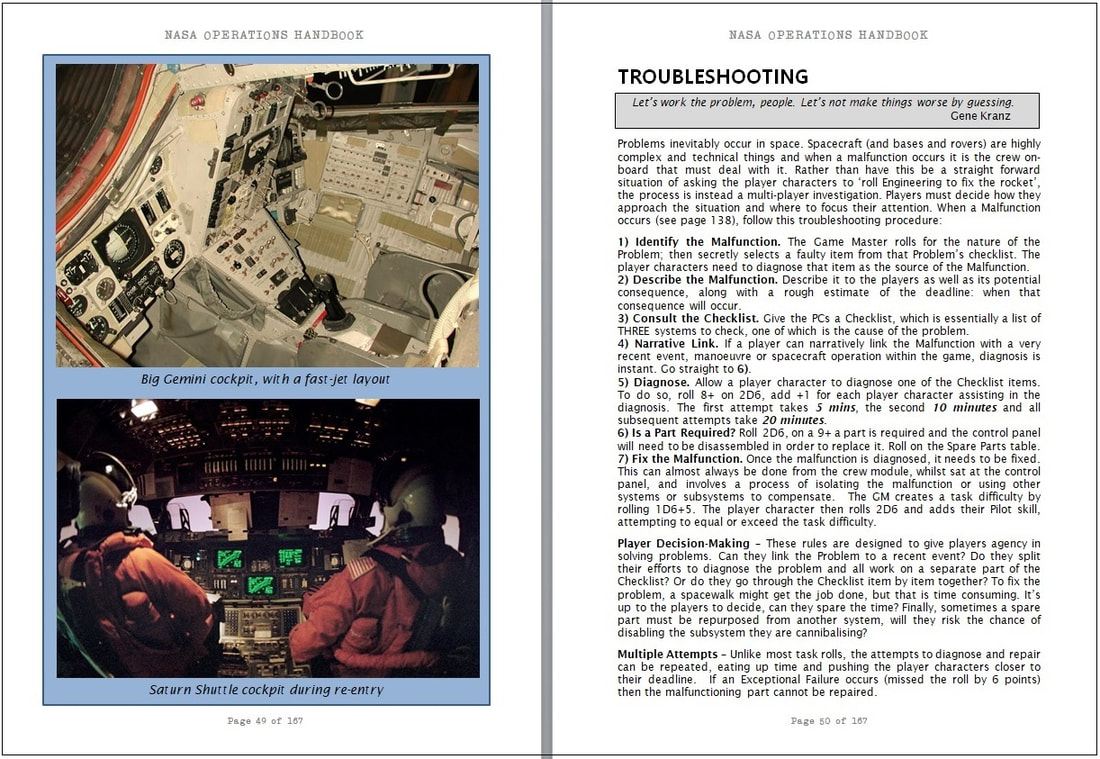
Personally, I like the Troubleshooting rule in Orbital Cold War much better than the ‘technobabble’ rules found in some games like Star Trek Adventures. Troubleshooting fits the setting better with a very NASA-like “work the problem” approach vice handwavium. Still, it might not be enough to draw some players in.
Buried in the penultimate chapter of Orbital Cold War called “Playing the Game” is a discussion of Technical Roleplaying. Though the discussion is appropriate where placed, it would help if it was referenced in the discussion of Troubleshooting as it is highly relevant—and an important part of the reason Orbital Cold War is a setting worth playing regardless of the backgrounds your players bring to the table:
This roleplaying game is a techno-thriller, with the technology front and centre – everyone depends on it for their lives. For some players, familiar with the concepts of spaceflight and engineering, there won’t be any problems in adapting to this technologically-dominated style of gaming. But for other players, this setting might seem daunting, they may struggle to play scientifically, and to meaningfully interact a technical or science-driven adventure, particularly when it’s about sciences or technology they aren’t familiar with.
For these players, who just want to play a role, make some meaningful decisions and have fun, taking on the role of an astronaut or scientist is just an exercise in frustration. With their only viable option being to confront every problem with the phrase “I roll my skill to solve the problem…”. If the GM denies the roll, they are forced into solving a problem for which they have no answer, and if the GM allows the roll any inherent tension in the situation is dissolved. It is, however, possible to find a middle-ground, but this requires a little attention from both the player and the GM.
The real issues is one around conflict. Conflict sits at the heart of most of fiction – including tabletop roleplaying games. For most roleplaying games, conflict takes a combative form: one faction wants one thing, another wants something else, and both sides will physically fight each other until the conflict is resolved. In less combat-oriented games, the conflict may be economic, social, or political. Luckily, most of these conflicts are easily-relatable – players understand resource issues, or navigating a tangles social situation. Unfortunately, that does not apply to the technical conflicts of hard science fiction. Unless your players are all space nuts, mechanics or engineers, your players likely will face trouble relating to technical conflicts.
Playing the Game – Technical Roleplaying, p. 153
The advice goes on to recommend that GMs make sure the conflict is obvious to players using mechanisms like the Troubleshooting process noted above. It also mentions using resource management (air, power, propellant) as a way to add drama. It ends with this very useful passage:
As a final, and important, piece of advice, we recommend the GM meets the players on technical details halfway. As long as they are making a show of thinking technically and scientifically, it’s absolutely fine to gloss over or subtly correct some minor technical inaccuracies in their plan. Go easy on player making ‘technical mistakes’ – always err on the side of the players and focus more on their intentions than their details. Its a game, its fun – for everyone.
Playing the Game- Technical Roleplaying, p. 154
It’s dangerous out there
Player-characters in Orbital Cold War not only face their foes but also the elements…or lack thereof. Vacuum, pressure loss (decompression), radiation, and zero-gravity are just the major ones. The “Survival” chapter in Orbital Cold War not only discusses these threats, but also the space suits and other equipment that player-characters can use in this hostile environment.
Catch a ride
“Space Vehicles” and “In Orbit” in Orbital Cold War is in many ways standard fare to Traveller or Cepheus Engine ship or orbital platform/station builders. As the book states:
The designs in this chapter are based on real world spacecraft or proposals that were on the drawing boards in the 60s and 70s. They were built using the Small Craft Design rules in Cepheus Universal (pages 270-272), with some slight modifications. Rules for batteries and solar panels have been added in this book (page 87).
Space Vehicles – Spacecraft, p. 68

High ground
While much of the adventure in Orbital Cold War can take place in the orbits above earth (hence the name of the game), the Moon is also a location presented for gaming. As the book states, “The focus of the orbital Cold War is the moon, without a doubt” (p. 103). In “The Moon” and “Lunar Orbit” chapters of Orbital Cold War one finds a description and maps of the moon, the various bases, outposts, and military bases, and stations above. Each location provides a background and current description and some even have non-player characters specified. The whole chapter is one huge set of plot hooks ready for player-characters or GMs to fish through and build adventures from. In many ways the plot hooks presented are designed to work with the next section of the book, “Factions.”
Who are you?
Factions are a major part of the default setting in Orbital Cold War:
Politically, the Cold War is back on in 1990 after a hard-line coup. The intelligence agencies of both East and West form major factions, as do the aerospace contractors. Factions are used to generate scenarios, with each one pulling in its own direction. The player characters work for NASA, the ESA or Glavkosmos, but will have a faction ally for whom they carry out secret missions, hidden even from their employer. To prevent mistrust and in-fighting within the PC group, the entire player character crew works for the same secret faction. The faction is broadly sympathetic to the space agency’s operations, but has its own agenda.
Factions, p. 129
I understand why some GMs (and players) may be uncomfortable playing with a potential “traitor” in their midst but, come on, is that not the rocket fuel for explosive adventure?
Your mission
For a campaign book that is so much a sandbox for adventuring, I must admit that my first reading of the “Playing the Game” chapter of Orbital Cold War created some doubt in my mind. In particular was this section:
What Do We Do?
So, what do player characters do in this game, and how will it differ from other modern-day roleplaying games? Characters are all astronauts, either pilots or else highly-trained specialists that re required for some technical or scientific task. Even though this game increases the number of astronauts and cosmonauts in space by a factor of twenty, they still face certain restrictions that are inherent with spaceflight in this era:
- Each mission is monitored by a large team of controllers back on Earth.
- Spacecraft have limited options in where they go.
- Time in flight is boring, with only set maintenance checks to carry out.
This differs from other roleplaying games, where players can freely travel in any direction, visit new locations and talk to people, often with a great deal of independence and anonymity.
Playing the Game – What Do We Do, p. 137
My initial reaction at this point was disappointment and I immediately started thinking about ways I could change the game to fit my adventuring needs. Alas, all I really needed to do was keep reading:
Instead, missions in Orbital Cold War are best thought of in much the same way as a military special forces mission. A team of commandoes will be given their mission and often allowed to plan out the approach and tactics themselves. One on the plane these commandos have to sit there and be transported hundred or thousands of kilometers to the mission location. Once they disembark, or make their parachute drop, they are on their won, without help, and are free to carry out the mission as they see fit. Think of a space-based mission this way, but with the astronaut player characters flying themselves to the mission location.
Playing the Game – What Do We Do, p. 137
Easy missions, but with complications
The last chapter of Orbital Cold War, “Missions,” says that games should, “focus on missions that are dangerous, unpredictable, and meaningful” (p. 155). The advice recommends that each mission be a chain of tasks to be completed, challenged by complications such as malfunctions and with added dramatic flair (it’s an easy task…except when the spaceship is tumbling). Many suggestions are given.
Hot time in cold orbit
Perhaps the greatest take-away I have from Orbital Cold War is, after decades of playing science fiction roleplaying games, a better understanding of Technical Roleplaying. Given that many of my play groups consisted of people highly interested in science fiction—and hard sciences—like myself I think in many ways I was insulated from the player enjoyment challenges Technical Roleplaying presents. Personally, my challenging form of roleplaying is Fantasy Roleplaying as I never deeply engaged with the games (like Dungeons & Dragons) nor the literature (yes, I read some Tolkien and others but never deeply). With my recent forays into The One Ring RPG from Free League I seemingly find myself sometimes unsure of what to do exactly because I lack the “fantasy” background.
Orbital Cold War is a setting that is expressly designed to engage players regardless of technical background. Cold War history buffs will likely find the setting intriguing, hard sci-fi fans will enjoy just enough crunch, but even non-history or non-technical players will find pathways to engaging with the adventures. It is the engagement with that last group that makes Orbital Cold War special; other roleplaying games try to simplify the technical but often at the expense of the setting—look no further than the wimp out “technobabble” rules in Star Trek Adventures.
Granted, Orbital Cold War is not for every group. But that is not because the setting and rules hinder engagement. Orbital Cold War shows a way for all to enjoy even crunchy-ish roleplaying settings.
Feature image courtesy https://www.imfdb.org/wiki/For_All_Mankind_-_Season_2
The opinions and views expressed in this blog are those of the author alone and are presented in a personal capacity. They do not necessarily represent the views of U.S. Navy or any other U.S. government Department, Agency, Office, or employer.
RockyMountainNavy.com © 2007-2025 by Ian B is licensed under CC BY-SA 4.0
 Rocky Mountain Navy Gamer
1 thought on “TTRPG Roll 25-16 ~ Cepheus Universal Cold War campaigning with Orbital Cold War (Paul Elliott, Zozer Games, 2025)”