
Generally speaking, I try to read one non-fiction book each week. Some weeks it is harder than others (especially when on spring break) but over the past few weeks I made great progress towards my goal. Though I did not intend my books to be closely related the fact to the matter is that each of the past five titles I read are related in some manner.
Chokepoints

Edward Fishman in Chokepoints: American Power in the Age of Economic Warfare provides a history of the US policy use of sanctions and other economic levers of power since the early 2000’s. Fishman tells us of the sanctions regime placed on Iran that eventually brought about the JPOA (Joint Plan of Action) to delay Iran from building a nuclear bomb. The second story is about the sanctions placed on Russia in the aftermath of “Little Green Men” incidents in Crimea in 2014. The third looks at sanctions placed on the PRC during the Trump 45 and Biden Administrations. The last study looks at the sanctions placed on Russia following the February 2022 invasion of Ukraine.
In the conclusion to Chokepoints, Fishman notes that geopolitical competition in an age of economic interdependence is upon us:
Today, another shift is looming. Russian imperialism and China’s bid for world mastery have brought geopolitical competition back with a vengeance. Yet economic interdependence persists. The result is that none of the great powers—neither the United States, nor China, nor Europe, nor Russia—feels economically secure. Something has to give.
Fishman, p. 425
Fishman continues:
The Age of Economic Warfare will likely end when the chokepoints upon which it depends no longer squeeze so tight…The biggest question is whether this will happen gradually—through “friendshoring” and long-term investment in self-sufficiency—or suddenly, through the outbreak of a catastrophic great power war in Taiwan or another hotspot.
Fishman, p. 425
Which brings me to…
Denial Strategy

Elbridge Colby is the recently appointed Undersecretary of Defense for Policy. His nomination, according to at least one reporter, was controversial:
Colby — who has served in the Pentagon, State Department and in the office of the director of national intelligence — was instrumental in crafting a 2018 national defense strategy during Trump’s first term. The blueprint sought to reorient the military on so-called great power competition with Russia and China.
The incoming policy head has argued that the U.S. must prioritize deterring an invasion of Taiwan by China over assisting Kyiv. He has insisted Beijing’s military buildup and limited U.S. stockpiles of weapons require that trade-off, and Europe should take on the burden of helping defend Ukraine.
The Strategy of Denial: American Defense in an Age of Great Power Competition (New Haven: Yale University Press, 2021) was obviously published after the Trump 45 administration and is, perhaps, an assessment of the 2018 National Defense Strategy. As Colby writes, the intent of Strategy of Denial is not to define a strategy per se, but a framework:
Importantly, a strategy is a framework, not a master plan. It is predicated on a coherent view of the world and provides a logic within which to make choices and prioritize. It is, at heart, a simplifying logic to deal with a complex world that otherwise would be bewildering.
Colby, p. xi
Like Fishman in Chokepoints, Colby too looks to great power competition and a possible great power war:
It is not only the structure of global power that has changed. In the 1990s or 2000s, one could imagine that the world was becoming more peaceful and cooperative; states such as China and Russia appeared largely to accept the international lay of the land. Recently, however, the world has become more tense, if not rivalrous, in ways that reflect not just structural changes but also the reemergence of a more overtly competitive attitude. This has meant that major war, which once seemed a thing of the past at least in certain parts of the world, now seems considerably more plausible.
Colby, p. x
In the preface to The Strategy of Denial, Colby summarizes the implications of his strategy thusly. I am going to quote this at length because it leads to issues raised in other book I read:
The top priority for the US defense establishment should be ensuring that China cannot subordinate a US ally or quasi-ally in Asia, with the first priority being developing and maintaining the ability to conduct a denial defense of Taiwan. In light of this, the United States should maintain it existing defense perimeter in Asia. It should generally seek to avoid assuming additional alliances, particularly on the Asian mainland, but, if conditions require it, consider selectively adding a small number of Asian states as allies. The United States should also maintain a strong nuclear deterrent and a focused but effective counterterrorism posture; it should maintain a missile defense shield against North Korea and Iran if this is not too costly. On the other hand, in order to focus its scarce resources, the United States should not size, shape, or posture its military to deal simultaneously with any other scenario alongside a war with China over Taiwan. Its first, overriding priority must be the effective defense of allies in Asia against China. If the United States does want additional insurance, however, it can make some provision for one other senario in which the Untied States might not realistically be able to defeat an opponent’s theory of victory after defeating a Chinese assault on an ally in Asia: defeating a Russian fait accompli attempt against an eastern NATO ally, which is the only other scenario in which the United States could find itself facing a great power armed with a survivable nuclear arsenal and able to seize and hold allied territory. That said, the Untied States should seek to have European states assume the greater role in NATO. Last…what to do if both a denial defense and binding strategy fail; in this even, selective friendly nuclear proliferation may be the least bad option, though this would be a panacea and would be dangerous.
Colby, pp. xvi-xvii
Any strategy, of course, needs a plan. Given my naval background I wondered about US war plans in the age of Colby’s The Strategy of Denial. That is when a book on naval war planning crossed over my shelves…
“The Best-Laid Plans”
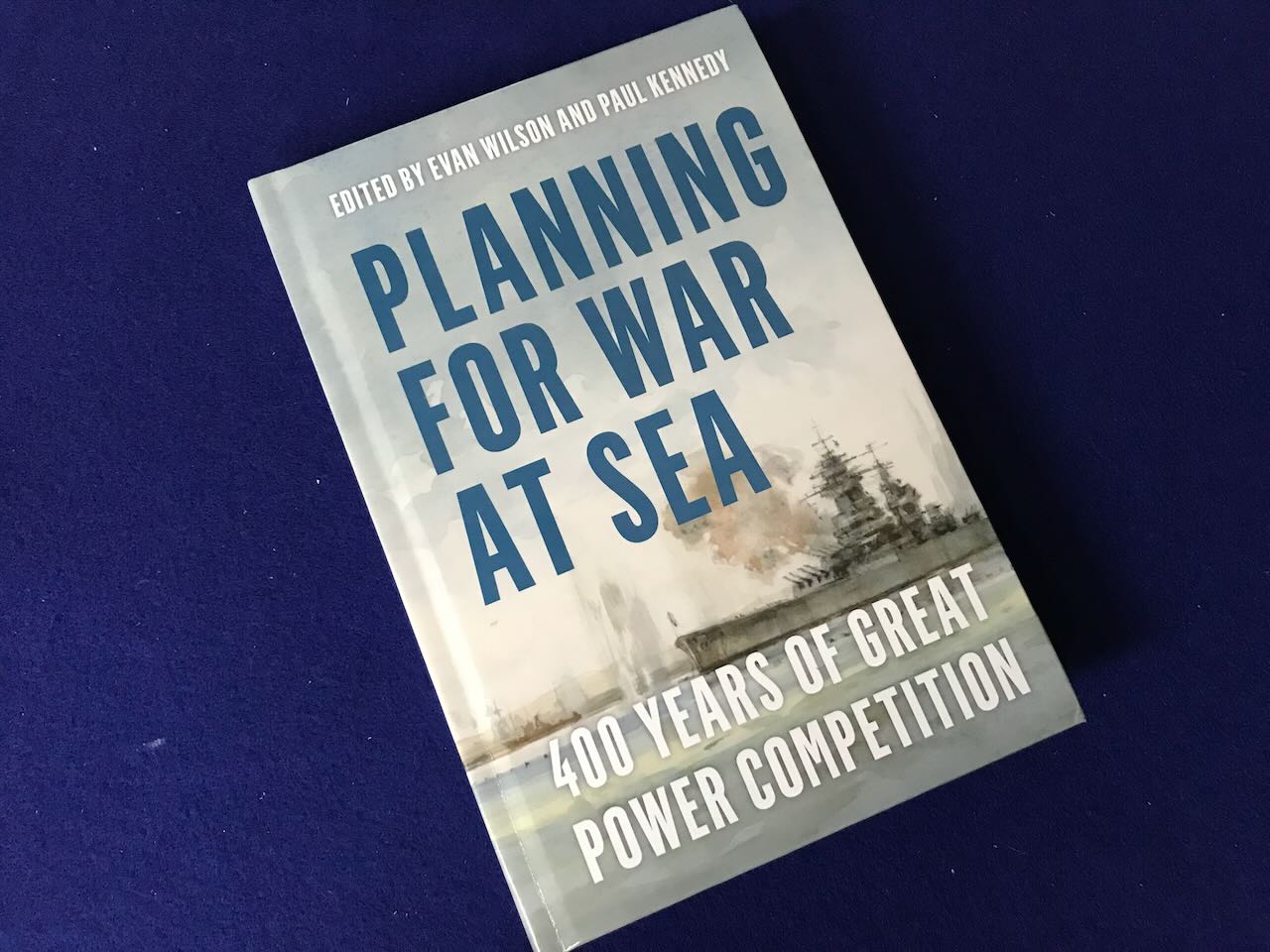
Planning for War at Sea: 400 Years of Great Power Competition is a work edited by Evan Wilson and Paul Kennedy for Naval Institute Press. Although published in 2025, the work compiles presentations at a 2022 conference. The original title was to be, “The Best-Laid Plans” which was borrowed from a poem by Robert Burns that goes, “the best-laid schemes [plans]…oft go awry” (Wilson & Kennedy, p. 1). The name, though eventually dropped, seemed to be a common theme amongst the essays:
In the long sweep of naval history, many admiralties and their planners have entered into war only to find that things were going awry: their strategic assumptions flawed, there was “something wrong” with their ships (Admiral Beattie’s lament at Jutland), logistics were inadequate, intelligence was badly wrong, and political leaders were either too rash or too timid. Not all prewar naval preparations and plans went astray, of course, and it is at least as useful to reflect on those that were successful as it is to analyze the cases of where navies went badly wrong.
Wilson & Kennedy, pp. 1-2
While Planning for War at Sea makes it case by looking at historical studies, from the First Anglo Dutch War of 1652-54 (Chapter 1 – “The First Anglo-Dutch War, 1652-54: How an Unexpected Enemy with Innovative Tactics Started an Arms Race with Long-Term Strategic Consequences” by John B. Hattendorf) through the US Maritime Strategy in the Cold War (Chapter 12 – “Deterrence or Escalation? A Reappraisal of the 1980s Maritime Strategy” by Sebastian Bruns) the final three chapters deal with today and the near-future by focusing on Russia (Chapter 13 – “Back to its Comfort Zone: The Russian Navy’s View of Its Principle Adversaries, Strategy and Force Application, and Capability Development” by Alexey D. Muraviev), China (Chapter 14 – “Adversaries and Planning Assumptions: China’s Navy and the Post-Cold War World” by Andrew S. Erickson), and the United States (Chapter 15 – “Navies and Strategic Surprises: The Post-Cold War U.S. Navy” by Norman Friedman). Indeed, it is that US-China great power competition that ends Planning for War at Sea. As Wilson and Kennedy write in their conclusion:
It is not difficult to imagine that the most serious current students of future naval operations, including best-laid plans that might go awry, could be the operational planners and logistics officers of the People’s Republic of China’s People’s Liberation Army Navy (PLAN). In the first place, this navy is undertaking the largest fleet expansion of modern times. Grappling with the implications of its changing capabilities will surely prove to be an immense challenge. It does appear, however, that the PLAN has clearly defined goals: to develop a world-class navy and unify Taiwan. Most other navies must be reactive; the PLAN will likely be able to choose the time and method of its attack, if it receives such an order. On the other hand, all the Chinese open discussions about securing the “first island chain” and then, later, more distant lines of islands and archipelagos, not to mention those well-known strategic chokepoints [see Fishman!] that would allow both Chinese surface warships and commercial vessels greater access to the Indo-Pacific, suggest ambitions beyond Taiwan.
Wilson & Kennedy, pp. 367-368
For the United States, on the other hand, Planning for War at Sea sees the strategy needed for the US Navy similar to, yet a bit differently than, Colby does:
It is relatively easy, therefore, to see where the U.S. Navy’s roles can be fitted to the larger strategic posture, and therefore to consider whether its weaponry and its planning might be vulnerable to the possibility of going awry against a well-prepared opponent. America’s strategic task remains, as it was historically, a two-fronted one. Across the Pacific, the sea-air posture necessary to deter a Chinese attack on Taiwan requires close integration with and support from vital allies like Japan, South Korea, and the Philippines. Across the Atlantic, the U.S. Navy plays an essential role in the sea-air-land posture necessary to bolster NATO and still, despite increasing domestic production, protect the supply of oil out of the Persian Gulf.
Wilson & Kennedy, p. 369
Wilson and Kennedy in Planning for War at Sea also recall a Donald Rumsfeld-ism, “technological disruption is a known unknown” (Wilson & Kennedy, p. 369). They go on to state, “Artificial intelligence may be announcing it arrival on the battlefield soon—or not, depending on whom you ask. But getting it wrong, either by falling behind its development or misunderstanding it strengths and weaknesses, is surely a source of concern” (Wilson & Kennedy, p. 369). Advanced technologies, not just AI, was the subject of my next book…
Tech Politics

Alexander C. Karp is the co-founder and CEO of Palantir Technologies, Inc. Since 2003 Palantir has provided software and AI solutions not only for industry but also for defense and intelligence customers both in the US and abroad. Karp’s co-author, Nicholas W. Zamiska, is the head of corporate affairs and legal counsel to the Palantir CEO as well as a member of the Palantir Foundation for Defense Policy and International Affairs.
The Technolgical Republic: Hard Power, Soft Belief, and the Future of the West is described by Kirkus Reviews this way:
In this book, they argue for a thorough rethinking within the tech sector, which, while full of intelligent and innovative people, has lost a sense of national purpose or common good. Instead, the authors say, America’s best and brightest are focused on creating shiny new toys, from phone apps and games to marketing algorithms. Karp and Zamiska posit that the culture of Silicon Valley is based on self-centered libertarianism, with most of the players coming from privileged backgrounds and a college system that disdains any collaboration with government. The result is that the U.S., while still leading in most areas of technology, is seeing its advantages diminish in next-gen fields like artificial intelligence and swarm warfare. There needs to be an increased awareness of the challenges facing the country and a readiness to put forward ambitious, multidimensional solutions, they argue. For its part, the government’s security institutions should be more welcoming of software specialists and should streamline the labyrinthine, wasteful procurement processes.
https://www.kirkusreviews.com/book-reviews/alexander-c-karp/the-technological-republic/
In the words of Karp and Zamiska:
The engineering elite of Silicon Valley has an affirmative obligation to participate in the defense of the nation and the articulation of a national project—and, by extension, to preserve the enduring yet fragile geopolitical advantage that the United States and its allies in Europe and elsewhere have retained over their adversaries.
Karp & Zamiska, p. xiv
Focusing specifically on AI, Karp and Zamiska state:
The rise of artificial intelligence, which for the first time in history presents a plausible challenge to our species for creative supremacy in the world, has only heightened the urgency of revisiting questions of national identity and purpose that many had thought could be safely cast aside. We might have muddled for years if not decades, dodging the more essential matters, if the rise of advanced AI, from large language models to the coming swarms of autonomous robots, had not threatened to upend the global order.
Karp & Zamiska, p. xv
Concerns over AI extend into nuclear matters too. That connection and Colby’s comment on “friendly nuclear proliferation” made me recall another existential threat to humanity: nuclear war. That is the subject of…
Nuclear Precipice
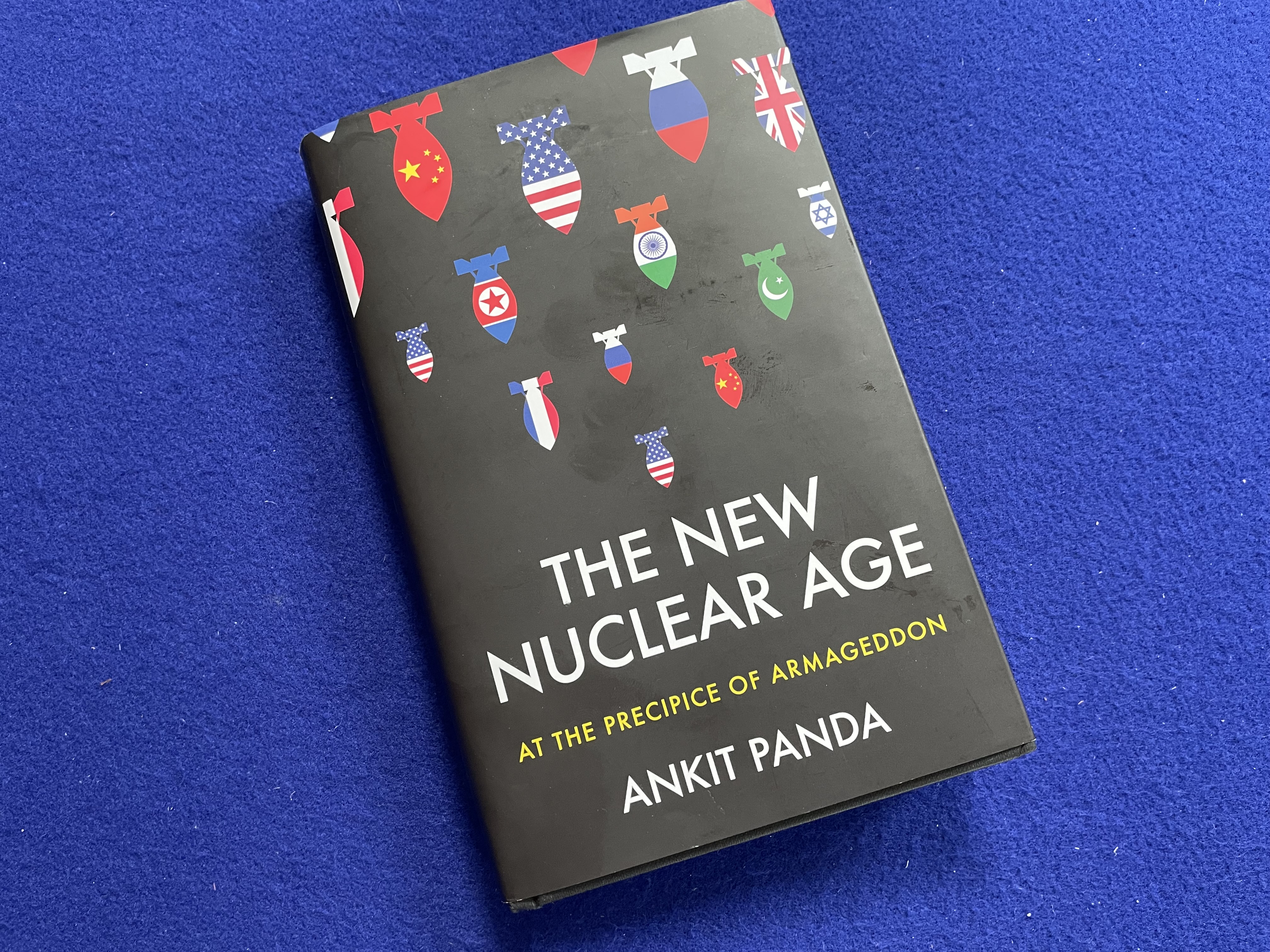
Ankit Panda in The New Nuclear Age: At the Precipice of Armageddon argues that the world is in a third, dangerous, nuclear age.
The first nuclear age was defined by bipolar superpower competition between the United States and the Soviet Union during the Cold War. The second nuclear age, after the conclusion of the Cold War, saw a transition to concern about stabilizing the former Soviet Union, preventing nuclear proliferation in South Asia and the Korean Peninsula, along with worries about possible nuclear or radiological terrorism.
Panda, p. 1
The third nuclear age, according to Panda, began in the 2020s with a growth of great power confrontation (though by another name):
That hope gave way to greater pessimism as the 2020s began, and, in particular, as relations between Russia and China on one side, and the West, on the other, have turned toward systemic confrontation.
Panda, p. 2
The New Nuclear Age particularly focuses on China in the time since 2020:
It is against this backdrop that China’s transition into this new nuclear age manifested itself in what is likely to be the most essential driver of enduring and new, global-scale nuclear risks. After decades of fielding a limited nuclear arsenal – comprising just a fraction of the warheads fielded by the United States and the Soviet Union at the height of the Cold War – China changed course and is now seeking a much larger force. Beijing’s choice in this regard stands to shift the center of gravity in global nuclear affairs away from Europe and toward Asia, where six of nine states that possess nuclear weapons have territory or regularly carry out substantial military operations. Substantial evidence suggests china has shaken off its traditional preference for a smaller nucler force, and that Beijing is pursuing an unprecedented quantitative expansion of its nuclear arsenal.
Panda, pp. 5-6
According to Panda, the third nuclear age, however, does not belong solely to the US and China or Russia:
While dynamics between the United States, Russia, and China are central to this new nuclear age, the risks of nuclear proliferation and war implicate a far greater number of states. Increasingly, technologically sophisticated non-nuclear states may have the capability to raise the risk of nuclear escalation by threatening the nuclear forces of a number of countries. Some of these countries are allies of the United States and have started to domestically debate the possibility of seeking their own nuclear weapons, perceiving long-term political dysfunction in Washington as an unacceptable risk to the reliability of their chief ally. Regional nuclear tinderboxes, from South Asia to the Korean Peninsula, have continued to fester without meaningful guardrails or confidence-building mechanisms. Finally, military and policy planners across nuclear-armed state bear anxieties about the potential role of rapid technological change on the nuclear balance – from emerging artificial intelligence capabilities to the proliferation of new missile defense and space technologies.
Panda, pp. 9-10
New Cold War or just Great Power Competition?
Whether you subscribe to the theory of a New Cold War or not, all of the above authors agree that the world has returned—in some fashion—to a condition of great power competition. Be it economics like Fishman talks about in Chokepoints or the need for a new resource-scarce, China-first strategy that Colby advocates for in The Strategy of Denial, there are lessons to be learned from the past like Wilson and Kennedy discuss in Planning for War at Sea. Karp and Zimaska in The Technological Republic tell us that a new relationship between Silicon Valley and DC is vital to victory, while Panda warns in The New Nuclear Age of the danger of that great power competition and advancing technology in a new, and unstable, third nuclear age. Regardless of what your personal political views of the matters are, all five books are worthy reads that offer intellectual stimulus as one personally navigates this new era.
Feature image courtesy Getty Images: “The world of 2034: 1. Washington, D.C. 2. Quantico 3. Barents Sea 4. Tehran 5. Isfahan 6. Bandar Abbas 7. Strait of Hormuz 8. New Delhi 9. Beijing 10. Yokusuka Naval Base 11. Zhanjiang 12. Taouan Airport 13. Taipei 14. South China Sea 15. Spratly Islands
The opinions and views expressed in this blog are those of the author alone and are presented in a personal capacity. They do not necessarily represent the views of U.S. Navy or any other U.S. government Department, Agency, Office, or employer.
RockyMountainNavy.com © 2007-2025 by Ian B is licensed under CC BY-SA 4.0
 Rocky Mountain Navy Gamer