
June 1944: the Allies have prepared the largest forces ever gathered for the massive, decisive invasion of Europe. Facing them on the coast of France is the might of the German Wehrmacht. What happens next is well known to any student of history – but the outcome could have been very different… .
Tsouras, Peter (1994) Disaster at D-Day: The Germans Defeat the Allies, June 1944. London: Greenhill Books, Dust Jacket
Playing war
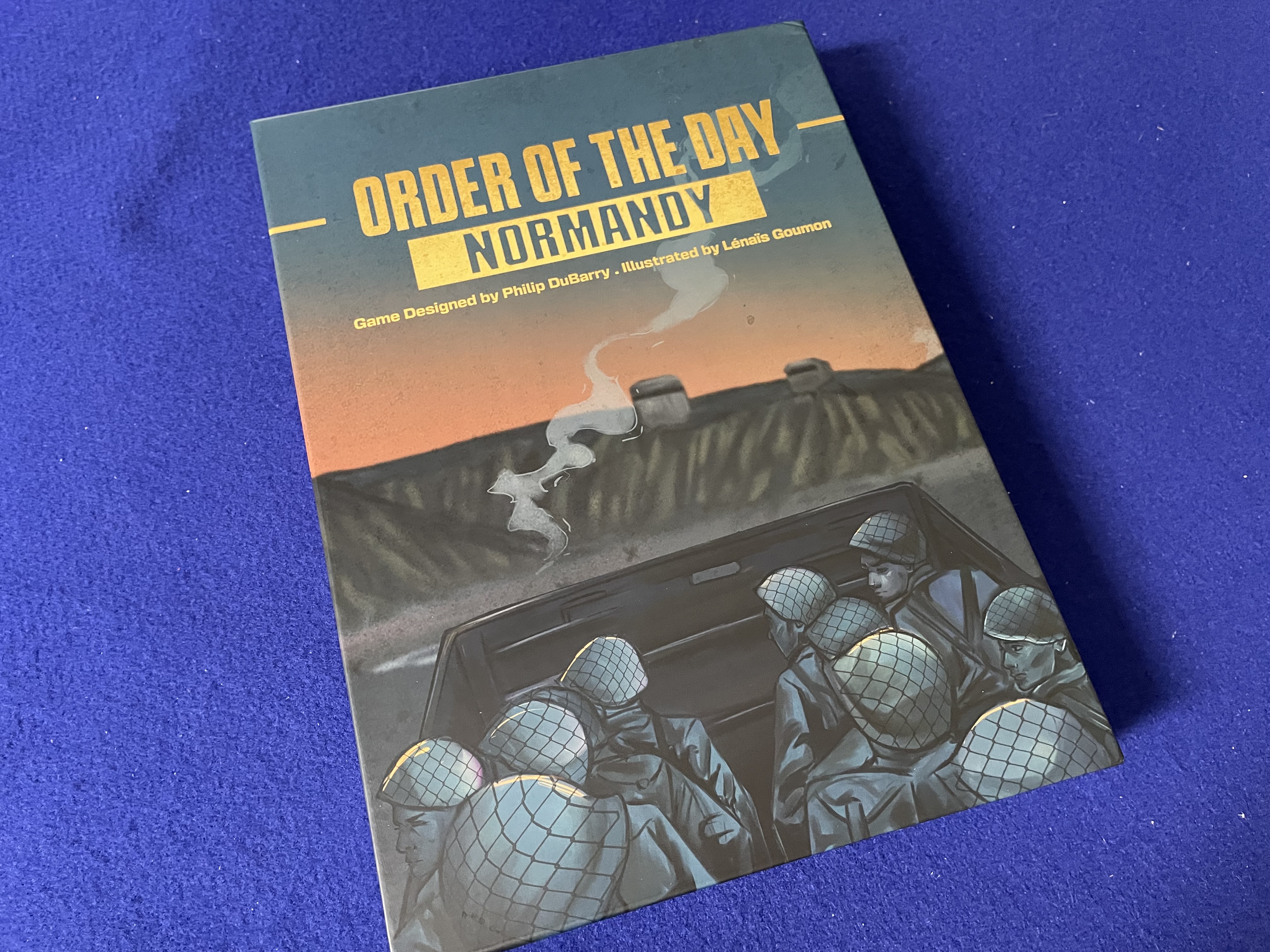
Many students of the past engage with history through reading books. To study the Normandy Invasion of June 1944 one might read a history book documenting the battle. Others may seek to explore the unknowns of the battle and read an alternate history book like Peter Tsouras’ Disaster at D-Day quoted above. Others yet, like myself, often turn to wargames to study history. The most recent D-Day wargame to enter my collection is Order of the Day: Normandy designed by Philip duBarry, illustrated by Lénaïs Goumon, and published by The Dietz Foundation in 2025.
The back of the box for Order of the Day: Normandy describes the game thusly:
Order of the Day: Normandy is a two-player game (with solitaire rules included) about the Overlord campaign to liberate France and Western Europe from Nazi Germany. Playable in 45-120 minutes, the game is approachable for both gamers and non-gamers, ideal for history buffs. One player takes the role of Dwight Eisenhower commanding the Allies. Can YOU choose the weak point in the German defenses, land reinforcements, and pin German units permitting Allied armor to drive eastward to victory?
The other player is Rommel. Will YOU deploy your vaunted armor divisions on the coast or hold them as a reserve, hoping to hold on long enough to force the Allies to negotiate for peace?
The choice is yours to make in Order of the Day: Normandy. Will you succeed or fail on June 6, 1944, ‘the Longest Day’?
Back of the box
In the case of Order of the Day: Normandy the box-of-the-back description is very much on target. The game is very approachable; this is certainly a game that one could introduce to non-wargamers and easily teach as it relies on several well-known (accepted?) boardgame mechanisms vice a classic hex and counter wargame. Order of the Day: Normandy has many historical elements that history buffs likely can connect to but the game is not a simulation by any stretch of the imagination. I do have a few small issues with the rules as presented though none are serious enough to warrant not recommending the game. Most importantly, each player is handed challenges very much in keeping with the historical situation. As the Allied player where do you invade? For the German player where do you prepare defenses…at the coastline or with reserves further back? Once ashore how fast do the Allies push inland and what can the Germans do to stop them? You decide the orders in Order of the Day: Normandy.
Boardgame of war
Order of the Day: Normandy is very much a boardgame more than a wargame. This is part of the approachable design the back of the box touts. As the ad copy for the game explains:
Played in IGOUGO fashion, players move units from area to area across northern France and Belgium. Combat occurs at the end of a turn in any area where both sides have forces and is resolved with a draw of cards. The cards inflict hits on opposing units with ‘bonus hits’ caused by having specific types of units in the battle (Panzers, Rangers, Artillery, etc).
Website ad copy
Order of the Day: Normandy can be comfortably played on a 3’x5′ table. The map uses areas—not hexes—to show the locations each side seeks to control. Units represents divisions and appear on the map with a chit. Each division is composed of one or two Unit Cards that show the combat elements. For history buffs the level of abstraction in the composition of each division may be a bit disconcerting; there is no historical order of battle aside from the unit names. Instead of a formal (historical) order of battle players decide what unit cards are assigned to each division. Is the US 4th Armored Division composed of purely tanks or do you include mechanized infantry? Combat is resolved sans dice; Combat Cards show damage inflicted which is tracked by placing small red wooden cubes on Unit Cards.
Abstractions in Order of the Day: Normandy extend beyond the order of battle. Game scales, both distance and time, are unstated. The game is played over the course of a single Round Zero (Invasion round) and then no more than four Standard Rounds. To be clear, the abstractions do not distract from play though they may distract history buffs who try to match historical events to situations on the game board. The game plays at a fast enough pace that such distractions should be fleeting and not serious interruptions to play.
Minor disorders
The rulebook for Order of the Day: Normandy is digest-sized, 18-pages, and saddle-stapled. The core rules take up only ten pages with the balance used for both Operation Roundup: 1943 and Solo variants (two pages each) as well as two single-page ‘player aids’ for the Round Zero process and Standard Round sequence of play.
While the rulebook for Order of the Day: Normandy lays out the rules to the game in an easy to understand conversational fashion, it does come up a bit short in a few areas. None of the problems are showstoppers—by any measure—but each requires players to reread the rules and carefully consider the situation.
- Setup. The Setup procedure is explained on pages 2-3 of the rulebook and has a useful graphic (duplicated on the back of the box) that seemingly intends to show the laid out game. What both graphics fail to show, however, is how the game table looks with the Unit Cards assigned to divisions. It took me a hot minute to figure this out. Not a showstopper but I wish it was explicitly shown in the rules.
- Division Tiles. The rules never explain how Division Tiles work with one for the Unit Cards on the board edge for each side and another for placement on the map. It is easy enough to figure out but a complete graphical Setup example would easily solve this (very) minor issue.
- Resistance Tiles. At first I was confused by Resistance Tiles which are tiles are used by the German player to show defenses inherent in a location. My confusion arose because when I saw “Resistance” I immediately thought of the French Resistance and assumed that the hits surely applied to German units. Nope!
- Combat Example. I am convinced the one combat example in the rulebook is not completely correct. I have reread it several times and cannot make sense out of the second German Combat Card result. The problem I see is that the text does not track to the graphic above it. Once I laid out the Unit Cards and played the example through myself the text makes sense.
Forget the small issues; it’s a really good game
While the rulebook for Order of the Day: Normandy has some minor issues, once gameplay begins the design truly shines. In terms of complexity Order of the Day: Normandy is a lite game but do not be deceived; the decisions players must make are very meaningful and challenging.
Invasion
The first serious decision space in Order of the Day: Normandy is the invasion. The invasion is played out over Round Zero. The round begins with Preparation where each side draws Unit Cards and assigning them to divisions; Allies first then Germans. The Germans then place half of their static defenses after which the Allies will Stage five divisions (which can include decoys) into the three invasion zones. The Germans respond by placing the second half of their static defenses after which the Allies get a free Recon action to look at one German defense and resistance tile. The Germans then place their divisions after which the Allies stage their remaining divisions (less airborne). Taken as a whole, the Preparation phase of Round Zero is a nice, somewhat simplified representation of Operation Bodyguard, the Allied deception campaign leading up to the invasion. Simple but with meaningful decisions.
The second phase of Round Zero in Order of the Day: Normandy is the actual invasion. The Allies first place three invasion arrows and land airborne troops which take hits from Resistance Tiles if present. The invasion arrows then provide gunfire support scoring hits on defending German divisions. The Allies then land troops which take hits first from beach defense tiles and then engage in a single combat round against defending German divisions if present. The airborne landings and battles on the beaches take a bit of some time to resolve (though the rules are streamlined) and given the casualties on both sides are high that this invasion round really does feel like ‘the Longest Day.’
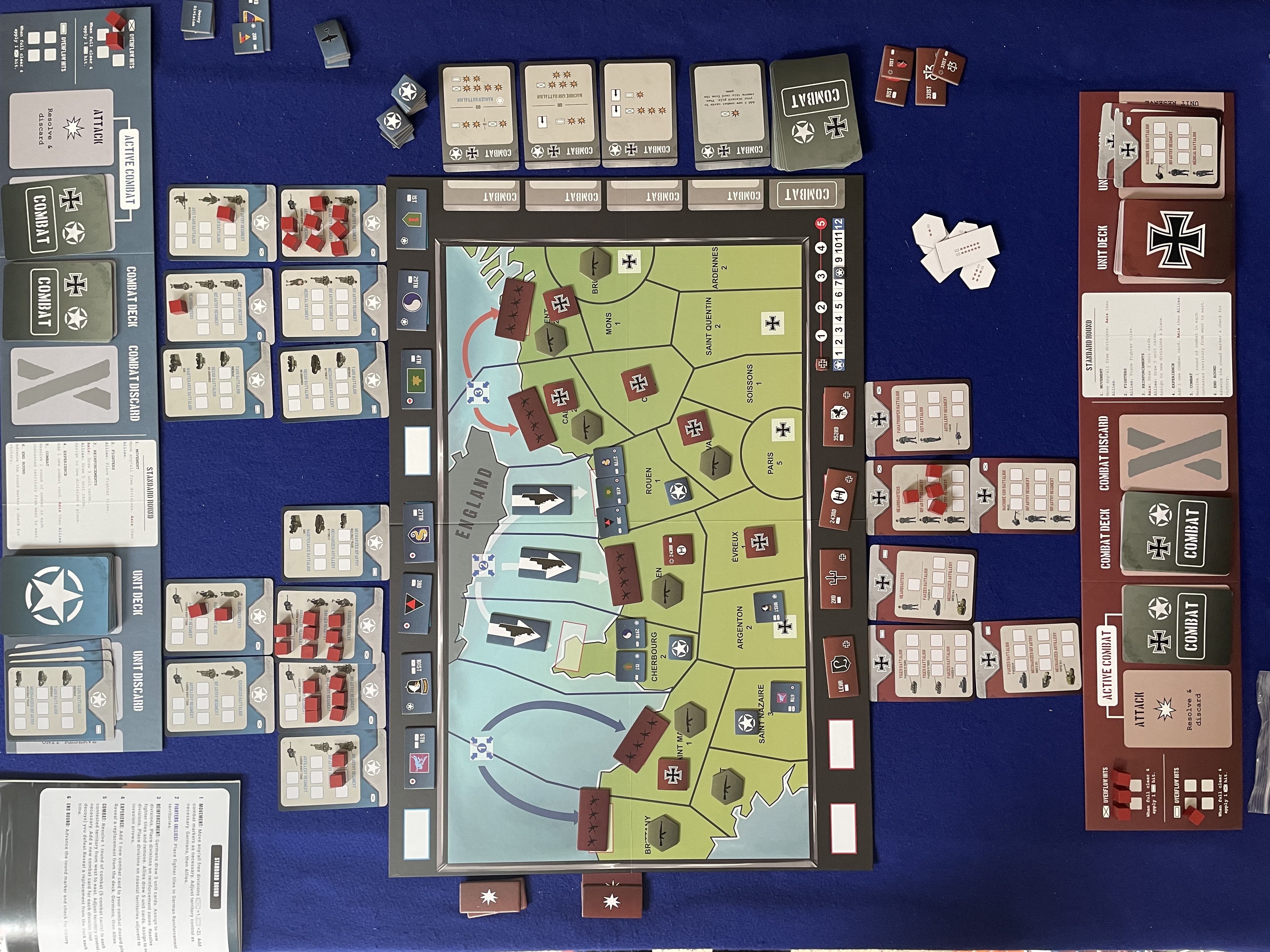
[In my learning game of Order of the Day: Normandy the Allied placed all three Decoy Divisions in Staging Area 1 (Brittany and Saint Malo) while the main invasion came ashore in Cherbourg and Rouen from Staging Area 2. No troops landed in the Caen zone as Recon revealed this to be very heavily defended. As it was, the 2nd US Armored Division was destroyed in the landing at Cherbourg while the US 1st Infantry Division took heavy casualties. The defending German 91st Infantry was destroyed so the beachhead was secured though at frightful cost. At Rouen, the Canadian 4th Armored and British 27th Armored supported by the Canadian 3rd Infantry faced heavy beach defenses and the German 331st Infantry. Pre-invasion bombardment had reduced the 331st which was eventually destroyed at the shoreline. The American 101st Airborne landed in Argenton to block reinforcements but took heavy casualties; it may need to be withdrawn immediately. The British 6th Para landed in Saint Nazarie facing only light opposition. Though the Allies have 8 of the necessary 12 points toward victory the units on the board are bloodied and likely need to be rotated out—Round 1 will almost certainly be a rebuilding round for the Allies. Ominously, the German Panzer units are unhurt and ready to surge forward against the landing beaches. The Allied player can only hope that fighter coverage will slow the Panzers down long enough for reinforcements to arrive to continue the drive inland… .]
Pressing inland to victory…or defeat
Once the invasion in Order of the Day: Normandy is played out a second race begins—territory control. The Allies win the game if, at the end of any Round, they control 12 points of territories. The Germans win if the Allies fail to meet their victory condition by the end of the fourth Round.
While the Standard Rounds in Order of the Day: Normandy are a race for territorial control there still are many meaningful decisions needed by each player. Both players must decide where they move (infantry units move a single territory but armor can move two) and the Allied player gets fighter tiles to slow down reinforcing German units. Reinforcements are perhaps the most important step in a Standard Round; building and placing new divisions to enter the fight can be a win or loss situation.
Combat in a Standard Round of Order of the Day: Normandy is, like the rest of the game, very streamlined and does not use dice. Instead, Combat Cards are drawn and the noted actions performed. While each side starts with a basic set of ten combat cards, new cards are earned each Round to show growing combat experience. One new Combat Card is gained automatically each Round and another card is earned when an enemy division is defeated. This ‘deck builder’ game mechanism is actually another set of important decisions as each Combat card is different and each player get to choose which card to gain from a face up pool of cards. Trying to match Combat Card effects with Unit Cards in your active divisions is an important choice; as is the flexibility to adjust your strategy given the inevitable losses in combat.
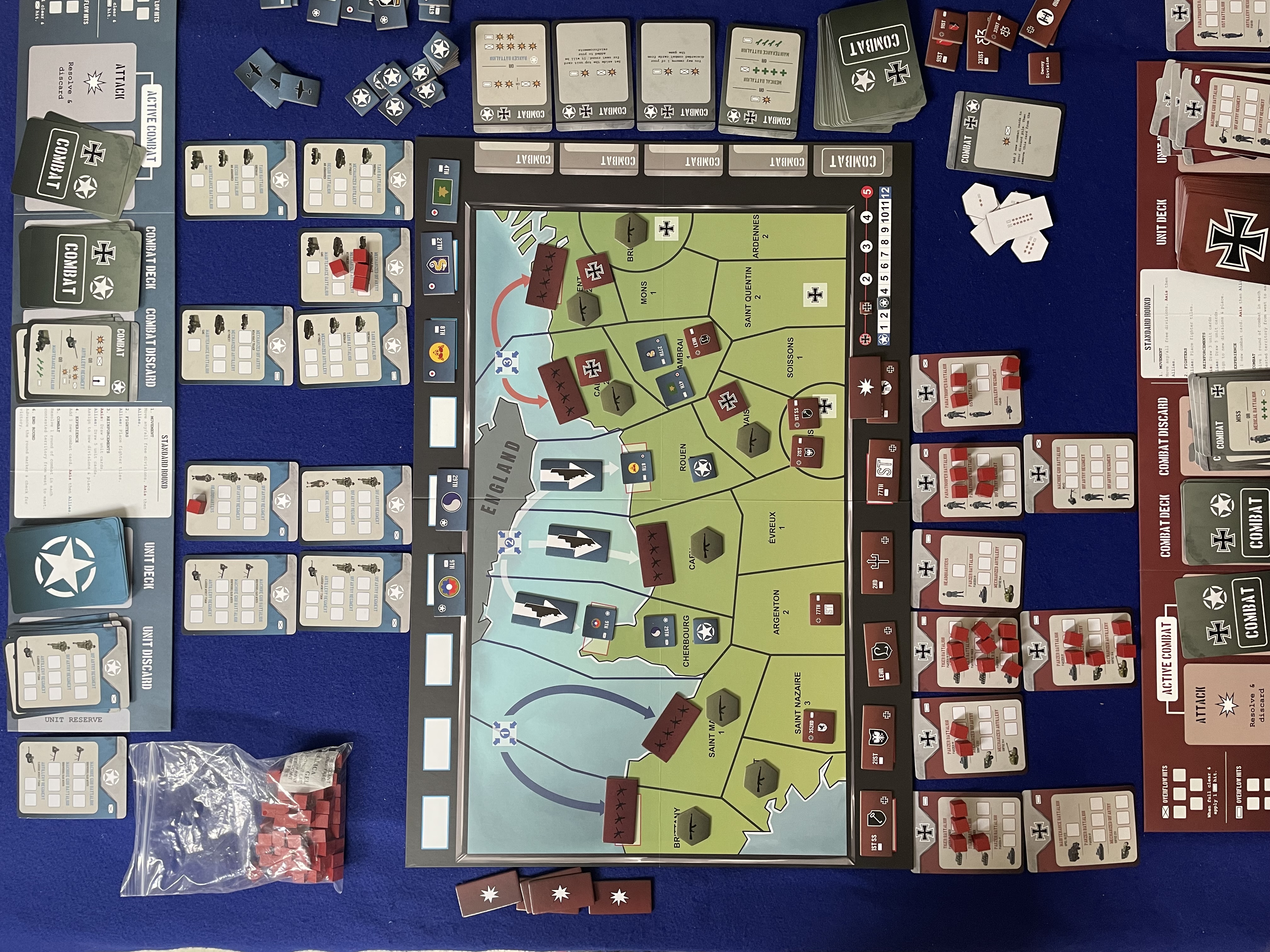
[In my learning game Round 1 the Allies start by moving the 27th and 4th Armor off the beaches of Rouen into Cambrai where they run directly into the German Panzer Lehr Division. In the Reinforcement Phase the Germans twice draw a Unit Card awarding three more draws; after withdrawing the 243rd Infantry the Germans build two new Panzer divisions and a new infantry division. The German Panzers enter at Paris and are bloodied by Allied fighters but still bring considerable combat power to the battlefield. The Americans withdraw the heavily bloodied 1st and 3rd Infantry but bring the new British 8th Armored ashore at Rouen and the new American 9th Infantry ashore at Cherbourg. In the Experience Phase the Germans go first and grab a Combat Card that, when eventually played, yield bonus combat cards. Three battles are fought. Starting in the west the at Cambrai, Panzer Lehr fights the two Allied armor divisions to a standstill though is heavily bloodied. At Argeton the bloodied 101st Airborne tries to slow down the newly arrived 7th Infantry which, interestingly, is paratroops. The 101st is destroyed but bloodies half of the 7th Infantry. Finally, at Saint Nazarie the British 6th Para fights the 352nd Infantry in a nearly even battle. The eventual loss of the 6th Para is especially damaging because the last German Combat Card played is the one gained in the Experience Phase that delivers two new Combat Cards to the German deck—in addition to another gained for defeating the 6th Para. At the end of Round 1 the Allies are significantly set back holding only 3 points of territory… .]
Solo and ’43
Order of the Day: Normandy includes two variants: a Solo Variant and a 1943 invasion variant. I have not delved deeply into the Solo Variant as of yet but, like the rest of the game, it appears even more streamlined and uses a special deck of Solo Unit and Combat Cards for the Germans. The ‘1943: Operation Roundup Variant’ appears equally simple to set up though, given fewer units and defenses on each side, it also appears on the surface to be more challenging (fewer units likely makes each mistake more costly).
True order of the day
Order of the Day: Normandy certainly meets it claim to be a very approachable game. The game has enough historical flavor to draw history buffs in though major historical elements, such as the order of battle, are abstracted. The rules for the invasion and subsequent drive inland deliver sufficient, meaningful decisions to keep players engaged. Most importantly, the ‘order of the day’ truly are those streamlined, easy to learn and play game mechanisms building important decisions.
Feature image courtesy RMN
The opinions and views expressed in this blog are those of the author alone and are presented in a personal capacity. They do not necessarily represent the views of U.S. Navy or any other U.S. government Department, Agency, Office, or employer.
RockyMountainNavy.com © 2007-2025 by Ian B is licensed under CC BY-SA 4.0
 Rocky Mountain Navy Gamer