
It has been a few months since Tactical Commander by Crisanto Lorente and Jose A. Luengo from Traflager Editions fulfilled from Kickstarter. I just recently (and finally) got the game to the table for a full rules learning and play. The goal of Trafalgar Editions, according to their website, “is to make the games easier and short-lived [less play time], but above all, who are of high quality and eye candy.” Tactical Commander comes close to achieving that goal though learning the game takes patience.
EuroWargame
If one fully endorses the argument by Riccardo Masini in their chapter “Attack of the Hybrids! Wargames and Eurogames-derived mechanics” in the recent book EuroWarGames1 (reviewed by me on Armchair Dragoons) then Tactical Commander is a quintessential example of a “hybrid game.” Masini defines a “hybrid game” as, “a game that uses, to various degrees, mechanics coming from different genres, in our particular case from simulation/wargames and Eurogames.” Masini goes on stating, “We can begin with one of the most recognizable ‘telltale signs’ of a hybrid game: cards” (Heinemann, et al., p. 33).

From appearances alone Tactical Commander certainly fits Masini’s definition of a hybrid game. On one hand the map is hexes and the units are counters—all very traditional American wargame accoutrement. On the other hand, the main components of the game are Unit and Action Cards and the Table Sheets (tableaus) they are played on which Masini claims are telltale signs of Eurogame influences. Given the centrality of cards in the core game mechanism for Tactical Commander, designers Lorente and Luengo certainly meet Masini’s definition of a hybrid game.
Tactical Commander is a card based wargame, designed to simulate World War II battles at battalion level, leading the command of you companies on the battlefield.
Tactical Commander, Box Edge
While the design of Tactical Commander meets Masini’s definition of a hybrid game the execution of the design has its pros and cons. On the con side, the rules need further refinement as they are unclear—or even silent—on key game mechanisms. On the pro side, once the unclear rules are figured out the game play is quick and engaging.
Kicked into 2024
Tactical Commander lists its copyright as 2023. While the game rules may have been around back then, the full game was delivered in a 2024 Kickstarter campaign. The game is dual-language with materials in both Spanish and English.
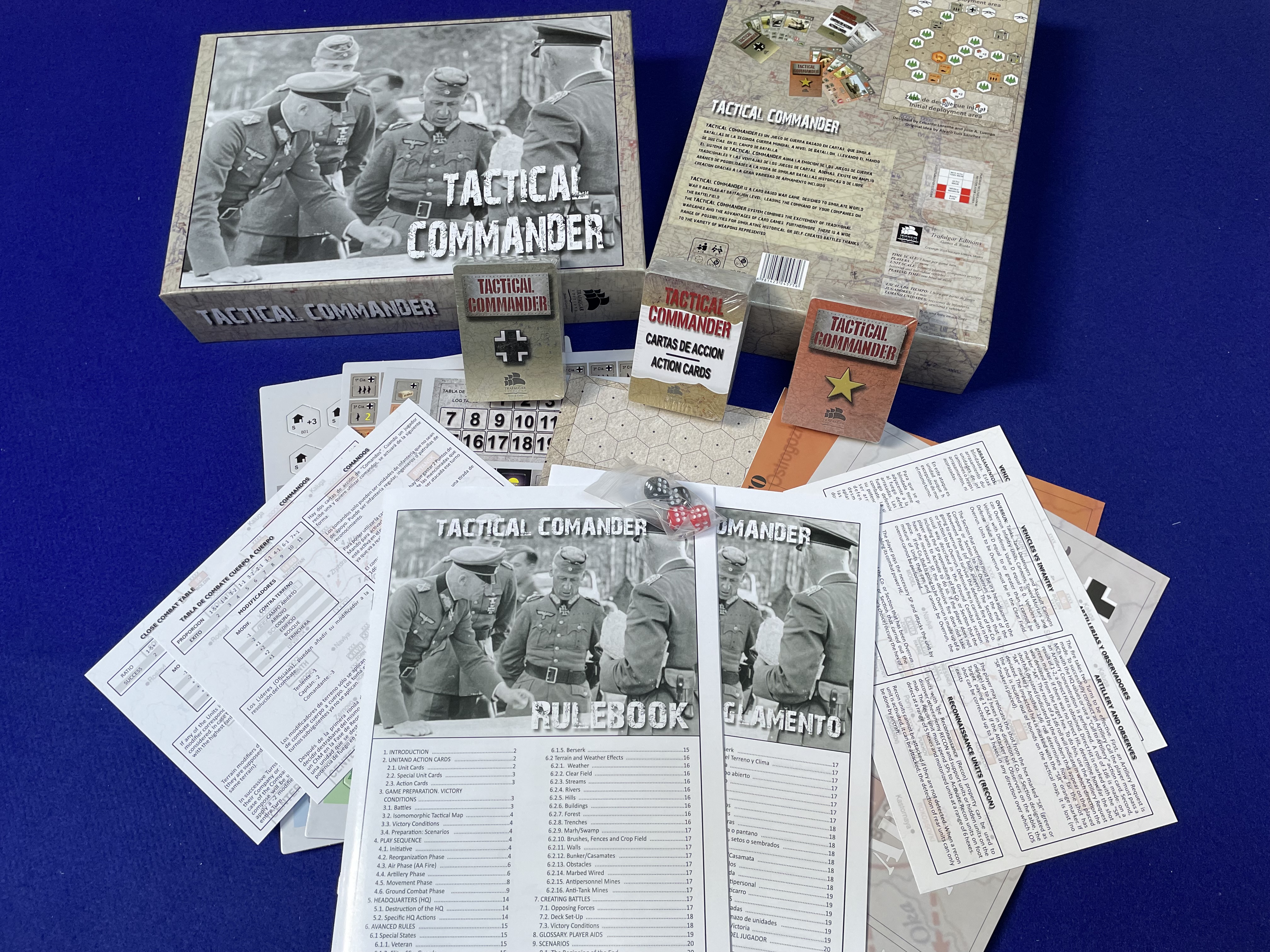
Component-wise, Tactical Commander ships in a linen-finish box measuring roughly 12″ x 8.5″ (a bit narrower and taller than a standard bookcase box). Enclosed within one finds:
- A Tactical Map that is hex gridded and mounted measuring roughly 8.5″ x 11″.
- Rule Books (separate Spanish and English) each about 24 pages.
- 2x Table Sheets or card tableaus; folding cardstock measuring a bit over 23″ x 8″ when opened.
- 2x Scenario Sheets (Spanish and English)
- 3x Countersheets.
- 4x Play Aids (2x Spanish language, 2x in English)
- 60x German Unit Cards.
- 60x Soviet Unit Cards.
- 80x Action Cards.
- A twenty-compartment counter tray is also in the box.
My Kickstarter edition of Tactical Commander also included another scenario and Unit Cards for a battle where Spanish troops face off against the Russians in 1942.
Overall the component quality of Tactical Commander is very high. The only small exception is perhaps the Table Sheets (tableaus) which are printed on cardstock. Given the more Eurogame touch to the other components (Can you say pre-rounded corners on counters?) I more than half-expected the boards to be mounted too. The fact they are not does not, however, detract from enjoying the game.
Carded for battle
When preparing to play Tactical Commander the players sit opposite one another and take their respective tableau in front of them. The small tactical map sits between them and is populated with markers depicting terrain as indicated in the scenario set up instructions. At start Units set up in a Deployment Zone on the map. Unit cards for the scenario are placed on the tableaus. Interestingly, the use of scenarios is not the default battle set up in Tactical Commander. The rule “Start units” under 3.1 Battles lay out the procedure for making your own force to battle with. The custom scenario rules are expanded upon in rule 7 Creating Battles. Once the forces are decided players draw two (2) Unit and two (2) Action Cards to form their starting hand.
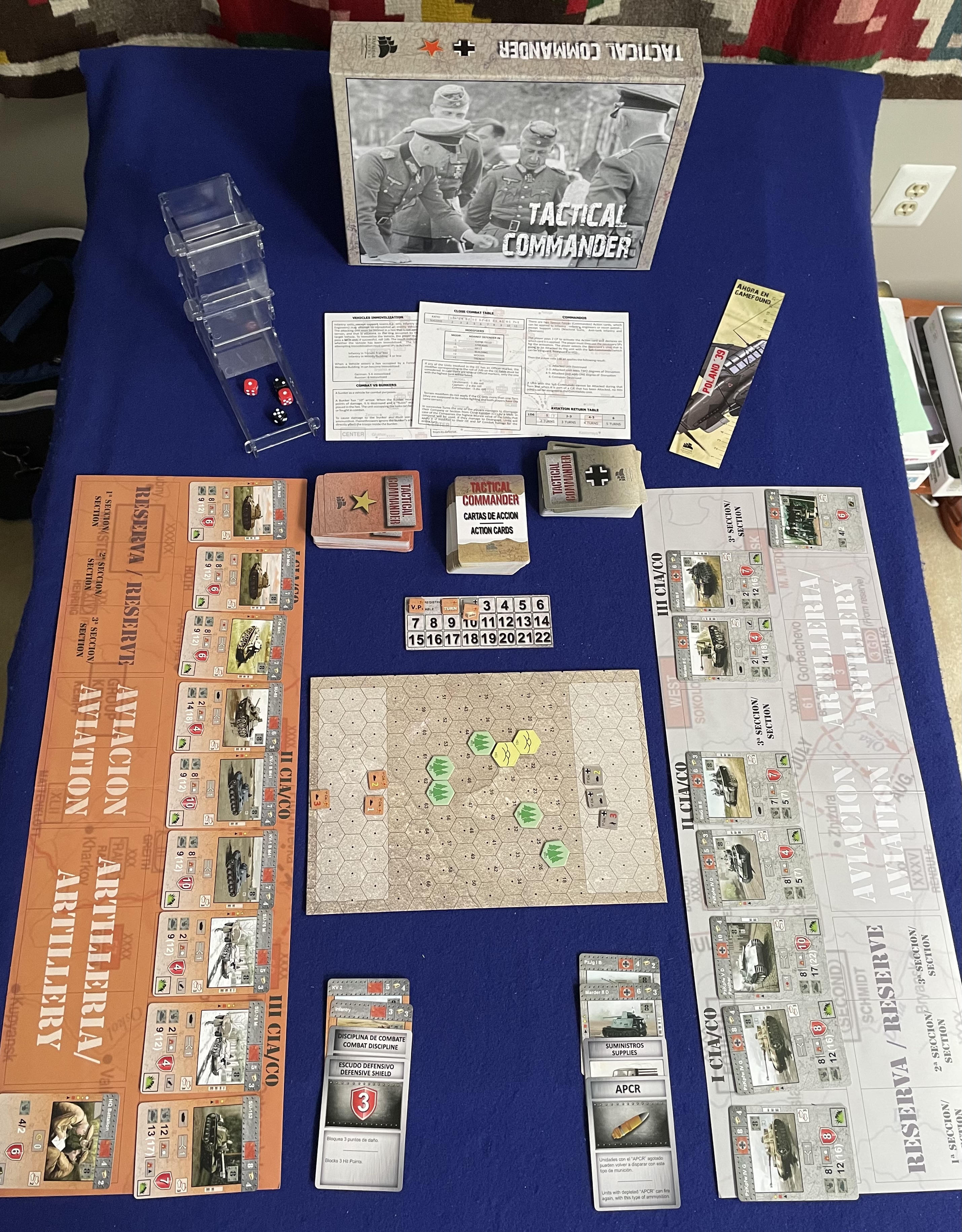
Each turn of Tactical Commander proceeds through six Phases:
- Initiative.
- Reorganization Phase. The Reorganization Phase which starts off with drawing up your hand of cards and is followed by many administrative tasks. The last part of the Reorganization Phase is the Play Cards Phase [A phase within a phase…just asking for confusion.] The Play Cards Phase is when new units are deployed to the map.
- Air Phase. Air combat and Air Attack.
- Artillery Phase. A two-turn process with the first turn the call for fire and the second for effect.
- Movement Phase. There are two types of movment in Tactical Commander, operational and tactical. Units entering the map usually need a turn or two of operational movement before they actually reach the battlefield. Tactical movement is movement on the map board.
- Ground Combat Phase. To quote rule 4.6.1 Attack, “NO dice rolls are performed.” Instead combat values are compared and, if desired, effects from Action Cards are played. While units may end up destroyed, more often they are damaged in some way in the form of disruption or reduced combat factors or movement. Close Combat, that is, combat between adjacent Infantry Units or between an Infantry Unit and an adjacent Vehicle or Bunker, does call for a die roll (2d6).
Cards for grognards
Tactical Commander is, by nature of its core game mechanism, a somewhat abstract version of conflict. The primary abstraction is the Unit Card. While these cards explain the capabilities of various Units they do so in a very abstract manner. Here players will not necessarily find combat factors (though some are present) but instead encounter iconography that reveals various properties of the Unit. Gearheads are likely to spin at the simplifications but they are properly in keeping with the core game design intent.
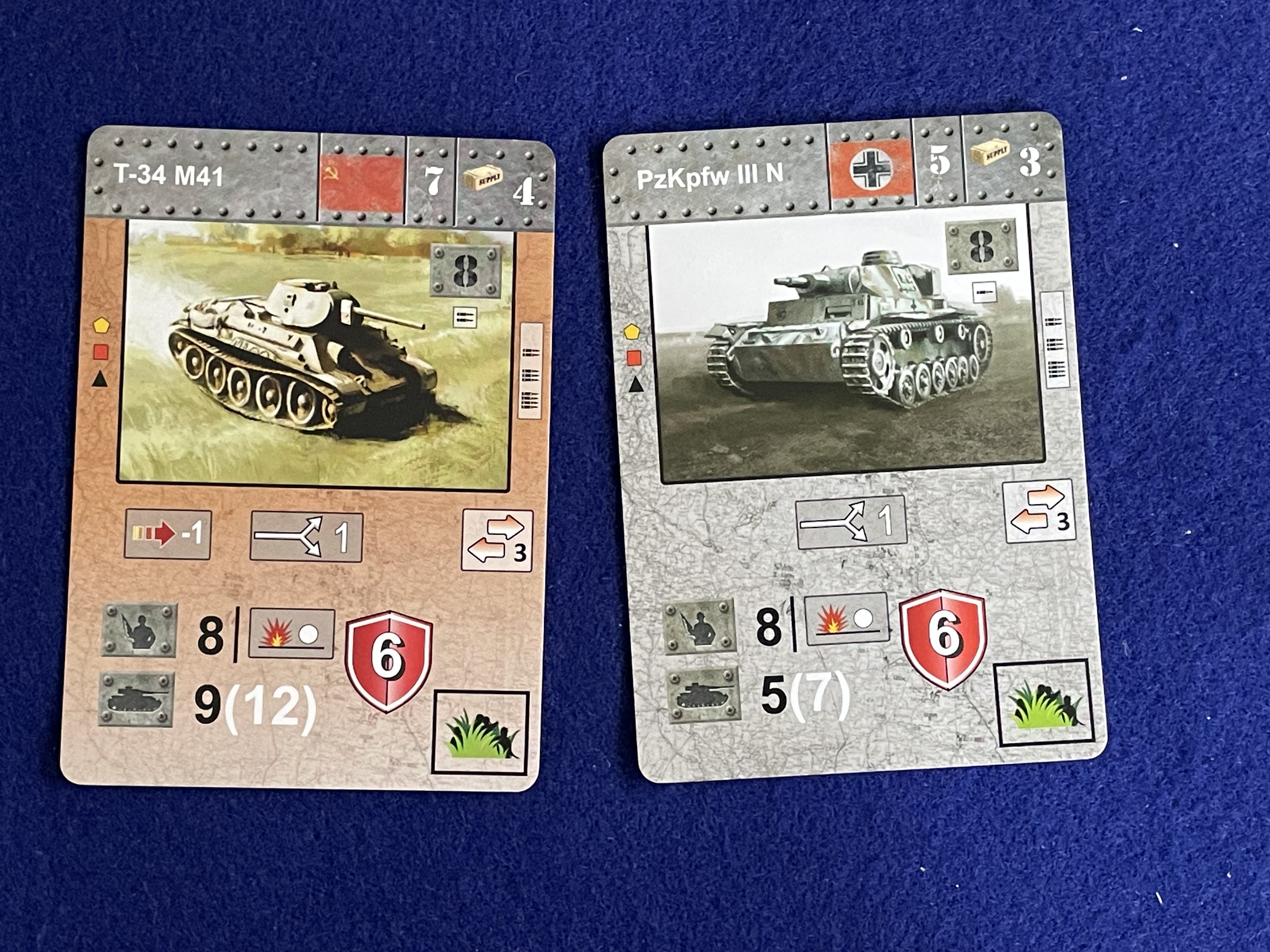
A second major abstraction in Tactical Commander is combat resolution. As already noted, “No dice rolls are performed.” To help explain let’s look at a Soviet T-34 M41 attacking a German PzKpfw III N at a range of two (2) hexes:
- To attack the Soviet player must first pay 4 Supply Points.
- The T-34 requires a clear Line of Sight.
- The T-34 chooses to use normal ammo (no Action Card is available for special ammo) with an initial attack rating of 9 reduced by 2 for each hex of range (see 4.6.5. Combat Values Reduction) giving a final attack rating of 5.
- For Vehicles, before assessing damage it must be determined if the shot penetrates the armor.
- The T-34 has a Shield Penetration value of 2; the Panzer III has a Defensive shield rating of 4/3/2. As the Penetration rating is included in the Defensive rating the shot penetrates for damage.
- If the Panzer III was shooting at the T-34 the Shield Penetration value of 1 would bounce off the T-34 that has a Defensive rating of 4/3/2.
- The Panzer III is marked with 5 hits; as it takes 6 to destroy it the Panzer III remains in action…for now.
- Technically the Panzer III has the option to Respond but, knowing the shot cannot penetrate, declines.
Non-armored vehicle combat in Tactical Commander is basically the same with the added element of Disruption that prevents Units from attacking in any form. Too much Disruption can result in Demoralization which further restricts actions until the Unit can Rally.
The amount of special rules in Tactical Commander is actually quite limited. There are rules for Reconnaissance units and Engineers but each is only one or two paragraphs in length. Rules for Leaders are also provided. Headquarters get their own section of rules. Rule section 6 is for Advanced Rules of which there are only five.
Fog of war
I recognize that my perceptions of Tactical Commander are based on the English-language edition of the rules which is not the primary language of the designers nor publisher. For myself that means I must make sure to carefully read the rules while recognizing that I may have to interpolate parts. From a few comments I read (translated versions) in Spanish language forums it appears concerns over the rules are more than just a translation issue.
Here are a few of the rules in Tactical Commander that I had the most difficulty figuring out or that just rally bothered me:
Initiative. Rule 4.1 Initiative start off with, “Both players roll 1d6 to determine who wins the Initiative and so is the first to play (if there is a tie the dice are rolled again).” The rule that is never stated is the one that says players alternate turns (i.e. one pass through the Play Sequence) or by Phase (alternate actions in each Phase). I tried playing it both ways and finally settled on alternating turns…but I do not know for sure.
Iconography. There is no consolidated guide to the iconography on the cards in Tactical Commander. While the graphics for 2.1 Unit Cards list the elements of a card, there is no good list of what the icons in different elements mean. For example, the lower right corner of a Unit Cards is for Properties (see 2.1). Figuring out what the “green bush” property on some cards means is found under 5.1.3. Concealment and Ambush. But what of Unit Cards with a Property showing an Infantry symbol followed by a +X value and a tree icon? That is a Shooting Bonus in Forest which I could not figure out until I recognized it in the graphic for 4.4 Artillery Phase.
Supply Points vs. Command Points. I am still shaky on the difference between Supply Points (SP) and Command Points (CP) in Tactical Commander. Rule 2.1 Unit Cards defines Supply Cost as , “Indicates the Supply Points (SP), or Command Points (CM) needed to Activate the card.” That makes SP and CM [or is it CP?] sound like the same thing. Later, in rule 4.2.2. Administrative Phase, players add 2x SP and 1x CP [CM?] for that turn. In rule 4.4 Artillery Phase players must pay a supply value to fire which draws from SP (an assumption since it is not explicitly stated). The use of SP or CM/CP get more confusing when it comes to combat where, per 4.6.1. Attack, players must pay SP to Activate Vanguard Units which begs the question if CP or CP Action Cards can be used because in some ways that makes sense thematically (HQ issues orders). There are a few more examples but even given only the ones listed here it is clear to me that the rules for SP and CM need to be clarified.
Action Cards. Given cards are such an important element on a hybrid game like Tactical Commander I expected to see robust rules for using Action Cards. Alas, the most “robust” rule appears to be 2.3 Action Cards which states:
These cards are not Units but actions carried out against the enemy, for our defense or generate a random event. They can be used at any time during the game, either on the player’s or the opponents turn; … .”
2.3 Action Cards
Two exceptions follow. Finding another mention of using Action Cards in the rule book is difficult. Rule 4.2.1. Replacement and Discards only talks about drawing Action Cards into your hand. There is no mention of Action Cards in rule 4.2.3. Play Cards Phase though some Action Cards award Command Points that players should (?) be able to use to play Unit Cards to the battle map…I guess. Two more exceptions to Action Card use are mentioned in 4.6.8 Close Combat. A very brief mention of restrictions on using Action Cards appears in rule 5.1.3. Concealment and Ambush which explains what Action Cards cannot be used in certain conditions. That is literally the extent of the rules for using Action Cards in the game.
“You’ve got to know when to hold ’em. Know when to fold ’em.”
“So Rocky,” you ask, “with all your griping about Tactical Commander why would one ever consider buying it?” While the rules may need help, once you divine them the game of Tactical Commander that emerges is very engaging. While a player might know what they want to do, making it happen on the game board is not simply a matter of pushing a chit around and rolling a die against a CRT [Combat Results Table] like a grognard demigod. To make things happen you need cards. It is perhaps best to think about the cards in Tactical Commander as your operations, supply, and planning staffs. All those elements need to work together to make your plan of battle work; the cards embody that reality. I “know” I have another company of troops available but to call them forward takes cards and time—and I might not have the right cards in hand at the moment. Cards can also represent luck; that enemy tank section should have me dead-to-rights but I just happen to have a “Malfunction Gun” Action Card in hand that has a 1-in-6 chance of permanently disabling the gun and a 2-in-3 chance of keeping it unserviceable for another turn. It does give the opponent a 1-in-6 chance of fixing it, but I have good cards to help protect me…I hope.

When I first laid Tactical Commander out on my gaming table I scowled at the small game map that is quite literally one-quarter the size of the two player tableaus and only had a 9×9 hex playable area. My instinctive reaction was to condemn the game in a very offhand manner for I assumed it would be impossible to create an engaging wargame experience with such a small, relatively uninteresting, map. When I tried learning the rules for Tactical Commander I nearly gave up. Once I got to play, however, each game turned into a deeply engaging narrative. The action in Tactical Commander is not really on that small game map but in the literal hands of the players. Similar to how the Russians cannot take a dump without a plan, in Tactical Commander the players cannot plan their fight without cards. That makes Tactical Commander a very interesting, and fun, wargame…
…even if it needs a better written rule book.
Every gambler knows
Kenny Rogers, “The Gambler”
That the secret to survivin’
Is knowin’ what to throw away
And knowin’ what to keep
‘Cause every hand’s a winner
And every hand’s a loser
And the best that you can hope for is to die
in your sleep
- Heinemann, Jan with Riccardo Masini and Frédéric Serval, Eds. (2025) EuroWarGames: The history, state and future of professional and public (war)gaming in Europe. Nuts! Publishing. ↩︎
Feature image courtesy RMN
The opinions and views expressed in this blog are those of the author alone and are presented in a personal capacity. They do not necessarily represent the views of U.S. Navy or any other U.S. government Department, Agency, Office, or employer.
RockyMountainNavy.com © 2007-2025 by Ian B is licensed under CC BY-SA 4.0
 Rocky Mountain Navy Gamer