
Thanks to the generosity of Yasushi Nakaguro of Bonsai Games in Japan I acquired a copy of a small wargame that looks at the everyday maritime confrontation between Japan and the People’s Republic of China (PRC). Maritime Police vs. Coast Guard – A No Gunfire Sea Battle is published by the small and very independent Jibsail Games which is the house company of designer Kazuya Nagahama. The game is a very interesting look at today’s “grey zone”1 confrontation at sea between Japan and the PRC where both sides try to advance their claims without resorting to gunfire. Maritime Police vs. Coast Guard provides interesting—and in some ways even entertaining—insights into this everyday confrontation for hobby wargamers or wargame practitioners alike; meaning the game should also be equally welcome on gamers tables or in the offices of policy makers.

Maritime Police vs. Coast Guard is technically a wargame in that it portrays a confrontation between entities. Alas, if you are looking for a wargame that has the Japanese Coast Guard shooting it out with the Chinese Maritime Police you will likely be disappointed with this title. As the introduction in the rule book explains:2
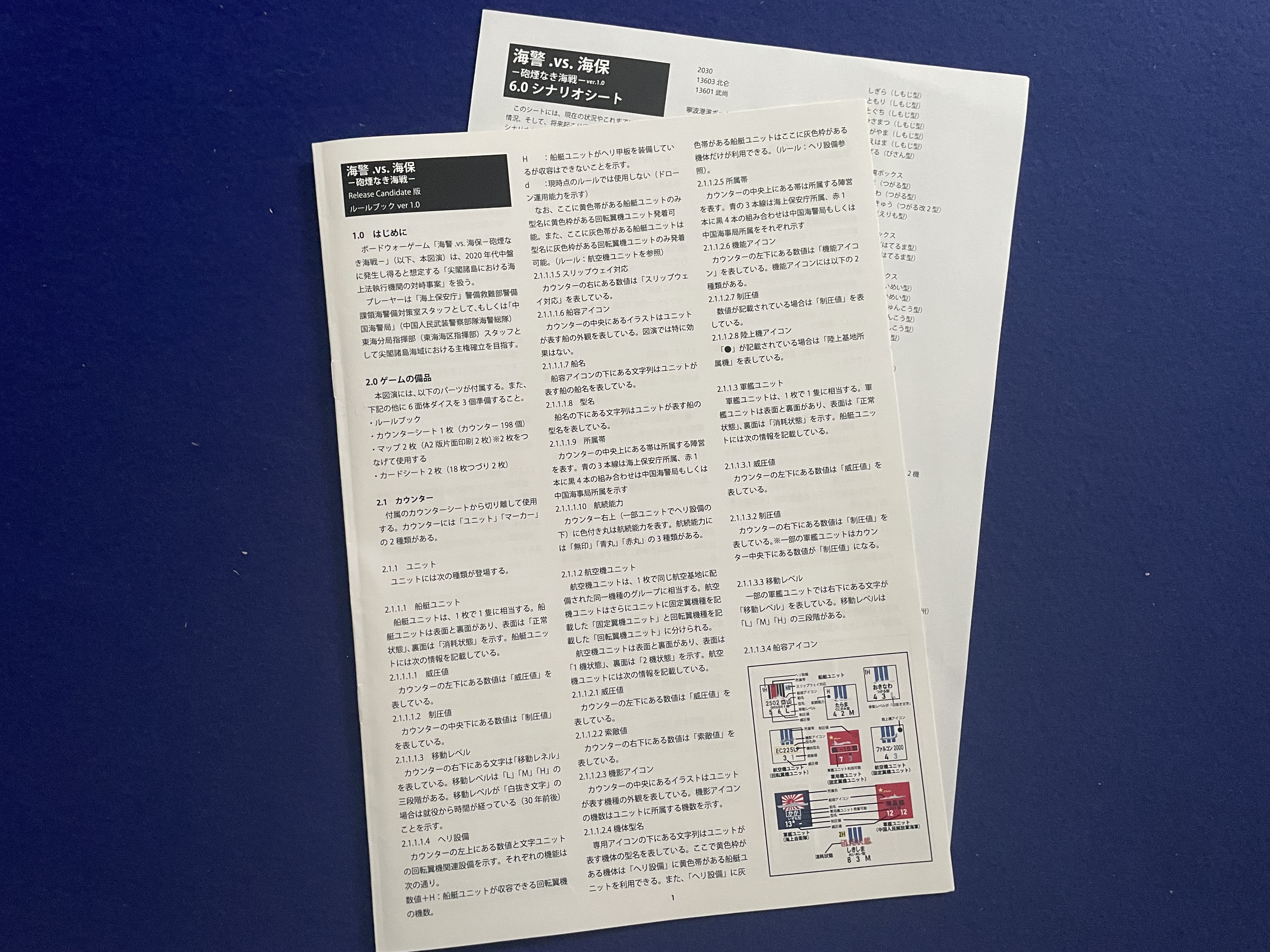
The board war game Maritime Police vs. Coast Guard – A No Gunfire Sea Battle (hereafter referred to as “the game”) deals with a hypothetical confrontation scenario between maritime law enforcement agencies near the Senkaku Islands in the mid-2020s.
Players act as staff members of either the “Japan Coast Guard” (Maritime Security and Rescue Department) or the “China Coast Guard” (Eastern Region Command) to establish sovereignty in the waters surrounding the Senkaku Islands.Maritime Police vs. Coast Guard, Rule Book, 1.0 Introduciton
Folio-seas
Component-wise, Maritime Police vs. Coast Guard is a simple game. The folio-packaging includes a nice cardstock front/back cover with the usual “box front” art and the equally usual “back cover” matter. The Japanese-language rule book is eight triple-column pages; my English translation worked out to just under 6,500 words. A separate two-page, three-column sheet includes the set-up instructions for three scenarios as well as optional rules and (very little) errata.
The map for Maritime Police vs. Coast Guard is ~16.6″ x ~24″. No hex scale is noted but the map covers from the Southwest Islands of Japan to the Chinese coastline south to Taiwan including the important Senkaku Islands area. Unlike many wargames the map for Maritime Police vs. Coast Guard is very helpfully laid out for two players sitting opposite each other; the Japanese player has the text and tracks for their side oriented towards them whereas the PRC player, sitting across from the Japanese player, likewise had their tracks and text oriented their direction (upside down to the Japanese player). Text for the disputed areas or tracks shared by both player are oriented in yet a third direction that is neutral for both players. This triple orientation arrangement helps immerse both players in their roles. The game also uses a secondary tableau with holding boxes for various ports and airfields. The center of the tableau is the Confrontation Box where the various incidents are played out rather than players being forced to deal with unwieldy stacks on game map. Similar to the main map the tableau again is laid out with a dual orientation making it easy to use for both players.

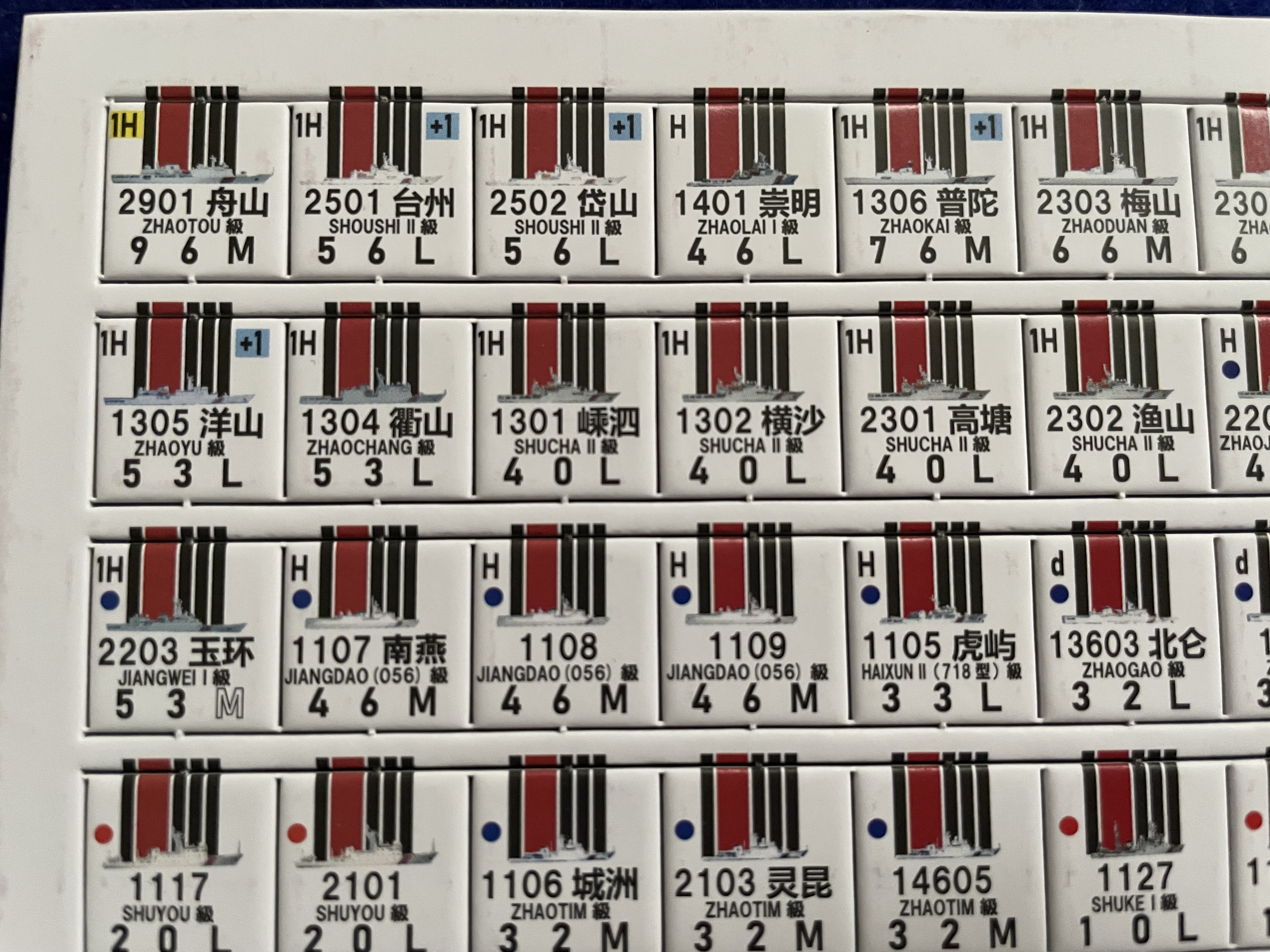
There are 198 counters in Maritime Police vs. Coast Guard. The counters are on the smaller size—each a bit over 9/16″ square. The main factors on the counters are easy to see but the identifiers of the various ships or aircraft are a bit challenging for the ship/aircraft/helo profiles are not very distinctive on the counters. The majority of the PRC counters have an identifier number making sorting and setup easy; the Japanese ships use ship or class names (in Japanese, of course) making them a bit harder for this English reader to recognize at a glance. Such is the welcome challenge from a game published in another language!


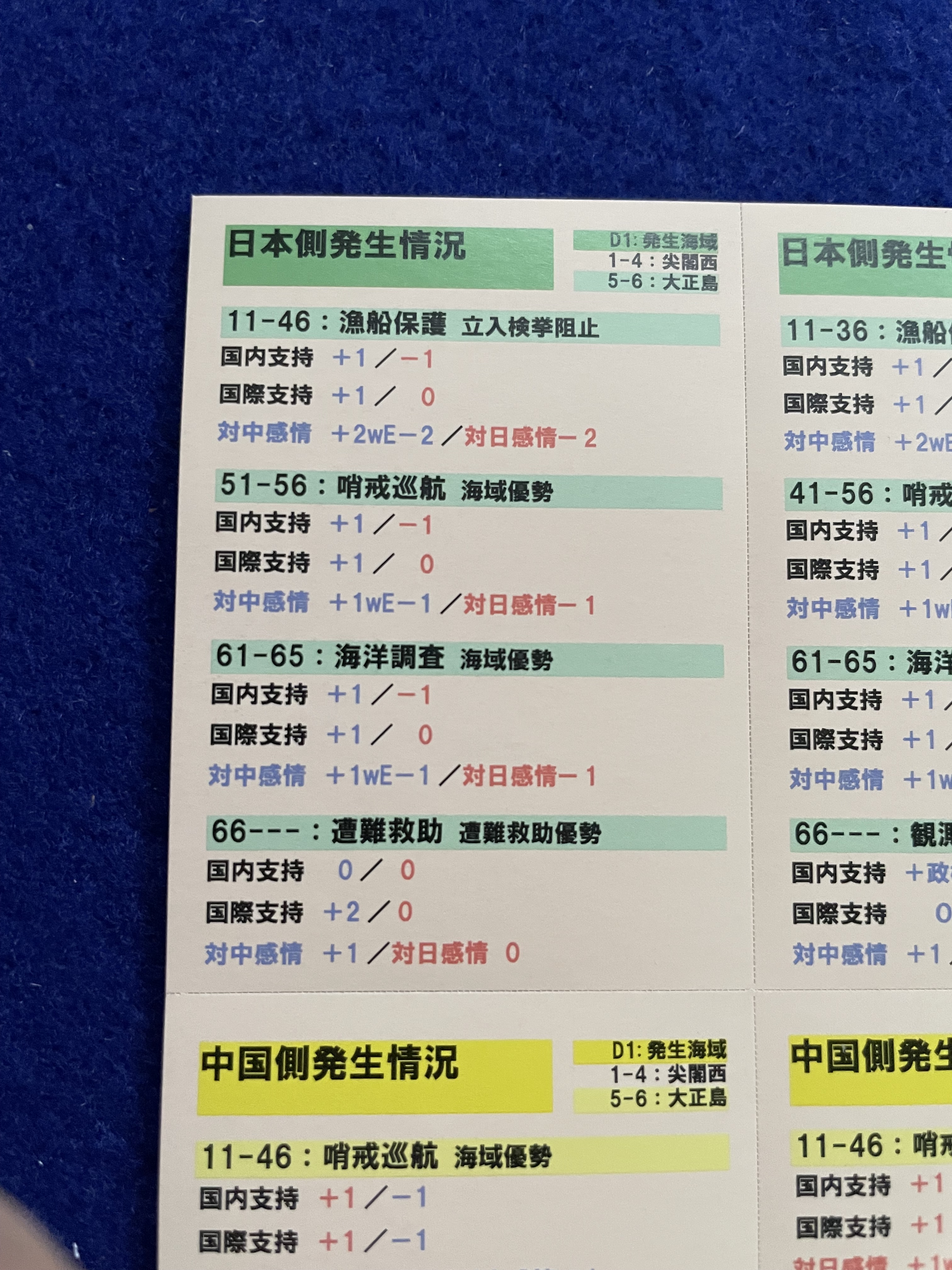
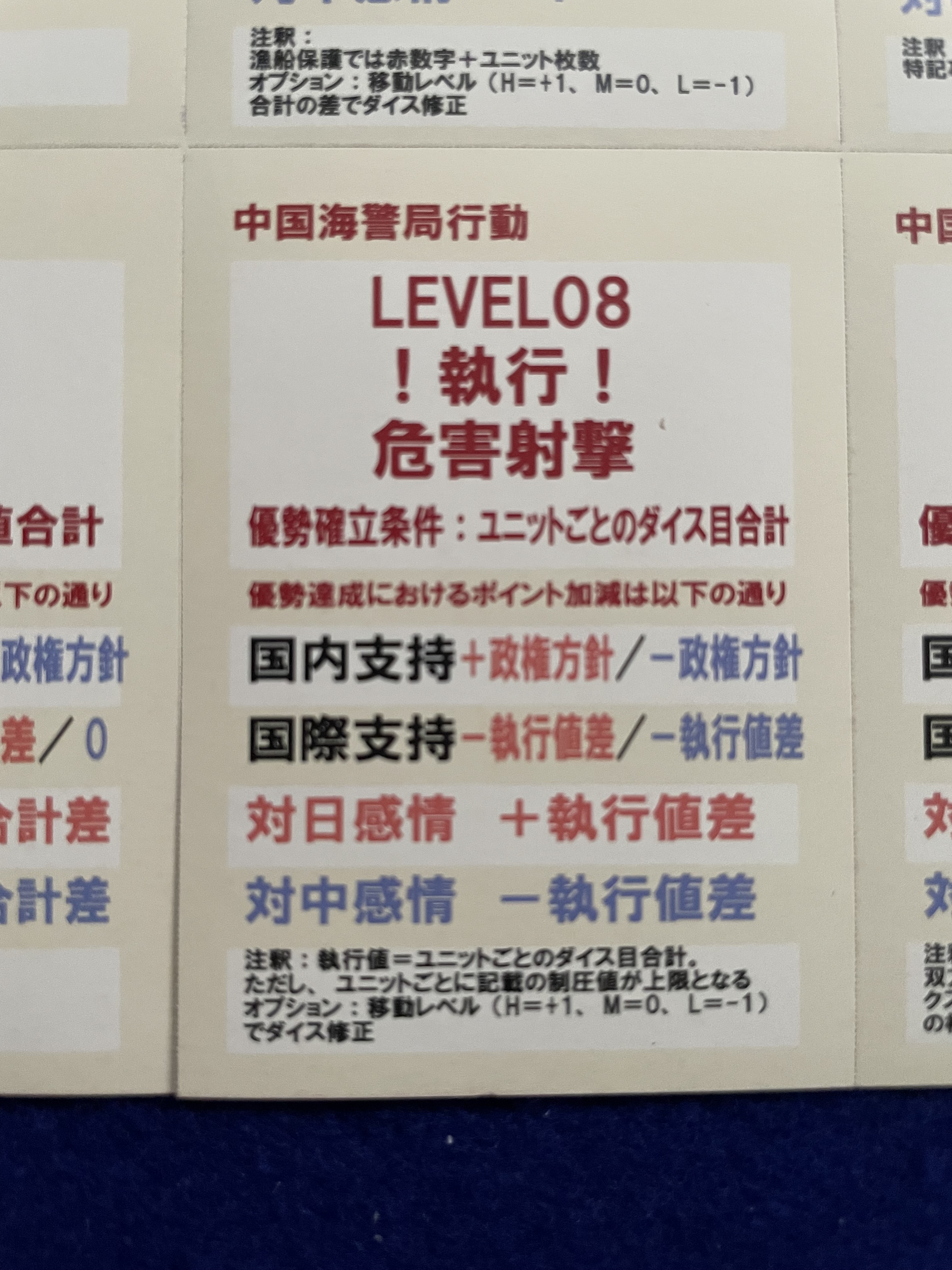
Cards also play an important role in Maritime Police vs. Coast Guard. There are 36 cards in the game each printed on thin, lightweight, slightly glossy cardstock and measuring a bit under 2″x3″; these definitely need to be sleeved for durability. The game includes ten Incident Situation Cards (5x Japanese, 5x PRC) along with 26 Escalation Cards (13x Japanese, 13x PRC).

Hazy grey
In Maritime Police vs. Coast Guard players are not charged with running a kinetic fight between the Japanese Coast Guard and the Chinese Maritime Police but instead confront each other “in the grey zone.” Every turn (which represents about a month of time) the players will have to deal with “incidents.” The different incidents are listed in rule 2.4.1.2.1 Nature of the Incident and can include:
- “Protecting Fishing Vessels: Preventing an opposing country from apprehending domestic fishing vessels operating in the contiguous zone or territorial waters of the Senkaku Islands, thereby asserting jurisdiction internationally.
- Patrol Missions: Patrolling the contiguous zone or territorial waters of the Senkaku Islands to assert jurisdiction internationally.
- Marine Surveys: Conducting marine surveys in the contiguous zone or territorial waters of the Senkaku Islands to assert jurisdiction internationally.
- Rescuing Distressed Individuals: Rescuing distressed individuals found in the contiguous zone, territorial waters, or territory of the Senkaku Islands to assert jurisdiction internationally.
- VIP Visits: Ensuring that government officials successfully visit the Senkaku Islands to enhance the domestic reputation of maritime law enforcement agencies.
- Placing Observation Buoys: Installing marine observation buoys in disputed waters near the Japan-China median line to assert jurisdiction and provoke public opinion in the opposing country.
- Removing Observation Buoys: Removing marine observation buoys placed by the opposing country in disputed waters near the Japan-China median line to assert jurisdiction and stimulate domestic public opinion.
- Constructing Oil Rigs: Constructing offshore oil rigs in disputed waters near the Japan-China median line to assert jurisdiction and provoke the opposing country’s public opinion.
- Apprehending Oil Rigs: Apprehending offshore oil rigs constructed by the opposing country without consent to assert jurisdiction and stimulate domestic public opinion.
- Preventing Illegal Landings: Apprehending activists attempting illegal landings on the Senkaku Islands to assert jurisdiction and stimulate domestic public opinion.
- Political Group Ships: Apprehending activists from political groups attempting illegal landings on the Senkaku Islands to assert jurisdiction and stimulate domestic public opinion.
- Maritime Militia: Stationing maritime militia attempting to occupy the contiguous zone, territorial waters, or territory of the Senkaku Islands to assert jurisdiction internationally.
- Establishing Outposts: Building permanent facilities in the contiguous zone, territorial waters, or territory of the Senkaku Islands to assert jurisdiction internationally.
- Landing Troops: Deploying military forces in the contiguous zone, territorial waters, or territory of the Senkaku Islands to assert jurisdiction internationally.” (Rule 2.4.1.2.1)
Each “Incident Situation Card” in Maritime Police vs. Coast Guard also has some sort of designated objective. The objective might include achieving some form of Maritime Superiority, Preventing Apprehension of a subject, or maybe making a Rescue. A nice design touch in Maritime Police vs. Coast Guard is that each Incident Situation Card (there are ten in the game) assigns one player as the “Lead” and then randomizes the location amongst three areas. Each card also has four different objectives which means there are numerous different possible incident combinations which all-but-ensures that no two games will ever play out the same. The objective tells players what factors they need to use: Coercion/Intimidation or Suppression. The stakes for any given objective are usually expressed in terms of changes to Domestic or International Support, Sentiment against the adversary, and impacts to Policy.
Resolving an incident in Maritime Police vs. Coast Guard means the players must bring their forces to bear. The two most important factors to consider for each ship or aircraft (fixed-wing or helicopter) are the Coercion/Intimidation Value and the Suppression Value. Planning to have the right forces available for an incident is not, however, just a matter of deploying the right units or ensuring enough are available, Players must also decide how much they are willing to escalate the situation. Those rules are in the Confrontation Management Step.
The Confrontation Management Step in Maritime Police vs. Coast Guard is in many respects a card duel. Both players have a hand of thirteen Escalation Cards going from Level 00 to Level 10 (some levels have more than one card to choose from). Most confrontations start at Level 01. Players then alternate playing confrontation cards higher in value than the last confrontation card played until one player declines to play a card. The confrontation is then resolved.
Resolving a confrontation in Maritime Police vs. Coast Guard is simply a matter of looking at the Escalation card and adjusting tracks as appropriate using the card’s “Action Details,” “Superiority Establishment Conditions,” or “Notes.” Dice rolls may be required, and the player who placed the last card gains a +1 modifier to their dice roll. Following confrontation resolution there is a “return to base” segment and play moves to the next round.
While Maritime Police vs. Coast Guard focuses on the maritime law enforcement elements of each power, the respective navies also make an appearance in the game. These units, with the highest factors, likely will tip the balance in favor of the using side in a confrontation. The use of naval units will almost certainly draw international and policy condemnation that often make their use questionable if not outright undesirable.
Play of Maritime Police vs. Coast Guard continues until the end directed in a scenario. The standard rules for winning a scenario has players comparing the following factors:
- Domestic Support
- International Support
- Sentiment Points (Anti-China or Anti-Japan Sentiment)
The player with the higher combined score across these categories is declared the winner. In a not-so-subtle nod to wargame practitioners the game also notes that specific scenarios may introduce unique criteria or objectives.
Play the game
Honestly, the hardest part of playing Maritime Police vs. Coast Guard was before game play. As the game materials are all in Japanese they required translation. The rule book, available in a pdf file, was not hard to run through the various AI translators and then edit. The map was not that hard to use as only a few locations need be annotated. The counters were a mixed-blessing; the identifier numbers on PRC ships make them easy to read but the name-only Japanese ships were a bit of a challenge to read. Not impossible, just challenging. The Incident and Escalation cards were harder as each needed to be done separately and “new” card produced in English. (Some examples of my translation processes are shown below.)

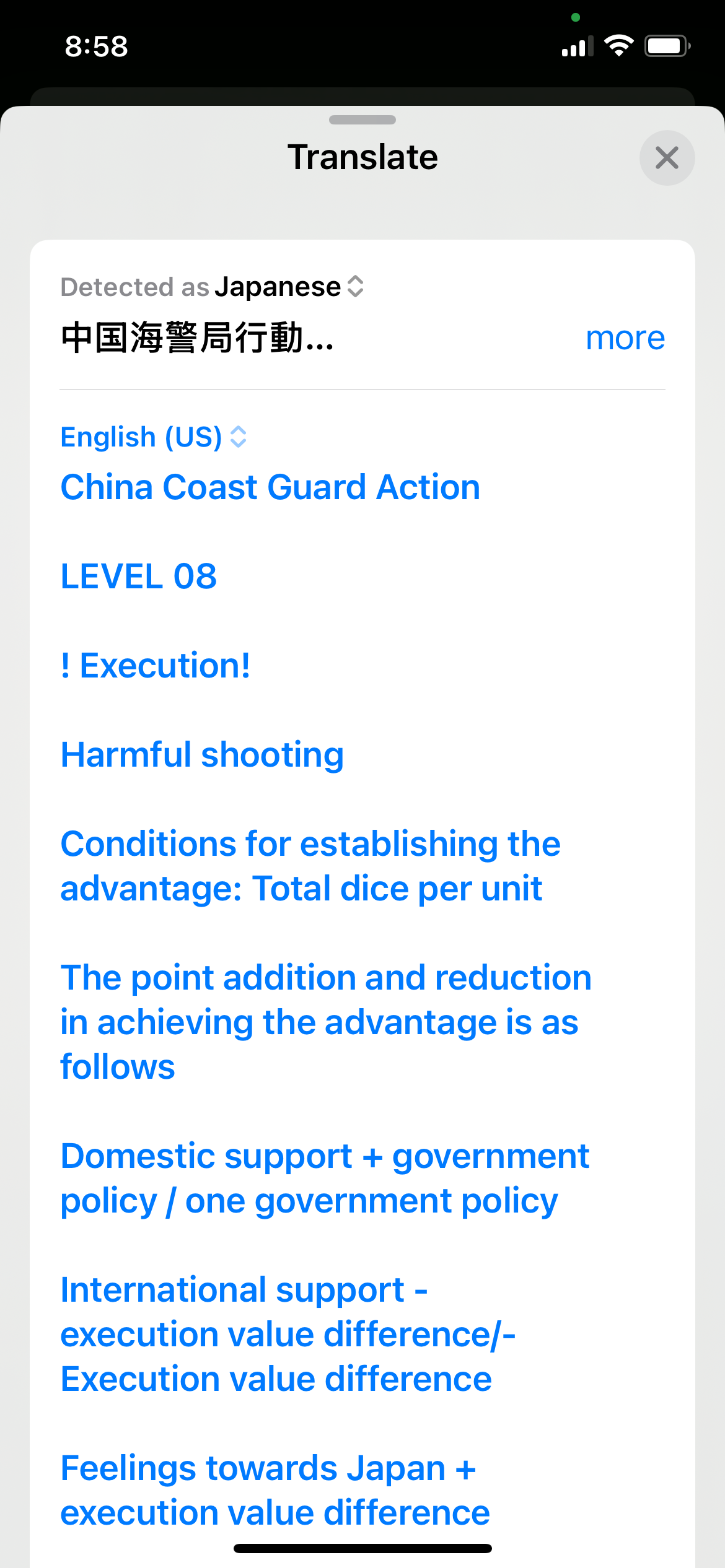
If one was to only read the rule book for Maritime Police vs. Coast Guard they likely would declare that the game is very procedural. That is a fair criticism; the sequence of play (“Simulation Procedure”) is somewhat repetitive in that each turn has two nearly identical Action Phases with drawing of cards, rolls for location and situation, movement, escalation, return to base. The movement of the various markers on tracks also looks a bit underwhelming.
While a strict reading of the rules might seem underwhelming, in play Maritime Police vs. Coast Guard creates a fantastic and extremely tense narrative. The tension in the game noticeably rises when an Incident Situation Card is drawn and the location and objective is revealed. The variability of the locations and objectives means one cannot be too wedded to a plan; flexibility and adaptability are absolutely necessary. Hard choices are also called for; not every incident is good for a player but some are “less bad” than others. Players must decide what they are willing to risk. The tension then builds again as each side moves their forces towards the incident and players are able to see for themselves what level of commitment the other appears to be considering. The tension peaks with the playing of the Escalation Cards; that is the time for good poker faces and trying to bluff the other player. Added to the tension is the fact that after every incident the entire deck of Incident Situation Cards is shuffled making any chance of predicting the future all-but-impossible. Even if a player is ahead in scoring the lead is never really comfortable as the next incident could very easily shift their fortunes. Maritime Police vs. Coast Guard may not be a gunfight on the mapboard but it certainly is a very engaging—even stressful—form of cognitive warfare in each player’s mind.
It takes two to tango
One last note. A careful study of the BoardGameGeek database reveals another Jibsail Games “coast guard” title that might be easily confused with Maritime Police vs. Coast Guard. The other title is from 2023 and listed as Work of the JCG. The cover for Work of the JCG looks somewhat similar to that used for Maritime Police vs. Coast Guard.


Work of the JCG is, however, a very different game. As the publisher’s blurb explains:
Work of the JCG is a tabletop exercise based on the operations of the Japan Coast Guard, assuming the first half of the 2020s.
The player takes on the role of an integrated response coordinator (a fictional role) who is responsible for the Security Division, Security Information Division, Rescue Division, Environmental Disaster Prevention Division, and Marine Information Division of the Japan Coast Guard’s Security and Rescue Department, and aims to operate patrol boats, aircraft, SST (special security team), special rescue team, and mobile disaster prevention team in an “appropriate organization” and “appropriate scale.”
The map for the tabletop exercise covers the “vast” Japanese territorial waters and exclusive economic zone under the jurisdiction of the Japan Coast Guard.
Every large patrol vessel owned by the JCG is included as a single unit, and all major types of medium-sized and smaller patrol vessels also appear.
In this tabletop exercise, you will experience the difficulties of engaging in a wide variety of “works,” including territorial waters security, such as the Senkaku Islands, which have become a hot topic in recent years, as well as rescue missions and suspicious ships, which were a focus of attention by Umizaru, marine surveys of the continental shelf, and environmental protection, such as marine pollution.
Work of the JCG, Publisher’s Blurb, BGG
Although I do not own Work of the JCG I strongly recommend Maritime Police vs. Coast Guard over the former title. There is just no way a solo game can produce the nail-biting tension like that found in Maritime Police vs. Coast Guard. It is not a perfect game, and playing it in English requires a good effort to prepare to play, but it does a great job at making players consider risk and reward in a way few wargames are able to do.
- “Gray” or “Grey Zone” activities are usually activities by a state that are harmful to another state and are sometimes considered to be acts of war, but are not legally acts of war. ↩︎
- nvb – Quotes are the product of translation from Japanese-language materials into English using ChatGPT and/or GrokAI and then human reviewed. Quotes cited here are not authoritative. ↩︎
Feature image courtesy RMN
The opinions and views expressed in this blog are those of the author alone and are presented in a personal capacity. They do not necessarily represent the views of U.S. Navy or any other U.S. government Department, Agency, Office, or employer.
RockyMountainNavy.com © 2007-2025 by Ian B is licensed under CC BY-SA 4.0
 Rocky Mountain Navy Gamer
SDHistcon, this Saturday February 8, had a session reviewing the current state of Japanese wargaming. Very interesting and the talk of short print runs left me wishing the Japanese publishers (and some wstern ones) would sell them as pdf’s, making them accessible worldwide. Translating looks like a chore but manageable with tech these days.
Harold Buchanan interviewed Peter Pelligrini on his Arctic game which involved multiple political and economic inputs and I some of the playtesting showed some interesting contacts. The grey area elements from this Japanese game would fit very well into an Arctic scenario (and others I am sure). Nice to see non military scenarios being developed.
I have the Japanese rulebook pdf from the publishers website (thanks for your links). I’ll have a go at translating myself to see the mechanics and ideas.
Thanks for posting this.
SDHistcon, this Saturday February 8, had a session reviewing the current state of Japanese wargaming. Very interesting and the talk of short print runs left me wishing the Japanese publishers (and some wstern ones) would sell them as pdf’s, making them accessible worldwide. Translating looks like a chore but manageable with tech these days.
Harold Buchanan interviewed Peter Pelligrini on his Arctic game which involved multiple political and economic inputs and I some of the playtesting showed some interesting contacts. The grey area elements from this Japanese game would fit very well into an Arctic scenario (and others I am sure). Nice to see non military scenarios being developed.
I have the Japanese rulebook pdf from the publishers website (thanks for your links). I’ll have a go at translating myself to see the mechanics and ideas.
Thanks for posting this.
Thanks for stopping by!