
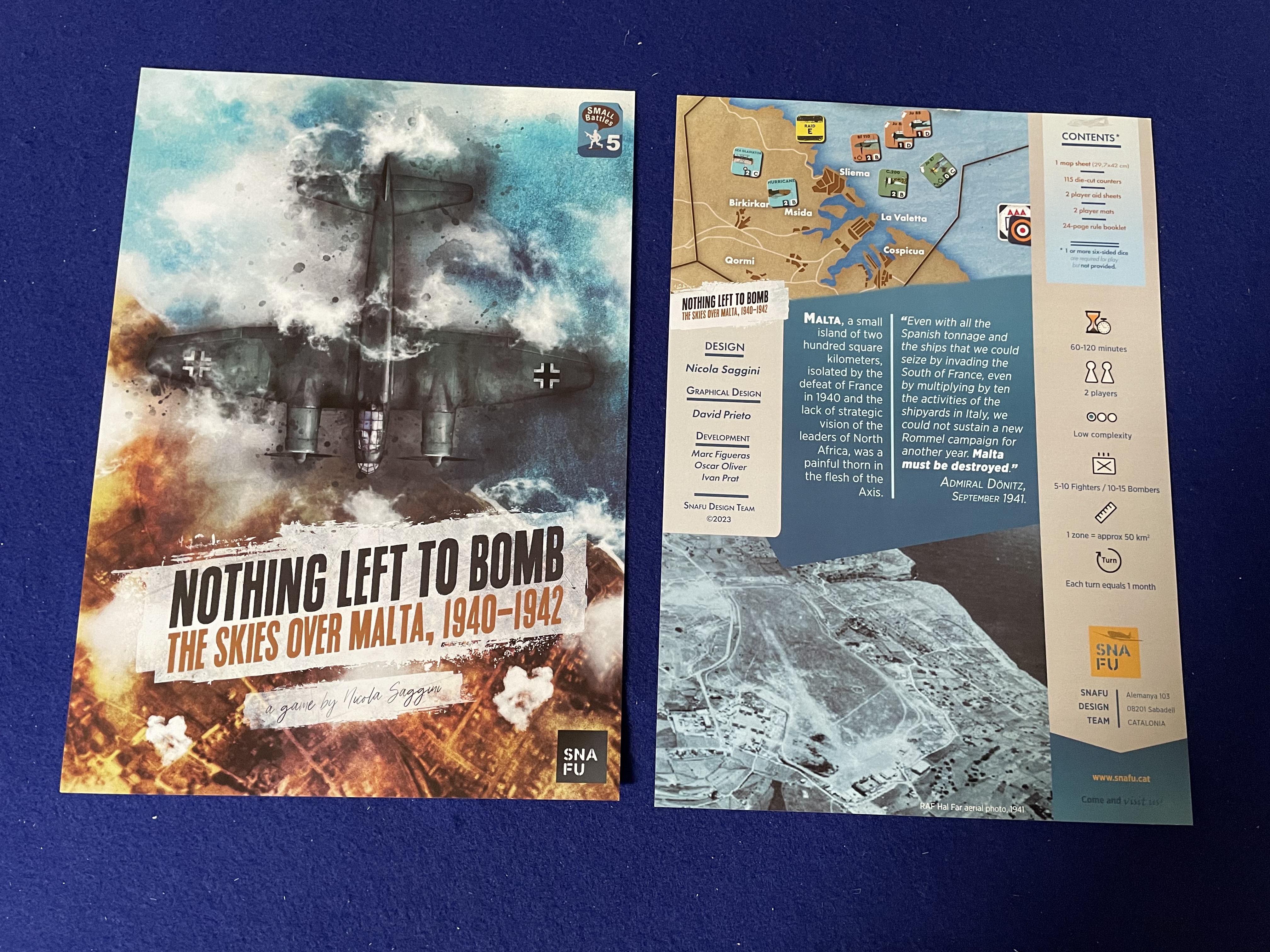
Nothing Left to Bomb: The Skies Over Malta, 1940-1942 by Nicola Saggini from SNAFU Design Team (2023) is marketed as “SNAFU Small Battles #5.” In many ways that is a very correct characterization of the game; the components are packed folio-style with a two-column 24-page rule book, 115 1/2″ counters, a 16.5″ x 11.75″ paper map, two glossy cardstock player aids, and two player mats that also serve as the front and back “covers” for the game. Nothing Left to Bomb is a two-player wargame of low complexity with each scenario rated for 60-120 minutes (experience says the low end is easily achievable). So yes, the game is “small;” that is, until one actually plays the game and experiences the larger strategic challenges given to each player. While physically small, Nothing Left to Bomb serves up a surprisingly large dose of meaningful decisions in an easy to learn, fun and quick to play, yet deeply engaging wargame.

Nothing Left to Bomb is a two-player game set in World War II that recreates the efforts of the Axis powers to gain air superiority or even air supremacy in the skies above the strategic island of Malta, and the British struggle to prevent it.
Nothing Left to Bomb, Rule Book, 1. Introduction
“This another dogfight, right?
One of the first things I do when reading a new rule book is flip to the designer’s notes or other similar section. I enjoy reading these sections as it often provides some insight into the designer’s intent as well as historical or situational background before I start learning the rules and actually playing the game. So when I first picked up the rule book for Nothing Left to Bomb I flipped to the back section titled, “Airplanes, a short primer.” This section, covering eight (8) pages—basically one-third of the rule book—is a very solid discussion of the different aircraft that fought over the skies of Malta as well as descriptions of the main airfields on the island. Taken together with the subtitle of the game (“The Skies Over Malta…”), the very first paragraph of the introduction (seen above), and the pictures on the back cover showing different aircraft counters, I was more-than-half expecting to find myself playing yet another dogfighting air combat wargame. Designer Nicola Saggini, however, delivers something wonderfully different in Nothing Left to Bomb.

In retrospect the difference should of been obvious to me; the back cover of Nothing Left to Bomb notes that each unit is 5-10 fighters or 10-15 bombers. That is what I term “squadron scale” meaning this is a low complexity squadron dogfighter game, right? The map is divided into zones each about 50km. Malta is a small place and that still works for squadron scale, yes? Each turn is about one…month? Hmm…that is a long time for a squadron scale game, eh? That does not make sense…
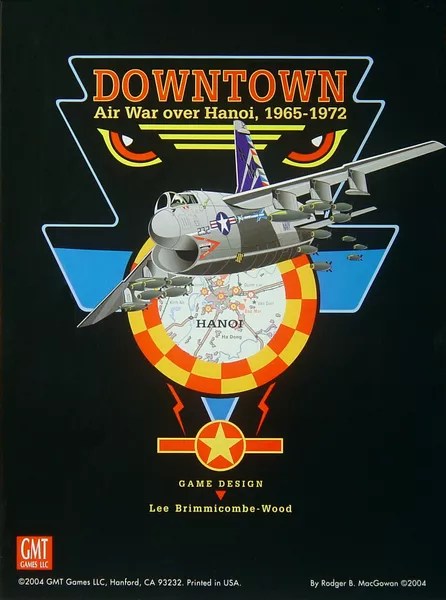
…until one realizes that Nothing Left to Bomb is a really a campaign game and the most important element of combat is not air-to-air engagements but the planning, execution, and defense of raids. In that respect Nothing Left to Bomb in some ways harkens back to designer John Butterfield’s RAF – August 1940: The Battle of Britain Solitaire (West End Games, 1986), but for two players, or maybe a simplified version of Lee Brimmicombe-Woods’ “Raid” series of air combat wargames that started with Downtown: Air Combat Over Hanoi, 1965-1972 (GMT Games, 2004).

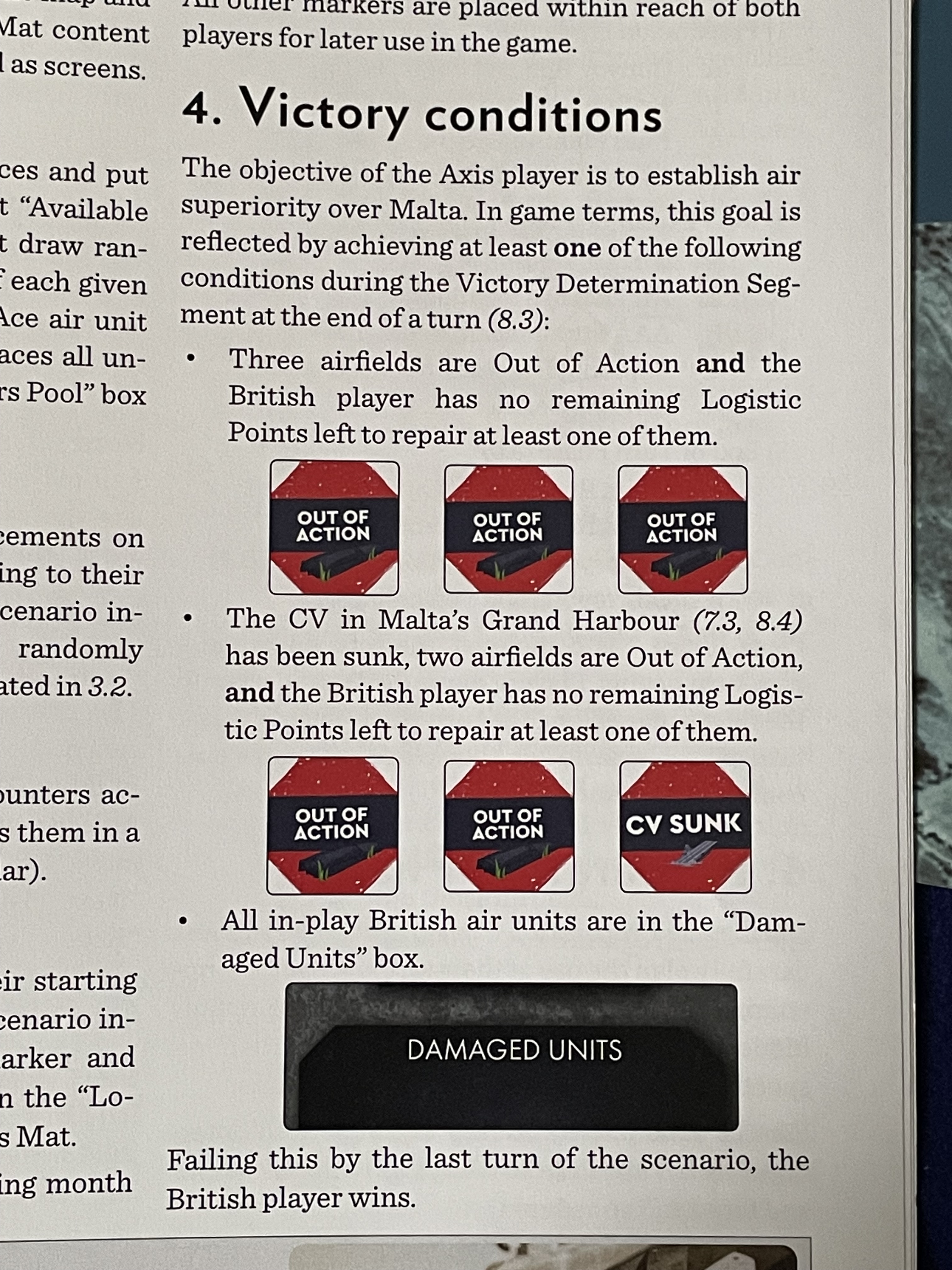
Nothing Left to Bomb is, however, far from just a simplified air raid resolution wargame; more interestingly it is a resource management game. Here the Axis player must raid the skies over Malta to deprive the Allied player of convoys, airfields, an aircraft carrier, or aircraft. The Allied player must carefully manage their supply, expressed in the game as Logistics Points, to defend convoys and airfields all while avoiding losing too many aircraft. The competition for resources is the heart of Nothing Left to Bomb. Instead of a tactical dogfight game players of Nothing Left to Bomb will find strategic challenges and decisions far greater than what the few components seemingly say is on offer.
Unpretentious
While the component list for Nothing Left to Bomb is small, the quality and look on the game table is nothing short of impressive. Graphical designer David Prieto deserves great accolades for not only making Nothing Left to Bomb look good but doing so while maintaining a high degree of usability for the players. There are many nice touches. I applaud the decision to use the other side of the front and back “covers” as Player Mats. I appreciate the Player Aid Sheets that double as planning screens each using basically the same tables but laid out in a manner most appropriate to each respective side. The main map is simple but easy to understand; I especially like the single Turn Track that is helpfully marked for use in all three scenarios. Put together the graphics of Nothing Left to Bomb assists the players in playing the game yet also immerses the players into their respective roles.


Malta LPs
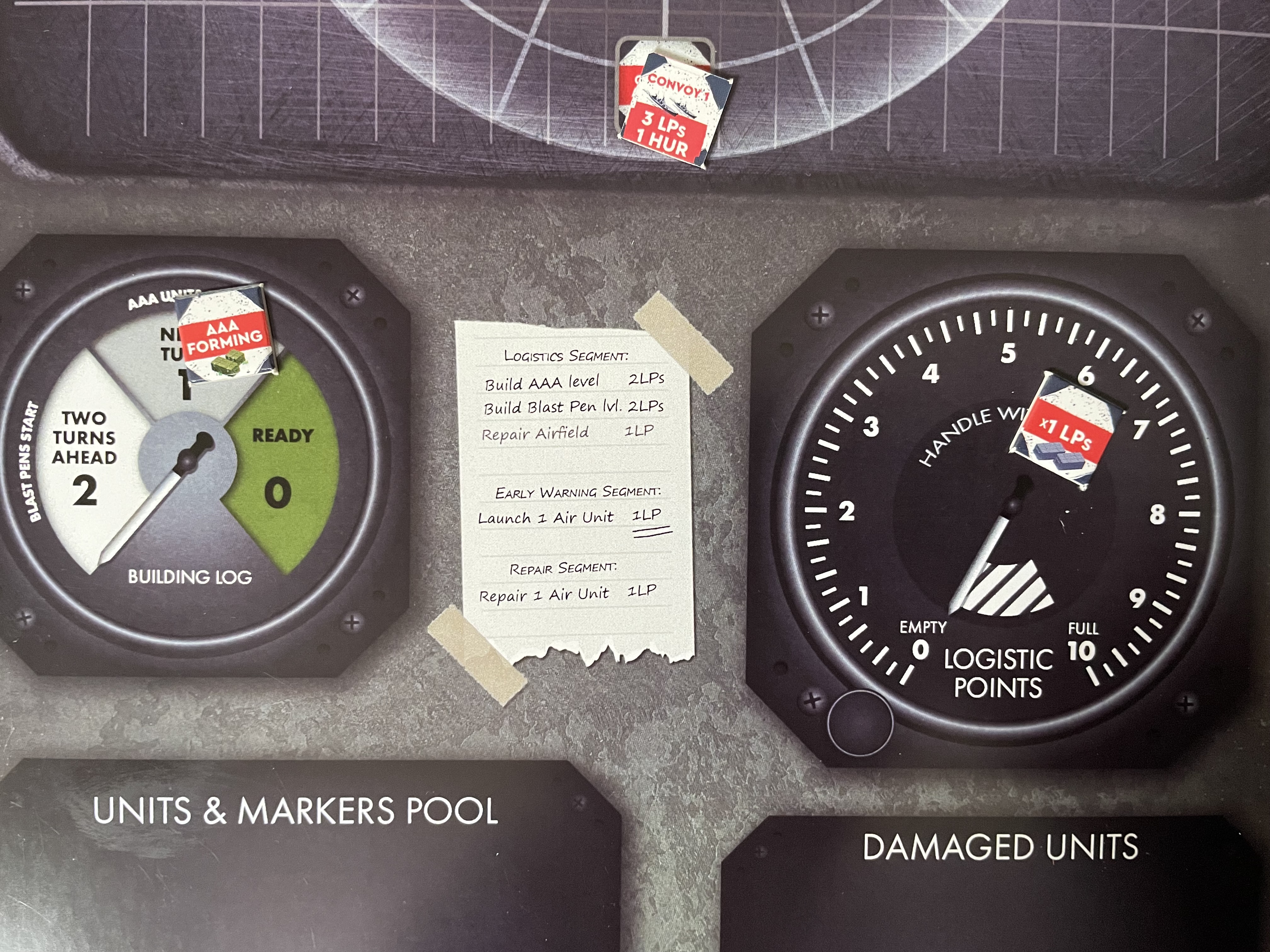
The core game mechanisms in Nothing Left to Bomb provide plenty of combat action. The Axis player secretly plans their raids at the same time the British secretly plan their defenses. The action then moves from the Player Mats to the game map where the raids are played out. Yet, while there is plenty of combat, the most important rules in Nothing Left to Bomb—the rules that will stress the players more so than most any combat die roll—are those for Logistics. Simply put the British player will seemingly never have enough Logistics Points (LP) to do everything they need to do. In the Preparation Phase, the British player has the option of spending LPs to repair airfields, build Blast Pens (in some scenarios), or build-up anti-aircraft artillery (AAA). In the Early Warning Segment, if an aircraft is launched it costs LP (fuels and spares). In the End of Turn Phase, the British player can spend LPs to repair damaged units. If a convoy arrives that turn the British player secretly looks at the convoy counter and gets than many aircraft and LPs minus the amount of damage incurred because of Axis bombing. Deliciously, the number of LPs that British player has in hand is kept secret from the Axis player—a simple rule that creates much doubt and tension in play.
Three in one
There are three scenarios in Nothing Left to Bomb. Each depicts a different historical period with special rules making each scenario unique.
“Scenario 1: The Italians at It Alone: June 1940-December 1940” (7 turns). Personally, this scenario is my favorite of the three because it showcases so many of the challenges both sides faced early in the conflict. For the British the aerial defenders of Malta initially center on a handful of obsolete Gloster Sea Gladiator biplanes that literally were cast offs—in crates—from when HMS Glorious left the Mediterranean for Norway. The Italians start the game with a handful of their own biplanes, the C.200, which are withdrawn after one month/turn as they historically were too dangerous to fly even in combat. In the course of the scenario the British player will have to make do with only a few convoys but the Axis player may also end up withdrawing the important SM.79 torpedo bombers for the campaign in Greece. While it certainly is difficult for the Italians to knock out all three airfields, the few LPs available to the British means a concerted Italian effort may just be enough.
“Scenario 2: From Norway to Sicily: January 1941-May 1941” (5 turns). This scenario features the arrival of the X. Fliegerkorps of the Luftwaffe. The British also find HMS Illustrious in Grand Harbour where it sheltered for repairs. Historically, the Luftwaffe missed hitting the stationary carrier in any meaningful manner while at the same time the British struggled against the Bf-109 fighters. Can you do better?
“Scenario 3: ‘Nothing Left to Bomb’: December 1941- April 1942 (5 turns). This scenario is the full Monty; the Luftwaffe is at peak strength while the British get better AAA, Blast Pens, and the vaunted Spitfire makes an appearance. As the historical notes mention the air campaign against Malta during this period was much like the Battle of Britain. The Germans failed over London, but will they be able to alter the outcome over Valetta?
SNAFU over Malta
While Nothing Left to Bomb is not the game I expected at first, this small format title with incredible graphics and easy to learn and play game mechanisms delivers a tight game full of tension; every turn sees players facing agonizing decisions in their plans and resources. For the Axis player the question often is, “Will one more effort be enough?” Should they go all in now or wait another turn? For the British player there are never enough Logistics Points to do all that is needed so what gets priority? Can you bluff the Axis into making a mistake? While there are many wargames with meaningful decision space for players few deliver those challenges in a small game format as well as Nothing Left to Bomb.
Afternote – Coming from the East
One final note; while I drew comparisons between Nothing Left to Bomb and John Butterfields’s RAF and Lee Brimmicombe-Woods’ “Raid” series of games, Saggini is clear that this, “game uses a modified system initially devised by Yasushi Nakaguro in his Operation Pointblank game (Bonsai Games, 2017)” (Rule Book, p. 2). Thanks, Nicola, now I have yet another game to bother Yas about!

Feature image courtesy RMN
The opinions and views expressed in this blog are those of the author alone and are presented in a personal capacity. They do not necessarily represent the views of U.S. Navy or any other U.S. government Department, Agency, Office, or employer.
RockyMountainNavy.com © 2007-2025 by Ian B is licensed under CC BY-SA 4.0
 Rocky Mountain Navy Gamer