
My gaming table this past week was occupied by the newly arrived Red Dragon Green Crescent Deluxe (Decision Games, 2024). Red Dragon Green Crescent Deluxe (RDGC Deluxe) is not the wargame many grognards likely expect; while combat is certainly an important element of the game design the real focus of the game system is on geopolitical aspects of confrontation. Stated another way, while the main emphasis of the game mechanisms of RDGC Deluxe center on naval and aerial combat, the most challenging—and most interesting—elements of play are not in the force-on-force combat model but instead are found when players are forced to deal with an ever-changing strategic situation due to shifting political alignments and conditions.

Red to green to deluxe
Red Dragon Green Crescent Deluxe is an updated edition of a series of games that began with Red Dragon Rising: The Coming War with China designed by Bruce Costello and published by Decision Games in Strategy & Tactics Magazine #250 in 2008. A sequel, Red Dragon Green Crescent, was published in Modern War Magazine #1 in 2012.
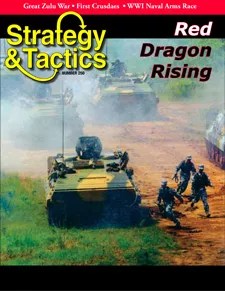

As the introduction for RDGC Deluxe tells us:
Red Dragon Green Crescent (RDGC) Deluxe is a strategic-level simulation of hypothetical future conflicts in and around East Asia, the Indian Ocean, and the Middle East. The time frame is the not-too-distant future, roughly between 2024 and 2035… .
This edition of RDGC Deluxe accounts for developments in the strategic situation since the original games were published… .
A critical consideration is the change in the global balance of power… .
There are numerous question marks raised by the game. Would Pakistan stand idly by if India allied with the US, given the existential threat they perceive of a US-Indian victory in a general war with China? And if Iran were ever to make a move to create dominance in the Persian Gulf, what better time than while its primary adversary, the United States, is embroiled in a full-on war with China? There are also conflicts on the Arabian Peninsula and the wider Middle East. Finally, there is the war in Ukraine, commencing February 2022 and with implications which are still to be seen.
The main emphasis on the game is on naval and aerial operations. Ground forces are included only insofar as they impact on the fight for naval bases and certain strategic targets, such as Taiwan and the Persian Gulf littoral.
RDGC Deluxe, System Rules, 1.1 Background
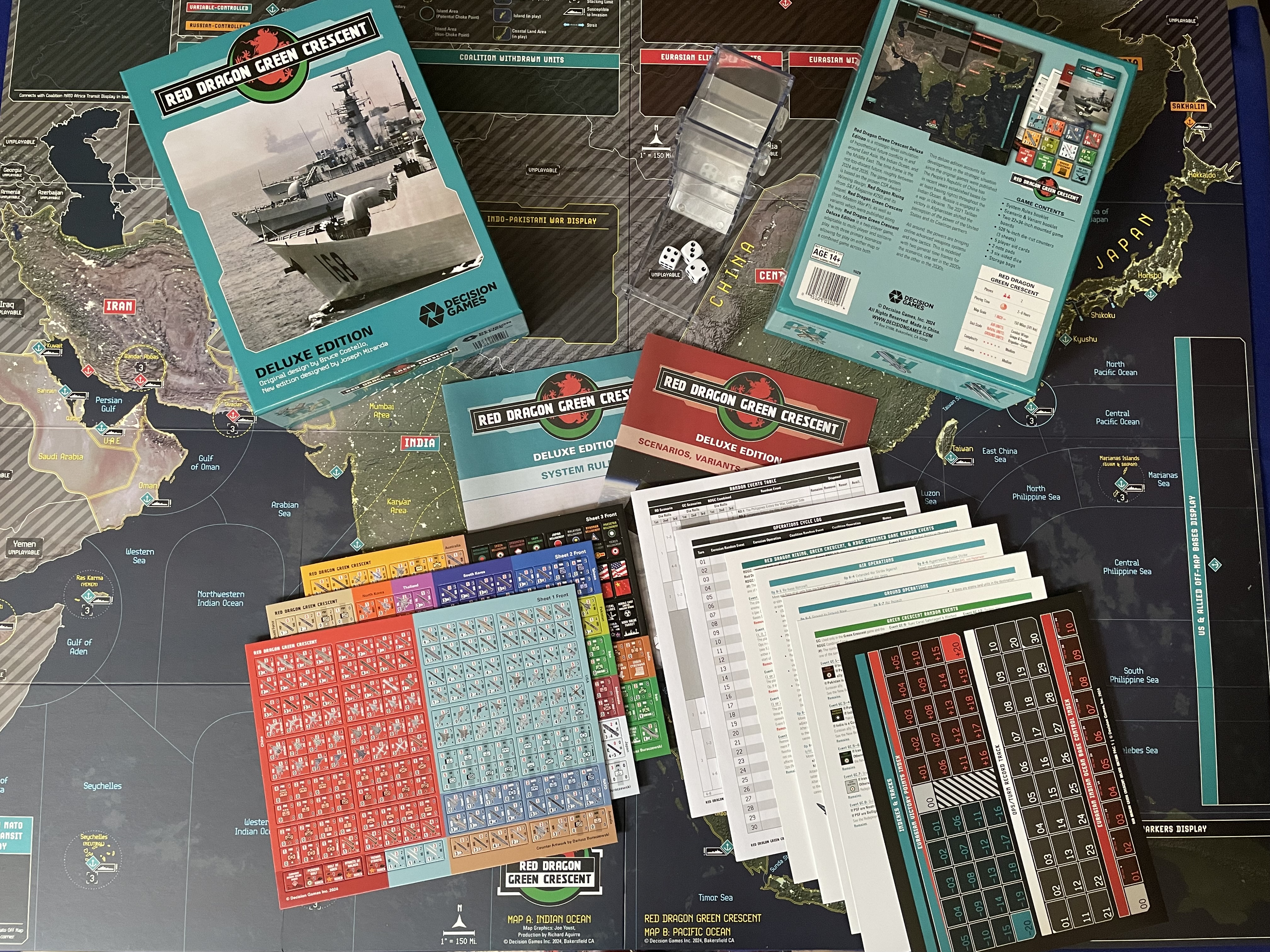
Component-wise, RDGC Deluxe ships with two large 22″x34″ mounted game boards (Map A – Indian Ocean / Map B – Pacific Ocean) each arranged in a portrait orientation (44″x34″ when assembled). The map uses areas—not hexes—with a scale of 1″ = 150 miles (not specified further). Also included are 528 counters at 5/8″ size. As explained in 1.2 Game Scales, ship counters represent individual capital ships (such as aircraft carriers) or groupings of surface ships or submarines. Amphibious units represent task forces, aircraft are “mixed-type combat wing formations,” and ground units mostly represent brigades or equivalent though some larger divisions and corps appear. There are also five Player Aid Cards (PAC) with double copies of PAC 4 and 5 added. Interestingly, there are also two note pads for record keeping during the game.
Red dragon embraces green crescent
The rules for RDGC Deluxe come in two rule books; System Rules is 24 pages while Scenarios, Variants & Optional Rules is 16 pages. As defined in rule 1.3 Operations, the game system for RDGC Deluxe is focused around Operations (Ops). In each Game Turn (called an Op Cycle in RDGC Deluxe) each player gets one Ops per map (Eurasian player first then Coalition player).1 There are seven different types of Ops (see 8.0 Operations):
- Naval Operations (Op N-1 thru Op N-12); see PAC 4.
- Air Operations (Op A-1 thru OP A-7); see PAC 1.
- Ground Operations (Op G-1 thru Op G-13); see PAC 5.
- Joint Operations (Op J-1 thru Op J-6); see PAC 5.
- Logistical Operations (Op L-1 thru Op L-7); see PAC 5.
- Intervention Operations (Op I-1 thru Op I-6); see PAC 4.
- Optional Operations (Op X-1 thru Op X-7); see PAC 4.
Some Ops in RDGC Deluxe are available to only the Eurasian or Coalition player, respectively. Further, while each player usually gets a single Ops per map in an Ops Cycle, some Random Events (see 6.0 Random Events) or Hyperwar Combat effects can award bonus Ops (see 12.0 Hyperwar Combat).
The game mechanisms in RDGC Deluxe for Sequence of Play (5.0), Stacking and the like (7.0), Operations (8.0), basic Movement (9.1 thru 9.10) and basic Combat (10.1 thru 10.6) are rather slim; those core rules take up only six of the 24 pages in the System Rules.
Where RDGC Deluxe sets itself apart from other wargames is in the other rules. The most interesting ones are:
Random Events: Rule 6.0 Random Events explains the use of Random Events in RDGC Deluxe. As found on PAC 2, there are 15 “Red Dragon Rising Random Events,” 15 “Green Crescent Random Events,” and seven (7) “Red Dragon Rising, Green Crescent, & RDGC Combined Game Random Events.” Most random events represent geopolitical events such as the entry/removal of an ally, realigning a nation, or some other major geopolitical shift such as Korean Crisis Escalation (RD.12) or Expanding Middle East War (GC.15).
National Restrictions: Rule 7.9 National Restrictions in RDGC Deluxe lists restrictions to “basing, movement, combat, and other Ops (within the general rules restrictions)” for different countries. Importantly, the National Restrictions detail with who or where a nation can—or cannot—operate.
Movement: While the core movement rules for RDGC Deluxe are provided in 9.1 thru 9.10, rules 9.11 thru 9.16 cover other movement rules for special units (such as 9.11 PRC Air Cushion Vehicle Flotilla) or the impact of locations on movement (for example, see 9.16 Suez Canal). For the most part, these later movement rules—again—specify how different national forces (or alliances) can work together.
Combat: Similar to movement, the core rules for combat in RDGC Deluxe are found in 10.1 thru 10.6. Later combat rules 10.7 thru 10.13 mostly add special rules for special combat units such as 10.7 Stealth Units or 10.11 Hypersonic Weapons.
Abstracted Wars: In rule 11.0 Abstracted Wars of RDGC Deluxe are the rules for playing out the War in Korea (11.1) or The Indo-Pakistani War (11.2) are specified. As the name of the rule implies, these “wars” are resolved in a highly abstracted manner and the impact of a war is not necessarily reflected in a change in only military forces but are also politically focused. Speaking of politics, to start one of these wars is a political decision using an Intervention Operation. Once started, a war continues where each player can play normal Operations (with some restrictions) until one player decides to make—another—political decision to try and end the war by spending another Intervention Operation to resolve the war. Resolving the war (hopefully in your favor) imposes geopolitical effects on the belligerents (somewhat advantageous for the winner; more dangerous for the loser).
Hyperwar Combat: Rule 12.0 Hyperwar Combat is listed as an optional rule for RDGC Deluxe but, frankly, it should be a default rule for any scenario. Hyperwar allows players to play two more Ops using a C4I Satellite marker (though it can be countered by play of an ASAT/BMD marker), or use Cyberwar (granting the attacker the Stealthy condition for all attackers giving them a free first strike) or Special Ops to launch a special operations attack.
The Scenarios, Variants & Optional Rules booklet for RDGC Deluxe includes “one-map” scenarios for Map A (Green Crescent scenarios 14.0 and 15.0) or Map B (Red Dragon scenario 13.0) as well as a combined two-map scenario (16.0 Red Dragon Green Crescent Combined Game). There are also rules for Optional Counters and Scenario Variants.
Optional Counters: These are the “shiny toys” of RDGC Deluxe. Some are obviously based on known or otherwise publicly disclosed weapons developments. Others are…fanciful.
Scenario Variants: These variants—again—mostly deliver political effects to change up scenarios of RDGC Deluxe. Here one finds 14 Red Dragon Variants (RD.V1 thru RD.V14), 13 Green Crescent Variants (GC.V1 thru GC.V13) as well as eight (8) combined game variants (RDGC.V1 thru RDGC.V8). Some examples are RD.V10 “Taiwan Microchips” which reduces Coalition reinforcements or GC.V11 “Iran Has Nukes” which gives the Eurasian player the option of launching limited Iranian nuclear strikes (yikes!). Several of the combined game variants are very interesting, such as the “AUKUS” (RDGC.V2) or “US Sanctions on China & Russia” (RDGC.V3) or “One Belt, One Road” (RDGC.V5).
While the one-map scenarios for RDGC Deluxe are very interesting to play, the two-map scenarios challenges players to manage their forces across two competing theaters (Middle East and Pacific). Players will quickly discover that they never have sufficient forces to be everywhere when needed. Those resource allocation challenges create very interesting decisions in play that each player must deal even as those conditions fluctuate.
New Cold War
As a grognard, when I first played RDGC Deluxe I focused on the combat game mechanisms. My initial reaction was, “This is too abstract; combat has been simplified to the point of near-irrelevance.” What I saw was a very simple combat resolution model where Units are rated according to four Combat Factors: Anti-Ground, Anti-Air, Anti-Submarine, and Anti-Surface Naval (see 2.3.8). Units absorb combat losses using Step Strength (see 2.3.9) with one or two steps; most units are removed from play when Step Strength goes to zero but a few two-step units can be repaired in play and returned to full strength (see 2.3.9). When participating in a battle, the attacker declares which unit is attacking and what the target is. Combat dice (d6) are rolled (attacker and defender) with results applied simultaneously. Generally speaking, one must roll equal to or less than the chosen Combat Factor to hit. There is only one round of combat.
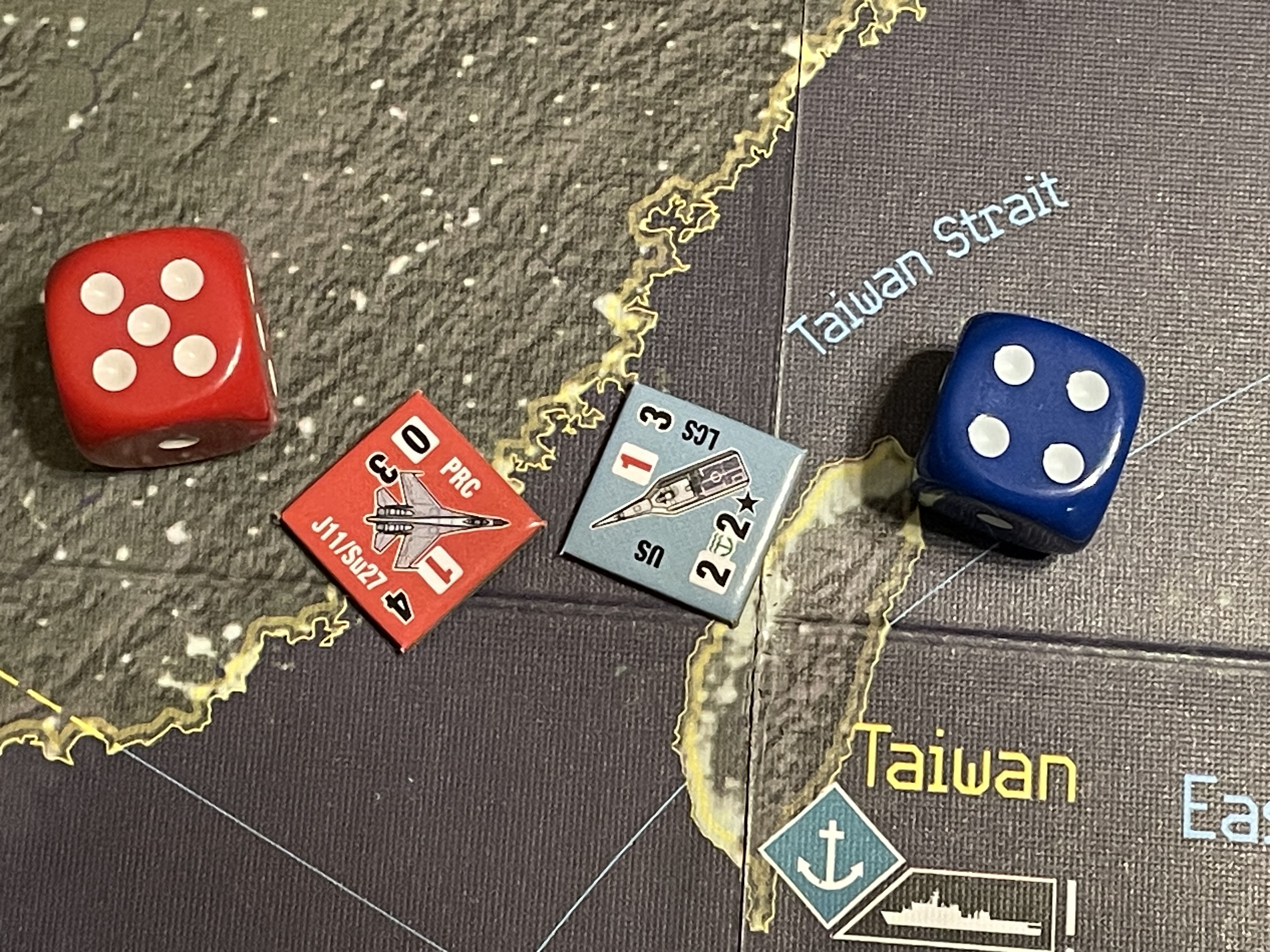
For example, a PRC J11/Su27 Air Unit is attacking a US LCS Naval Unit in the Taiwan Strait. The attacking J11 has an Anti-Surface Naval Factor of 3 while the defending LCS has an Anti-Air Factor of 3 and is Stealthy (+1 to enemy rolls to hit). Since the Taiwan Strait is an Astride Land Area (see 10.6 Naval Units Astride Land Areas) the PRC player gets a -1 die roll modifier which is offset by the Stealthy. The combat dice (d6) are rolled with the PRC player rolling an [5] (modified to 4 then back to 5) and the US player rolling a 4; both the PRC and US players miss as the LCS sails on.
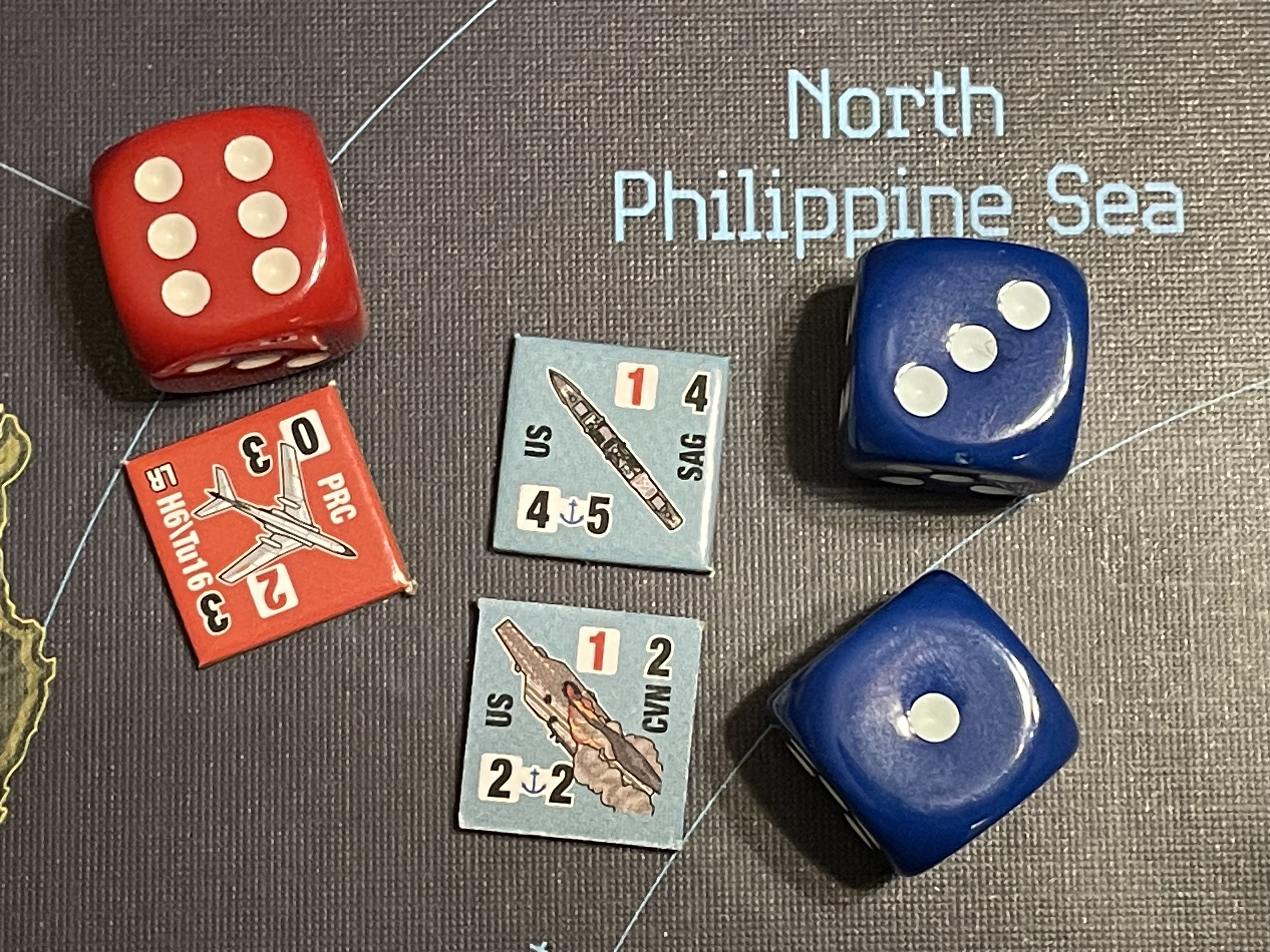
In another example, the PRC player plays a “C4I Satellite” Hyperwar marker for two further Ops in a row (see 12.2). The PRC player first plays “Op A-6 Hypersonic Missile Strike” against a US CVN (aircraft carrier) escorted by a US SAG (Surface Action Group). The PRC Hypersonic Strike (HS) has a Anti-Surface Naval Factor of 4 and is also rated for Stealth. The US CVN has an Anti-Air Factor of 5 while the US SAG has an Anti-Air Factor of 4. The HS, being a stealthy unit, can use rule 10.7 for a free First Fire where the defender cannot defend. For the First Fire using the HS the PRC player rolls a [2]; the HS hits and the CVN loses a step. Next, the PRC player plays “Op A-5 Long-Range Bomber Airstrike” to attack the now-damaged CVN. While the PRC player really wants the carrier, per rule 10.5 Protected Targets any CVN naval units can only be attacked, “if every other non-protected category of surface ship in the same zone or area is also being attacked by at least one enemy unit.” Therefore, the H6 must attack the SAG (escorts) and cannot attack the CVN (the PRC player should of brought a second H6!). The H6 attacks rolling a [6] for another miss. Both the US CVN and SAG can defend against the H6 (Per 10.1, “The defender fires back with all defending units…”) with the CVN rolling a [1] using a reduced Anti-Air Factor of 2 and the SAG rolling a [3]; the H6 is a single-step unit and the two hits eliminate it.

At first glance, the simplified combat game mechanisms of RDGC Deluxe seem to make the game a somewhat bland and uninteresting dice-chucker. Given more play, however, I believe players will discover—like I did—that the geopolitical elements of RDGC Deluxe make it an excellent “strategic-level investigation, with operational undertones, of the possibilities inherent in the first 30-or-so days of a hypothetical war” (BGG, Red Dragon Rising, Overview). In what may be a surprise to many wargamers, the focus of RDGC Deluxe is on the geopolitical effects on operations and not the gritty details of combat. This unexpected focus on geopolitical factors makes the simplified combat model in RDGC Deluxe very appropriate; tactical combat resolution is quick so that players can deal with the ever-changing and increasingly challenging strategic situation. This makes RDGC Deluxe a great choice for a strategic wargame exploring political impacts on military forces during competition, crisis, or war.
- Interestingly, the time scale for a Game Turn/Ops Cycle is not defined in RDGC Deluxe. The BGG overview for Red Dragon from 2008, however, states the game covers, “the first 30-or-so days” which, given the scenario ends at a maximum of 30 Ops Cycles, seemingly equates one Ops Cycle to one day. ↩︎
Feature image RMN
The opinions and views expressed in this blog are those of the author alone and are presented in a personal capacity. They do not necessarily represent the views of U.S. Navy or any other U.S. government Department, Agency, Office, or employer.
RockyMountainNavy.com © 2007-2025 by Ian B is licensed under CC BY-SA 4.0
 Rocky Mountain Navy Gamer
3 thoughts on “Wargame SITREP 25-05 ~ Geopolitics and crisis in Red Dragon Green Crescent Deluxe (Decision Games, 2024)”