
Last November after my first look at Close the Atlantic: World War Three by designer Michael Raymond (game printed and sold via Blue Panther) I was, admittedly, a bit less than enthused yet I tried to stay positive:
Close the Atlantic: World War Three is a game with potential. It starts with the theme: modern naval warfare in the Atlantic. The production values of the game are very good, from the canvas-like map to the counters the game is top notch. Where Close the Atlantic: World War Three comes up a short is the rule book. Further, the constant die rolling for random unit sizing and the need to use a calculator at multiple steps in the combat process also makes Close the Atlantic: World War Three feel…lifeless. Even with the use of random die rolls the game still feels very deterministic. As mentioned above, the rules also invite “gamey” solutions.
I have no reason to doubt that there is a good game in the box, it just appears at this point to still be hidden behind rules that need to be more tightly written and are yet to flow together in a logical, clearly explained manner. Maybe I will work on it…in all that other free time I have in my life, eh? Or maybe designer Michael Raymond needs to take another swing at the rule book and work on an update. We will see which happens first.
“Wargame SITREP 24-54 ~ Future look or alternate history in Close the Atlantic: World War Three (Michael Raymond, 2024),” 24 Nov 2024
Well, it looks like Michael Raymond beat me to a rework:

First, a huge THANK YOU to Mike Raymond for this gesture. I both deeply appreciate and respect you for taking the time and making the effort (not to mention spending the money) to make Close the Atlantic a better game. After reviewing the changes I am happy to report that your efforts are not in vain; Close the Atlantic (Ver 3.0) is a much improved game that I now enjoy bringing to my gaming table.
Book ’em, Michael
In my look at Close the Atlantic (Ver. 2.0) in November, my primary issue with the game was the rule book. Michael was kind enough to send along the Version 3.0 rules which are much improved. While the overall page count of the rule books are the same some of the very useful changes made are:
- Streamlining – The v3 rules are logically condensed into 18 sections, down from the 23 in v2.
- Arrangement – A Detailed Sequence of Play is introduced early in the rule book (p. 5) vice placed much later in the rules (p. 32 in v2).
- Logical – The rules in v3 are introduced in a very logical manner; effectively in the order that they are encountered in play.

One comment I made in November regarding the rules for Close the Atlantic was, “This is a game that has a fair-to-good tactical combat resolution system but the strategic system is far less refined.” Many of the changes made in version 3 of the rules for Close the Atlantic make it clear that the designer made a serious effort to make the strategic game as understandable as the tactical combat rules. My main bugaboo with the strategic game in version 2 of Close the Atlantic was the movement of FEBA (Forward Edge of the Battle Area) markers. The movement if FEBA markers is a vital part of the game as many victory (or defeat) conditions revolve around the location or status of those markers. In version 3 the designer is much more deliberate and explicit as to how the movement of FEBA markers works. The result is the strategic aspects of Close the Atlantic are more readily understood and their importance to victory is much better communicated.
…and a target in every port
In addition to the version 3 rule book for Close the Atlantic, Michael also sent along a new canvas map. The new map is very much like the original but with the noticeable addition more ports. At first I questioned the logic behind these additions; that is, until I read the last paragraph of 7.0 Supply Phase:
A port may come under attack during and after a Convoy unloads. The strike must result [in] hits by at least 30% of original missiles fired to destroy a port. All ships in that port are also destroyed. Less than 30% required hits will result in NO damage to port or ships.
7.0 Supply Phase, Close the Atlantic v3, p. 26
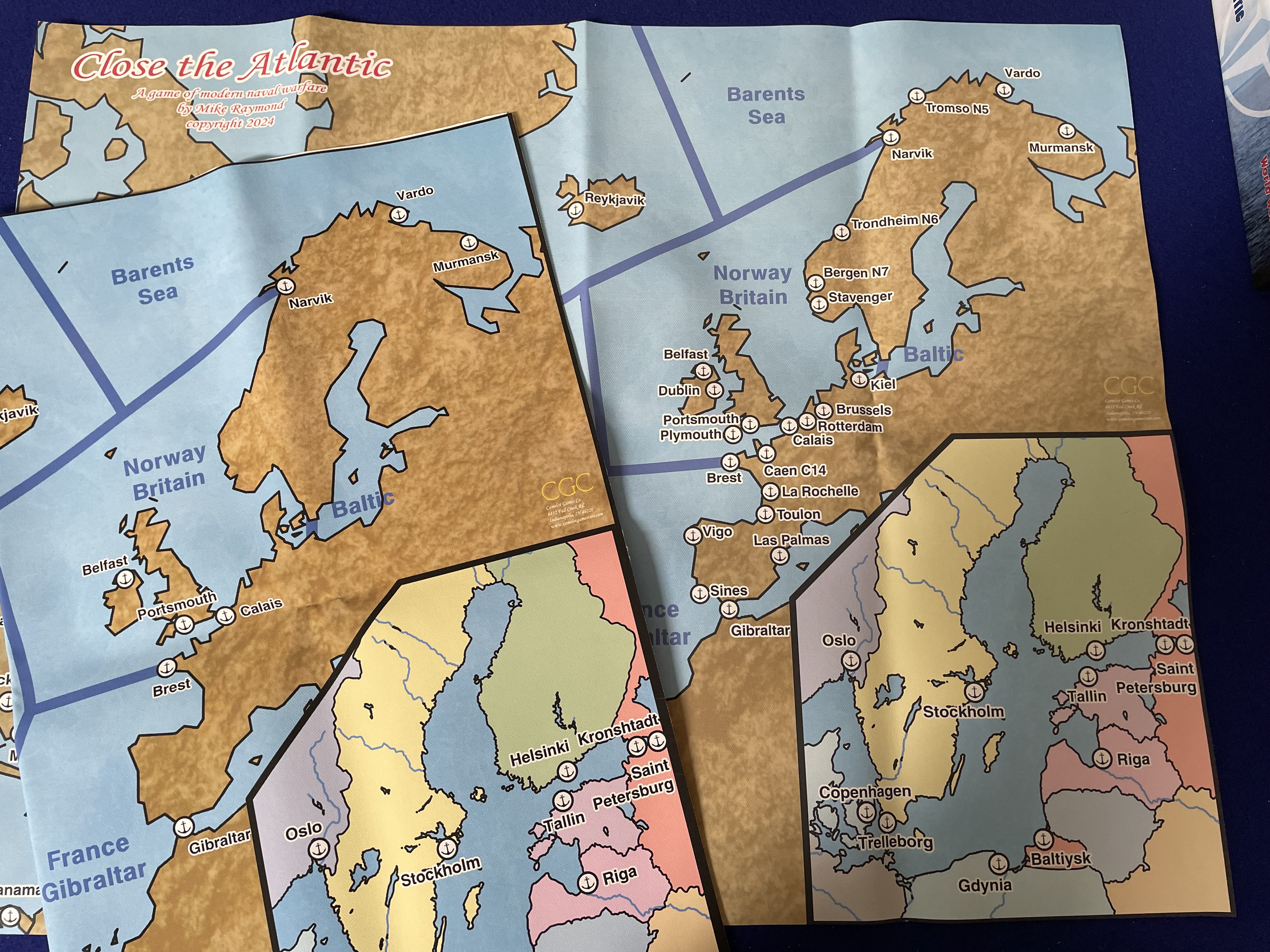
While one could quibble at the use of percentage of hits versus a number of hits (i.e hit with 1 of 3 missiles for 33% closing the port, but hit with 25 of 100 or only 25% will not) the percentage requirement is in keeping with the core design elements of Close the Atlantic. More importantly, Ports have an important supporting role when it comes to the FEBA marker movement; a role that is much more clearly communicated in version 3 of Close the Atlantic which in turns unveils interesting and engaging strategic decision-space for players.
Keep your calculator handy…or not
Most of the core game mechanisms in Close the Atlantic use a d10. In many cases a single d10 is rolled while at other times two d10 are rolled in a d100 fashion. In my November commentary I was a bit snarky in the caption for a picture where I added, “Calculator used but not shown.” In Close the Atlantic v3 those same basic die roll mechanisms are used. This time, however, with the strategic game more easily understood, a nagging concern I have with the combat die rolling stands out more so than it did before. At the same time, a simple potential solution also presents itself.
In Close the Atlantic, some combat processes require rolling d100 to determine a number of “strikers” (missiles or attacking aircraft). In my November example of play it was 96 inbound Russian bombers carrying 192 missiles. These were defended against by 75 fighters with 150 missiles. The fighters ended up hitting at 67% for 50 fighters hitting with 100 missiles that reduced the inbound strike of 192 missiles to 92 missiles remaining. A precision in numbers in turn drove a need to use a calculator in play.

While the die rolling in Close the Atlantic makes sense, I question the real value of “precision” in die roll percentages. In a game with many—proper and acceptable—abstractions why the need for single-digit percentage precision? To reduce (or even avoid) the use of a calculator I experimented with a “5% rounding” rule where all the d100 rolls were rounded to the nearest 5%. In many cases this allowed mathing without a calculator. In the November example the (now) 100 Russian bombers would have carried 200 missiles. The 75 fighters would have still carried 150 missiles, but a (now) rounded off 70% hit rate means 52.5 (7*7+3.5) rounded up to 53 fighters hitting with 106 missiles against an inbound raid of 200 leaving 94 to continue. The results are (generally) the same but the difference is I can do all that mathing quickly in my head.
Opening up Close the Atlantic
The rewritten—and much improved—rules for Close the Atlantic confirm to me that my previous assessment that, “there is a good game in the box” is true. The stellar work of Michael Raymond in revamping the rules for Close the Atlantic make it a much more playable, and enjoyable, wargame. One of the oldest adages in wargame publishing, oft-attributed to James Dunnigan of Simulations Publications, Inc. (SPI), is that “no game is ever finished, it just gets published.”1 The efforts of Close the Atlantic Designer Michael Raymond demonstrate the loving attention they have for their game. The updates to Close the Atlantic move this title into my gaming rotation and off my “good but needs work” gaming shelf section.
- As cited in Herman, M. (2024) Wargames According to Mark: An Historian’s View of Wargame Design. Westchester, Studiolo Designs, 2024. ↩︎
Feature image courtesy RMN
The opinions and views expressed in this blog are those of the author alone and are presented in a personal capacity. They do not necessarily represent the views of U.S. Navy or any other U.S. government Department, Agency, Office, or employer.
RockyMountainNavy.com © 2007-2025 by Ian B is licensed under CC BY-SA 4.0
 Rocky Mountain Navy Gamer
A 100 bomber sortie? From Russia? In theory, I suppose that’s possible, if every airframe Russia has flew on that mission, they could probably get to 100 airframes. That would be every serviceable Tu-95/22/160 along with every Su-30/34/35. They should have been able to do this before the war with Ukraine, but now? Given their likely O/R rate, that 100 airframe mission is likely all they’ve got. And most of these airframes probably can’t carry more than 1 Kh. I know, it’s an abstract game, but I would struggle with the basic concept. Not even going to get started with the Russian cruiser counters…
Quite honestly, the designer seems to have started with a 1980s Cold War Gone Hot theme but then reskinned into something a bit more modern. The numbers make sense if one accepts the grand abstractions.