
As loyal readers of my blog almost certainly know, I am a wargaming grognard first, a grognard sci-fi role-playing gamer second, and a hobby boardgamer third. Yet, one of my boardgame acquisitions this year is Arcs by designer Cole Wehrle published by Leder Games (2024). The public reception of Arcs, judging from the commentary on the forums and videos posted at BoardGameGeek, is mixed. The “controversy” (if it is even that) seems to center around the core game mechanism which uses a form of Trick-taking.1 In my plays of Arcs, however, I am finding a very ambitious game…but maybe not in the way others might think.
The ad copy for Arcs promises an ambitious game in terms of both design and play.

While many players of Arcs seem to focus on on the first major bullet of “Seize the initiative” which uses the Trick-taking game mechanism, for myself the second bullet item, “Declare ambitions,” is the key to the design and play of the game.
Ambitious Ambitions
To win in Arcs players have to be…ambitious. Scoring is Arcs comes through fulfilling an Ambition of which there are five—Tycoon (most Fuel and/or Material), Tyrant (most Captives), Warlord (most Trophies from battle), Keeper (most Relics) or Empath (most Psionic symbols). During play, the player with the Initiative not only gets to play the Lead card in a round but they can also declare an Ambition. Players can Declare an Ambition up to three times in a chapter; each declaration is of a value that increases as the game progresses. Player can even declare the same Ambition multiple times to further incentivize achieving an Ambition.

Some critics seemingly argue that Wehrle is too ambitious with the use of the Trick-taking game mechanism in Arcs. I disagree; the Trick-taking card play is actually rather clever in my view and greatly simplifies gameplay—a worthy ambition. When playing a round of Arcs, the initiative player plays a Lead card which sets the lead suit for the round and gives the Initiative player some number of standard actions. The Initiative player can also Declare Ambition which resets the Lead card value to zero (0) thus making it almost certain that the Initiative will pass to another player in the round. The other players then take their turns to play a card that can Surpass (same suit but higher value to get all the actions that card allows), Copy (play any Action card face down for a single action on lead card), Pivot (play different suit for single action on that card), or Seize the Initiative (Surpass, Copy, or Pivot with second card face down to immediately take the Initiative marker). If nobody seized the initiative the player who played the highest ranking Surpass card—if any—gains the initiative for the next round.

Rounds in Arcs continue until all players pass (if cards in hand) or, if they have no cards, one player passes. At that point the Chapter ends and Ambitions are scored. A game of Arcs usually consists of three to five Chapters.

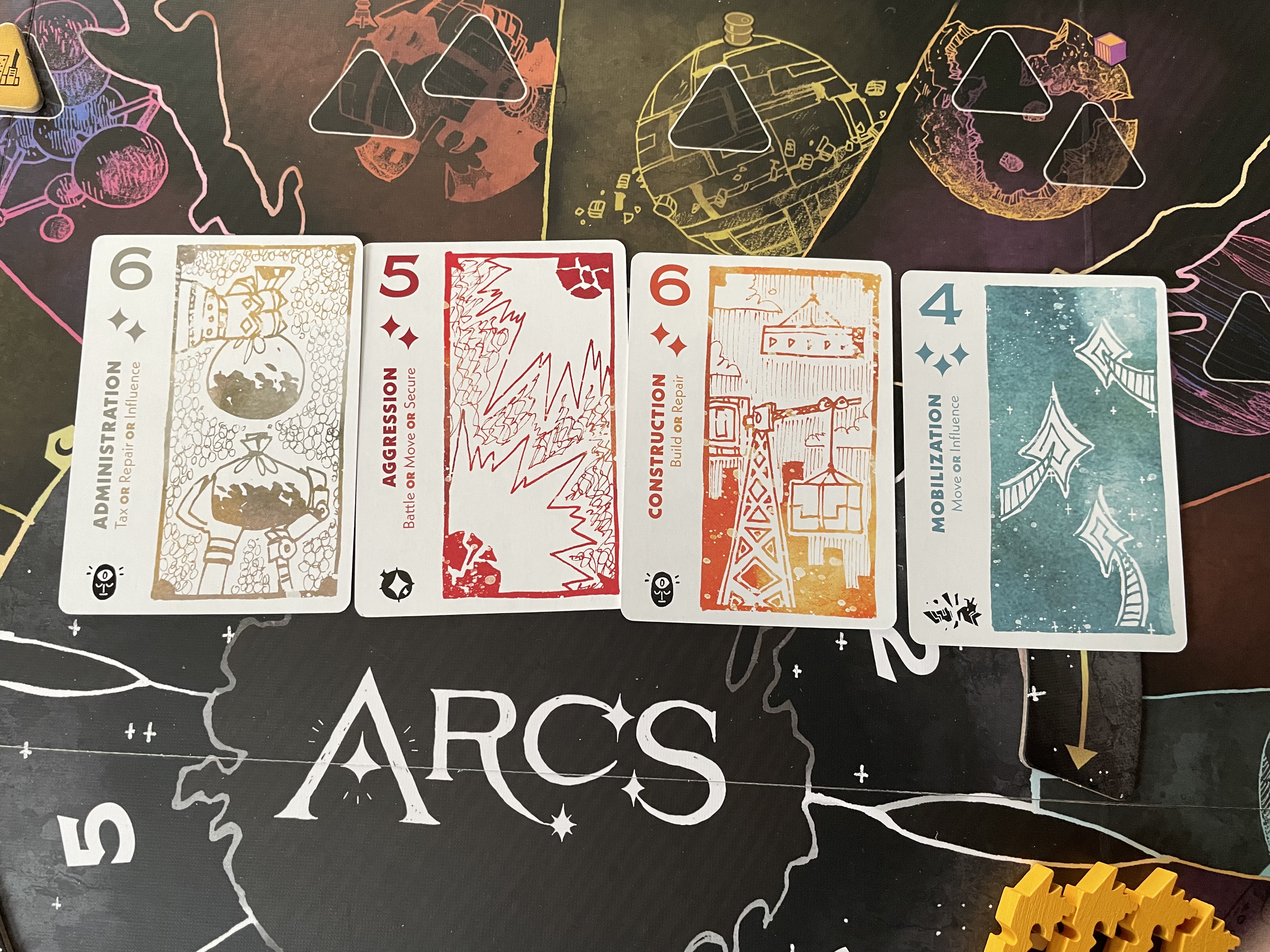
From what I have seen and read much of the criticism levied against Arcs seems to come from those who see the Action cards as too ambitious. That is, the Actions cards try to do too much. The Action cards in Arcs are one of four suits, each of which has an associated set of standard actions:
- Administration cards allow players to Tax, Repair, or Influence.
- Aggression cards empower players to Battle, Move, or Secure.
- Construction cards allow enables players to Build or Repair.
- Mobilization cards gives players the ability to Move or Influence.
Importantly, each Action card in Arcs also has an Ambition symbol in the lower left corner. When played as the Lead card, players are limited to declaring the Ambition on that card. What I feel throws some players off is that an Aggression card does not automatically have a Tyrant or Warlord Ambition symbol; i.e. the Ambition on each card is not necessarily related to the suit but seemingly a random distribution. All of which means players need to carefully consider not only what suit to play on a Lead card but also the value of that Lead card (related to likelihood to retain Initiative) and the Ambition on that card. For some (too many?) players all those considerations can lead to analysis paralysis as they overanalyze2 and slow play.
Ambition for resources
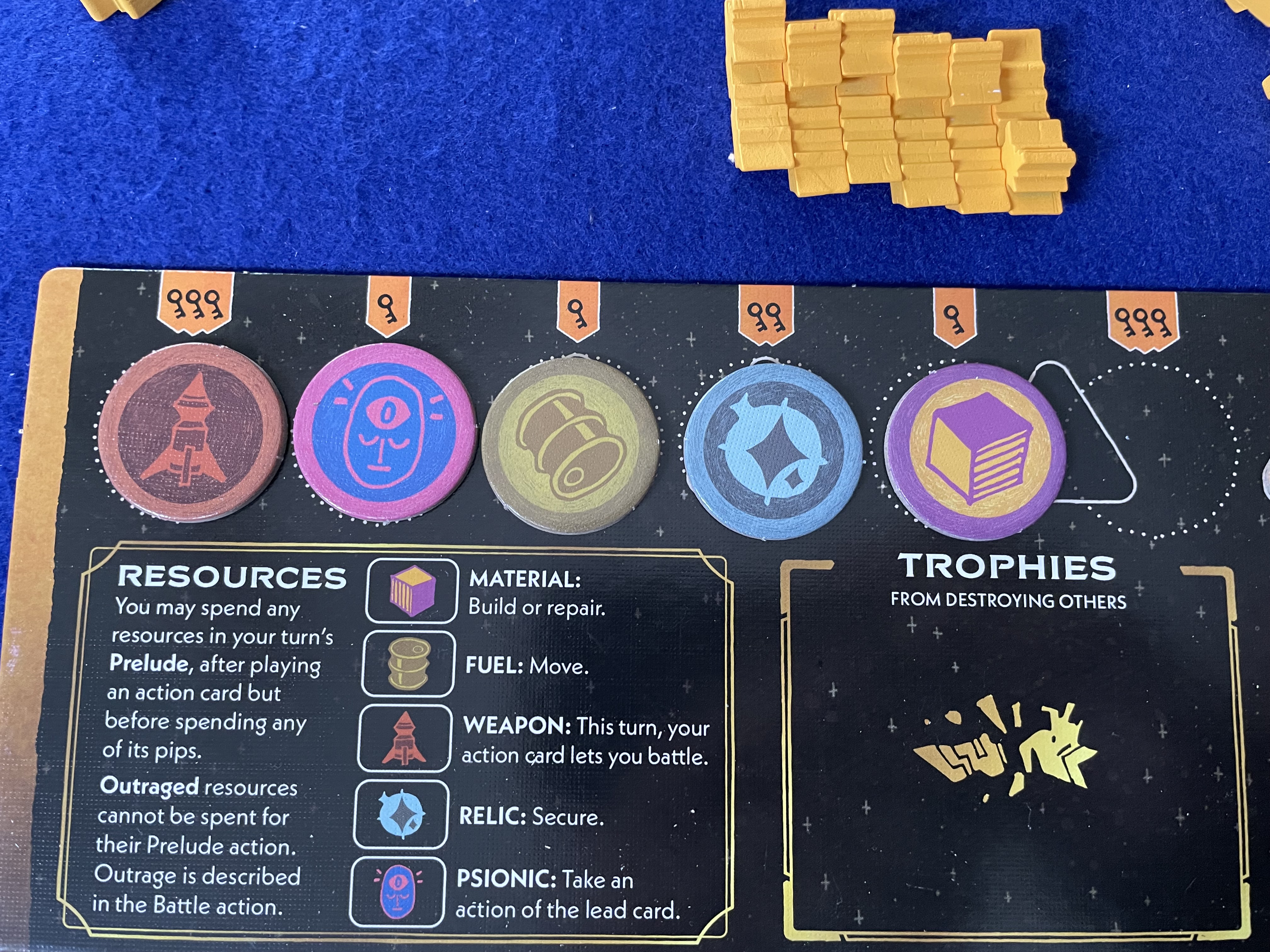
Action cards, however, are not the only way to take actions in Arcs. Ambitious players can also accumulate Resource Tokens which are used for scoring in the Tycoon, Keeper, or Empath Ambitions. Resource Tokens may also be spent after a card is played but before the associated card actions are performed. In that case, a Resource Token is spent as a Prelude action, the type of which depends on the Resource Token given up. This ambitious, yet simple, use of Resource Tokens adds a second economy to the game of Arcs as the supply of Resource Tokens is finite and there is a competition for them to be spent, saved, or even stolen.
Courtly ambitions
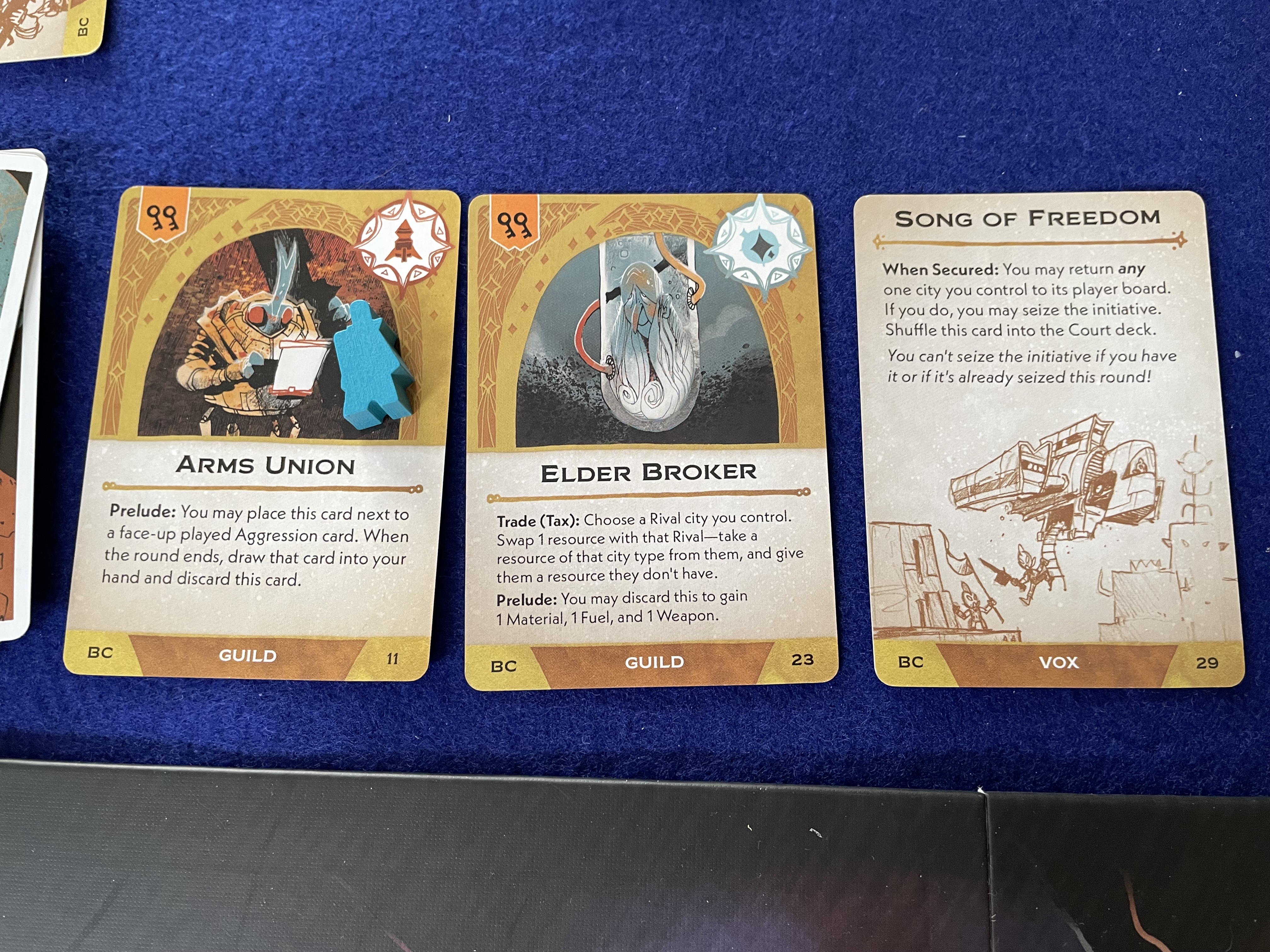
While most of the action in Arcs takes place on the main board, there is a secondary tableau of cards called the Court that opens opportunities to ambitious players. In the basic game of Arcs, the Court is seeded with Guild and Vox cards. Guild cards, “represent the support of guildmasters and task forces. They are gained from the Court, often give new actions, and can be stolen.” Vox cards, “represents incidents in the Reach that you can turn to your own ends. They are gained from the Court and resolve immediately” (Rulebook, p. 3). Players use the Influence action to place Agents on cards in the Court. Players can take cards from the Court through the Secure action (take Court card where you have at least one Agent more than other players) or when Ransacking the Court after destroying a city.
The standard game of Arcs also comes with Leader and Lore cards. Lore cards are shuffled into the Court to, “give persistent powers. They don’t have a guild icon or raid cost, so they do not add to ambitions and cannot be stolen.” Leader cards, “give you unique powers, starting pieces, and staring resources” (Rulebook, p. 21). Wehrle makes it clear that players should not be too ambitious and add these cards to early, learning plays of Arcs:
After playing a game or two, you’re ready to play with Leaders and Lore! This mode gives players wild, unique abilities, but they can be hard to handle if you’re starting out. Really, don’t play your first game with Leaders and Lore.
Rulebook, p. 21
Ambitious in battle
Speaking of battles, as a wargaming grognard one might expect that I am looking for an ambitious combat mechanism in Arcs. Happily, Wehrle chose not an ambitious combat design but one instead that emphasizes simplicity with flexibility. In a Battle, players can chose which of three different combat dice to use:
- “Assault dice damage the defender quickly at some cost to you.”
- “Skirmish dice damage the defender slowly but keep you safe.”
- “Raid dice steal stuff from the defender and might damage them but are risky” (Rulebook, p. 14).

The simplicity of the different combat dice in Arcs allow players to battle in a flexible manner opening up ambitious opportunities. For instance, in one game a player was clearly ahead in the Warlord Ambition with the most Trophies already collected. An opportunity to Battle another player who was on the path to win the Tycoon Ambition presented itself. Rather than choosing Assault or Skirmish dice to battle (and likely collect more Trophies to win an Ambition they already were clearly winning) the first player rolled Raid dice and succeeded in stealing enough Resource Tokens from the second player to not only win the Tycoon Ambition in place of the second player but they also ensured the second player did not even place second and gain any points for that Tycoon Ambition, all while still winning the Warlord Ambition.
Setting ambitions
I think too many critics of Arcs perceive the game as a failure because it does not meet their ambitions. Here I rise in defense of the designer and game designers everywhere who all too often are criticized for not giving players a game the players want. What those critics often seem to miss is the fact that a game design is a personal expression of a designer and the design delivered has to live up to their ambitions, not the players. Yes, it certainly helps if the players are also taken by a design, but star designers like Wehrle often are victim of excessive expectations; as in the expectations of the players often exceed the design delivered by the designer.
While Arcs on the surface portrays a vast, sweeping epoch of empires, the strategy in play is actually quite tactical. I sense that many players are frustrated during play because they want (expect?) grand, sweeping moves as empires battle empires. In Arcs, however, play is tactically focused on rounds where each player plays a single card (and possibly a second to Seize the Initiative) to score Ambitions. The sweeping story of your empires rise—or fall—is played out one card, one round, and one chapter at a time. Players in Arcs must be able to quickly adjust to the small situation presented before them in a round to get to the Ambitions in that Chapter. Given Ambitions change every chapter, players need to change their ambitions in play accordingly. Player that think on too grand a scale—as in “I want to be the Warlord in this galaxy”—may find their cards do not enable that ambition. A winning player (and remember, winning is by scoring points from Ambitions) is the one who can take the cards present in their hand and manage them in a way to Declare an Ambition that the card actions will work towards, all supported by a relatively scarce Resource Token economy and a fickle Court of supporting actions or powers that asymmetrically change the player. The game design of Arcs rewards players who can work towards their Ambitions literally card by card.
Sharp ambitions
The ad copy for Arcs calls the game a “sharp sci-fi strategy game.” That is an ambitious description—and game design goal—that I believe is also easily misunderstood. To my mind, the word “sharp” here has several meanings. First, the game is “sharp” in the unique use of the Trick-taking card game mechanism. I think most all will agree on that point even if some complain about the analysis paralysis that can set in. The second “sharp” I see, however, refers to the pace of play. As the Introduction in the rulebook states, “Your first game of Arcs will take about 45 minutes per player. After you play a few times, a game should take about 30 minutes per player” (Rulebook, p. 2). Wehrle, by design, intends for players to be able to play a vast, sweeping, game of empires in 120 minutes…or less. This is an ambitious goal espcially when compared to other space empire games like Twilight Imperium Fourth Edition (Fantasy Flight Games, 2017) that is rated at 240-480 minutes play time.

More than satisfactory ambitions
Arcs more than satisfactorily meets my ambitions for the game. Wehrle’s game design, especially the Trick-taking card mechanism, is sharp and simple to play, teach, and learn. Gameplay is likewise sharp and fits well into a RockyMountainNavy Game Night. The game is very enjoyable, that is, if one sets their ambitions accordingly. While Arcs is definitely a strategy game, game play is actually quite tactical and rewards players who can adjust or adapt their game plan in the most flexible manner. While some critics complain that Arcs fails to meet Wehrle’s ambitious design goals, it has certainly met mine.
- According to BGG, Trick-taking is defined as: “Players play cards from their hand to the table in a series of rounds, or ‘tricks’ which are each evaluated separately to determine a winner and to apply other potential effects. The most common way to win a trick is by having the card with highest value of the suit that was led, but many classical card games use the ‘trump’ system (where the certain cards, usually those of a designated suit, will win the trick if they are played). Occasionally there is a round of bidding to determine this trump suit. In many trick taking games (though not all), players are required to ‘follow suit’, i.e. play a card of the same suit as was led if they have one. If they do not have a matching card, they must play another card from their hand.
Cards are played sequentially, not simultaneously.” ↩︎ - From BGG: “v. To use an exorbitant amount of time to find an optimal move, especially when the resulting move is virtually equal to all other choices.” ↩︎
Feature image by RMN
The opinions and views expressed in this blog are those of the author alone and are presented in a personal capacity. They do not necessarily represent the views of U.S. Navy or any other U.S. government Department, Agency, Office, or employer.
RockyMountainNavy.com © 2007-2024 by Ian B is licensed under CC BY-SA 4.0
 Rocky Mountain Navy Gamer
2 thoughts on “Boardgame Bulletin 24-15 ~ The ambitions of Arcs (Cole Wehrle, Leder Games, 2024)”