
The Kickstarter campaign page for Forward Defense ’85 from Strategist’s Den Games (2024) carries the subtitle, “A solitaire tactical wargame with RPG elements leading a NATO company-size element in a hypothetical WW3.” This made Forward Defense ’85 sound like an Adventure Wargame, a self-defined genre of wargames with roleplaying game (RPG) elements that intrigues me. With the campaign fulfilling I am now able to deep dive into the game, for better or worse. The Good: Forward Defense ’85 is an excellent solo-play campaign system featuring easy to learn and play rules that creates an equally enjoyable narrative from play. The Bad(ish): Well, there are no true “RPG elements” in the current set of rules—but they really are not needed.
The five T-72 tanks began their descent into the valley in a line with about 100 meters between tanks. One of them had a mine roller attached to the front of its hull. He would have to be taken out in the first volley. As soon as the tanks started down a hill, a line of Soviet armored personnel carriers, BMP-2s, appeared on the crest of the hill and followed the tanks down without hesitation. There were fifteen of these personnel carriers deployed in a rough line about 100 meters behind the tanks. All moved down the opposite slope at a steady and somewhat restrained pace, as if they didn’t really want to go into the valley or get too far ahead of follow-on elements.
A third group of follow-on vehicles appeared. These were a gaggle of dissimilar armored vehicles. As they reached the crest of the hill, they paused for a moment. Just before they started their descent, the ands and ZBMPs in front made a sharp oblique to the left and headed for the north side of the village. Consisting of one BMP, a T-72, a BTR-60, and MTU bridge tank, and a ZSU 23-4 antiaircraft gun, this detachment could only be the battalion command group.
The scene before Team Yankee was too good to be true. For some unknown reason, the Team had not been hit by artillery yet. The Soviets were rolling forward as if they were on maneuvers, not attacking an enemy hunkered down in prepared position. Even better, their change in direction offered most of the Team flank shots. And on top of that, the actions of the command group had telegraphed who they were. If luck held for another minute or two, it would be all over for this motorized rifle battalion.
“ROMEO 83, THIS IS ROME 25. DO YOU SEE THAT LAST GAGGLE, COMING DOWN THE HILL? OVER.”
“25, THIS IS 83. ROGER. OVER.”
“83, THIS IS 25. THAT IS THE COMMAND GROUP. I WANT YOU AND THE TWO TRACKS YOU HAVE UP THERE TO TAKE THEM OUT, THE BMP AND TANK FIRST, OVER.”
“THIS IS 83, WILCO.”
Coyle, H.W. (2016) Team Yankee: A Novel of World War III, Havertown, PA: Casemate, p. 40

If your “viewpoint” of World War III on the plains of Europe in the 1980s comes from reading Coyle’s Team Yankee or Tom Clancy’s Red Storm Rising or Brad Smith’s World at War 85 novels then Forward Defense ’85 will resonate with you. As the back of the box advertises:
Forward Defense ’85 is a solitaire tactical tabletop wargame where the player leads a company-sized NATO element in a hypothetical, realistic WW3.
Forward Defense ’85, back of the box
Component-wise, Forward Defense ’85 is certainly a lite wargame. The boxed set comes with a 16-page spiral-bound rulebook that has a slightly heavier cardstock cover. Positively luxurious for a small game. There are two half-sheets of counters (196 total) and 20 2”x2” Map Tiles. There are also 48 Soviet unit cards, 16 NATO unit cards, and eight Deployment Cards. One can purchase Forward Defense ’85 as a print-n-play product; while that option might save you money the physical cards and mounted tiles and counters are very nice. Physical game space needed for play is very small—a 3’x3’ card table is more than sufficient.

Forward Defense ’85 is not just a battle generator, it is actually a campaign system. The two campaigns in the box, Helmstedt and Hanover (another, Simrishamn, is in Expansion #1) each consist of between four and seven battles. The player starts with a Force Pool of units that may be reinforced against a randomly generated enemy force. The key to winning the campaign is to maintain Momentum after battles. To maintain Momentum the player needs to protect/seize/complete the objective in each battle while losing as few units as possible and maximizing destruction of the enemy.
Each campaign will have a minimum level of momentum necessary to achieve victory. If the momentum tracker is above this level at the end of the number of battles shown as the campaign length, you win the campaign. Campaigns may also have other victory conditions.
2.5.1 Momentum Track
Each campaign in Forward Defense ’85 uses a guided setup from the Campaign Cards. The player will first need to select a difficulty level; Easy, Medium, or Hard. For each level the starting values for Momentum, Player Attrition, Enemy Attrition, and Commander Prestige are provided. The Campaign Card also details the player’s Force Pool, as well as tables for generating enemy forces.

Every battle (also called a Mission) in Forward Defense ’85 is set up in the same 11-step process. The setup begins with a Supply Phase to see if Reinforcements, Air & Artillery Support, or Attached Platoons come available for that battle. Some support can only be acquired once per campaign so be sure to ask for it only when needed! The battle map is a 3×4 grid randomly created from the 20 Map Tiles included in the game. Depending on if the player is Attacking or Defending, an Objective is placed somewhere on the map. The Enemy Force Composition (broadly how many tank or motorized rifle platoons the enemy has) is generated and, in a bit of a nod towards a better NATO intelligence apparatus, the player then choses their forces. The specific kit of the enemy force is then generated and rolls for Deployment Initiative (first setup, on or off board start) are made. If the enemy starts off board then Enemy Deployment Cards are randomly placed face down at Entrance Points followed by player deployment. The battle starts with the Enemy Deployment revealed. A Mission can be “generated” in less than 10 minutes.

While the Mission setup of Forward Defense ’85 generates battles, the system really shines as it is used through the campaign. As one fights their series of Missions, Player Attrition (loses) carries over from one battle into the next affecting the size of your Force Pool. The same is happening to the enemy so, hopefully, you are attriting the enemy faster than they are attriting you. Momentum is the reflection of that attrition—both Player and enemy—and modified by Commander Prestige which can be a boon (if you are a proven winner) or a bane (if you seem to be constantly on your heels or losing). If there is an RPG element to be found in Forward Defense ’85 then Commander Prestige, as small as it is, perhaps is what the designer referenced.
Commander Prestige is a reflection on the commander’s ability to achieve difficult missions while protecting soldiers.
2.5.2 Commander Prestige
Combat in Forward Defense ’85 is very simple. The game uses no CRT [Combat Results Table]. One d20 die is rolled for every attacking vehicle (even if dismounted infantry). Attacks are basically roll under a target number defined by an attack value +/- modifiers with every “hit” possibly causing the loss of a vehicle in the platoon as well as other effects (such as Suppression) if called for.
— — — — —
Leopard’s Claws

- Range Check: Leopard has Range 5; T-64 at range 4. In range.
- Line of Sight Check: No blocking terrain. Good LOS.
- Roll to Hit: Leopard 2 (055) has 4 vehicles and rolls 4d20 against Target Number Hard Accuracy (16) + Crew Quality (2) = 18 or less to hit – all four Leopard 2’s hit!
- Determine front/side armor: T-64 is facing Leopard 2. Front armor.
- Damage roll is Leopard 2 Hard Attack (15) – T-64 Front Armor (4) = 11 or less to damage. Rolls of 16, 8, 7, 2 result in 3x T-64 “knocked out.”
At the end of the Mission in the Recovery Phase, each KO T-64 rolls a d20 to determine final disposition:
- Die roll 18 = “Crew killed or severely wounded and the vehicle is destroyed.”
- Die roll 10 = “…vehicle is destroyed but the crew is serviceable. If you get a replacement vehicle in a future supply phase, they can be returned to service without a reduction in unit quality.”
- Die roll 1 = “…vehicle is returned to the player’s force undamaged.”
— — — — —
One criticism of many solo games I often have are that they are too procedural. Forward Defense ’85, while marketed as a “solo” game, is perhaps better thought of as a game of two-handed solo battles with an enemy force generated in a semi-random fashion by the game engine and “loosely controlled” by the enemy AI. I say “loosely controlled” because enemy AI actions are not strictly defined by the game engine but instead must conform to a set of “AI Goals.” Making the claim the AI uses “actual Soviet doctrine” that appears on the Kickstarter campaign page is a bit of a stretch; the yardstick I use to judge wargames in this respect is some sort of Soviet Battle Drill to reflect the propensity of Warsaw Pact forces to advance in a formation more suitable for maneuver and speed and then deploying into a more tactical formation once contact was made or is near. No such rule—or AI goal—is found in Forward Defense ’85. Though such a rule is missing, the higher level of abstraction used in Forward Defense ’85 admittedly does not make such a rule missed.
Game mechanics are built to reflect the AI using actual Soviet doctrine versus a more nimble but dramatically outnumbered NATO player.
Kickstarter campaign
Forward Defense ’85 is the third “Cold War Goes Hot in Europe” title I have taken in over the past year. Compared to Blackhorse (Tiny Battles Publishing, 2023) and the Designer’s Signature Edition of Air & Armor: Würzburg (Compass Games, 2024), Forward Defense ’85 is certainly the lightest in terms of rules and content amongst all three wargames. Forward Defense ’85 is also certainly the least complex and easiest to learn of the group. On no terms, however, would I call Forward Defense ’85 the least worthy of these three titles. Indeed, what makes Forward Defense ’85 stand apart from those other games is the highly replayable campaign system with an easy to learn, easy to play battle resolution system that is solo by design.
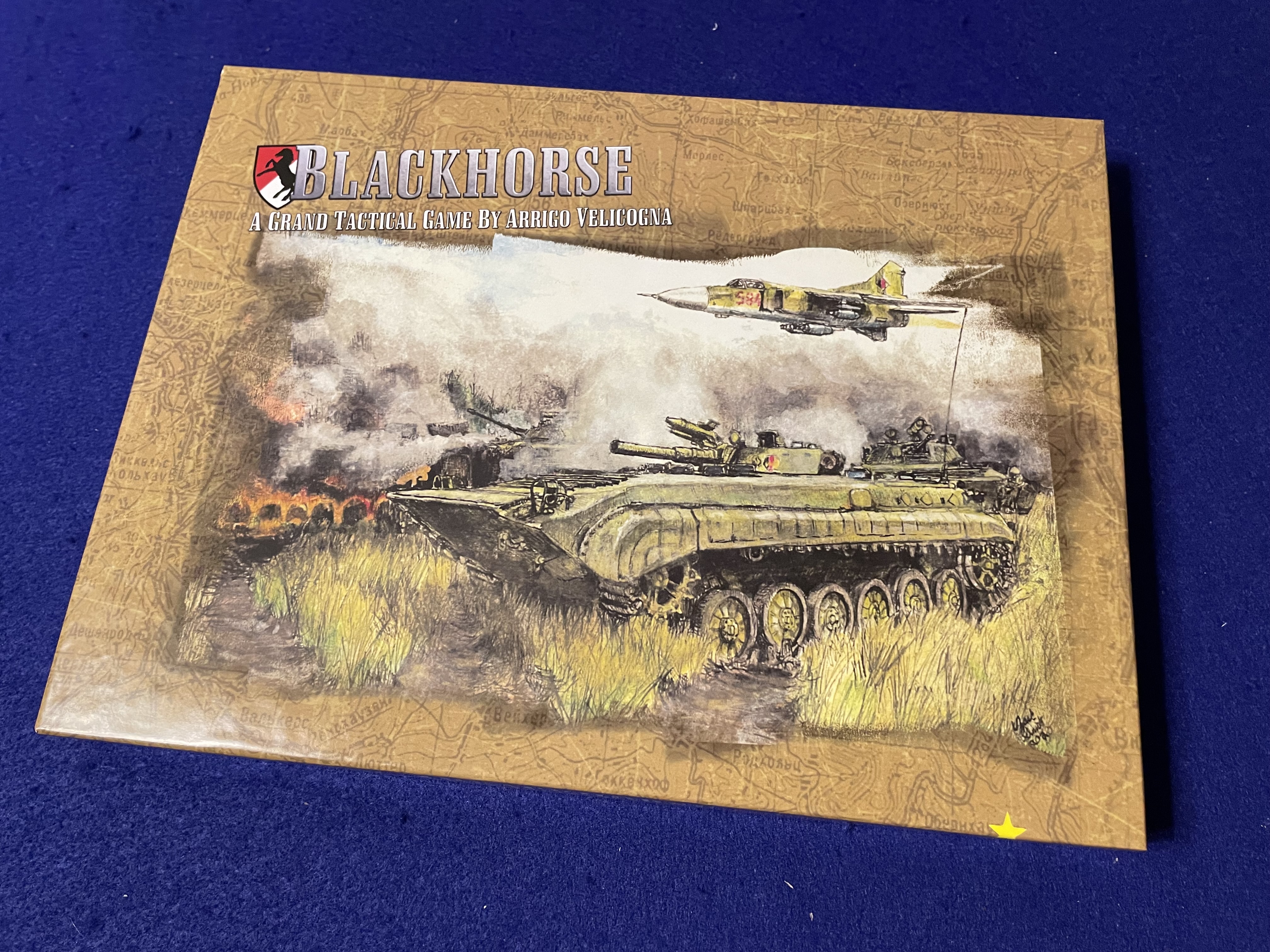

The most enjoyable aspect of play I found in Forward Defense ’85 is the story arc that emerges through the campaign. While Commander Prestige is barely a nod to RPG elements, the story of each mission and how you, the overall company (battalion?) commander has to apportion your forces and call for reinforcements or artillery or air support at the right time turns what could be a very staid after action report into a living scene worthy of Coyle, Bond, or Smith. If you want to play a Cold War tank game to learn about the doctrine and tactics of the day then go play Bruce Maxwell’s Air & Armor or Arrigo Velicogna’s Blackhorse. But, if you are looking for an easy, fun game that creates a truly interesting story, try your hand at Forward Defense ’85 and see what sort of history YOU can write.
Forward Defense ’85 is available as a boxed set ($60) or a Print-n-Play module ($15) from Strategist’s Den Games. Simrishamn – Expansion #1 is also available in a physical model for $15 or PnP for $8.
RockyMountainNavy.com © 2007-2024 by Ian B is licensed under CC BY-SA 4.0
 Rocky Mountain Navy Gamer
Speaking of “Team Yankee” by Harold Coyle: I have a well-worn paperback edition I bought when I was in college. It’s still readable even though the front cover is not in great shape. Because Coyle is one of my favorite military fiction writers, I also bought the reissued hardcover from Casemate a few years ago. I started re-reading “Team Yankee” when I received the reissue (which repurposed a photo of an M-60 tank on maneuvers back in ’85 for the cover art), but I was so annoyed by the typos I ran into that I had to stop reading.
Also, I have one Victory Games map-and-counters game: NATO: The Next War in Europe, but because I don’t know any local wargamers, I’ve never played it!
Ok, so the counters are not great, too hard to read when printed. But otherwise I have to say I am impressed.
Played three games today, part of the delaying campaign. The first took about three hours, the next two an hour or so each.
I will probably replace the unit counters. The rest is less sexy than some games, but fine.
The rules are clever, encompass a lot but with simple mechanics.
I’m totally won over. Great game, thanks for the pointer 😃
Part of the reason PnP is not my thing. But as far as the game goes totally agree…it’s good!
I’ve got a copy of the rules to skim through, so I intend check exactly that. I don’t relish printing and cutting maps and counters, but for the price…
😀
Given my lack of time for gaming with other players these days, solo games are the solution. Thanks for the review, it’s something to have a look for, I think.
And it’s got tanks!
A cut above some others. Worse case try the PnP version to see if it clicks for you.