
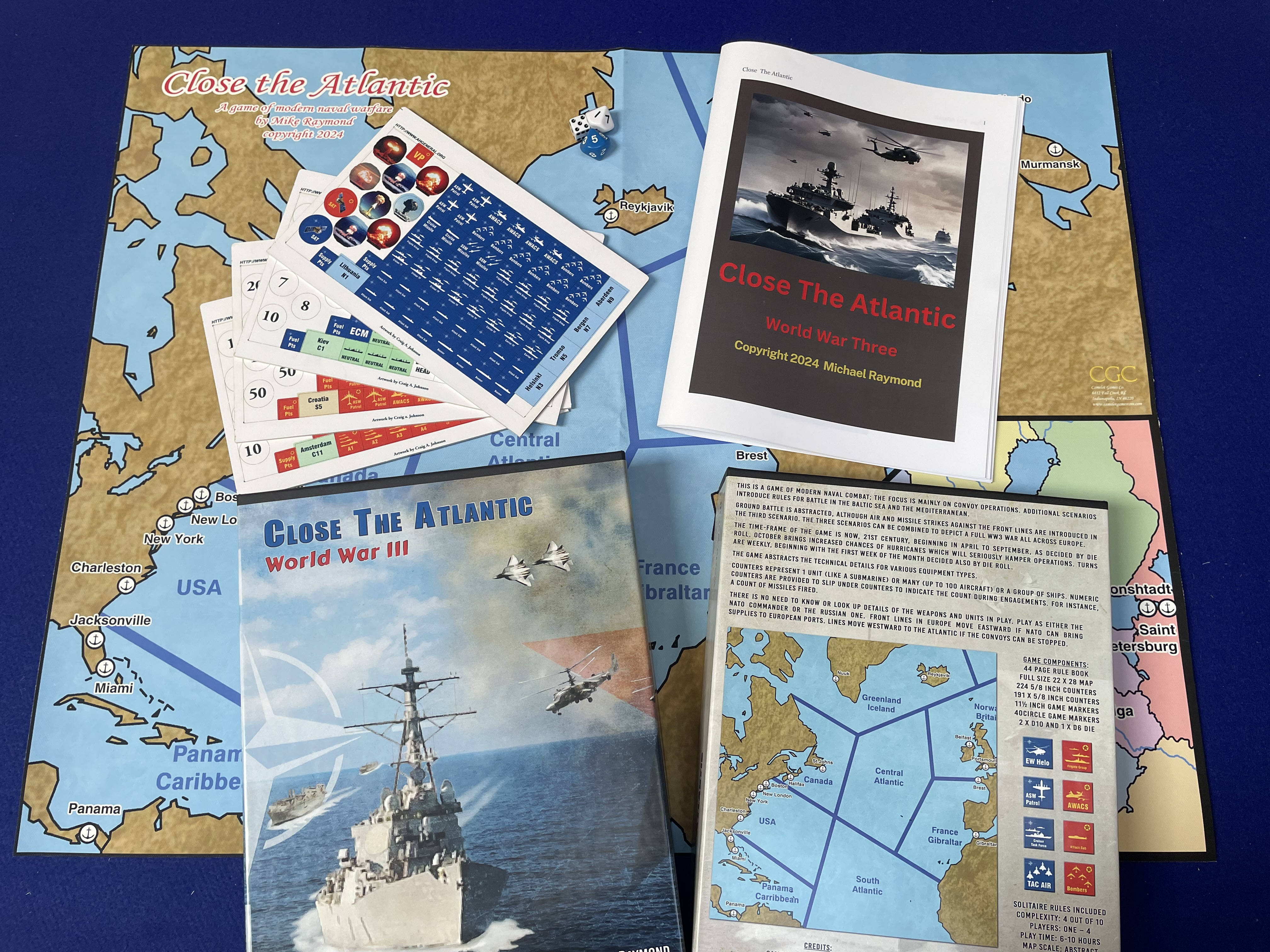
Close the Atlantic: World War Three is a self-published wargame by designer Michael Raymond. It is an interesting wargame to me. The theme in particular—the next Battle of the Atlantic—is of very high interest. The game design itself appears to be a strategic view of the conflict, not so much different in look or scale than the older Avalon Hill Victory at Sea. Taken together one gets a somewhat abstracted view of a potential future conflict in the Atlantic Ocean.
Well, sort of.

Self-published-ish
Before talking about game play, however, a comment about how the game came about is in order. Close the Atlantic: World War Three is my latest acquisition resulting from what appears to be a trend in wargame manufacturing; self-published physical games as compared to simple print-and-play. In this case, designer Michael Raymond took their wargame design and published it using services provided in large part by Blue Panther. This practically means Close the Atlantic: World War Three is “printed” and “sold” by Blue Panther but it is “published” by the designer.
Close the Atlantic: World War Three originally started out as a self-published print-and play game and I am happy the designer was able to bring a physical game to market. I am not personally a fan of print-n-play (PnP) games because I don’t have that spectacular printer nor do I necessarily have the patience or arts & crafts skills needed to “produce” a decent PnP game.
Designer Michael Raymond put a Game Blog up on BoardGameGeek with some further insights if you are interested in reading more.
Next Atlantic War in a box
Close the Atlantic: World War Three comes with a luxurious 22″ x 28″ “canvas” map. The map depicts the Atlantic Ocean east-to-west from the U.S east coast to Europe and from north-to-south from the Arctic to mid-Atlantic with the sea divided into zones. The game is played in weekly turns. The rule book tell us, “Counters represent 1 unit (like a submarine) or many (up to 100 aircraft) or a group of ships” (Rule Book, p. 2). The rule book goes on to state, “Convoy and naval counters have a set number of ship types per counter, based on the mission(s) each can perform” (Rule Book, p. 3).
The scaling of units in Close the Atlantic: World War Three interests me. The subgrouping numbers appear to be arbitrary; perhaps designed to take advantage of “easy simplification” of capabilities onto a counter. In this game the grognard in me cannot assemble a carrier battle group but instead simply grabs a “Carrier TF” counter and calls it a day. It is a level of abstraction that I personally find a bit unsettling but nonetheless accept as a designer’s decision.
To win a game of Close the Atlantic: World War Three the NATO player must escort convoys across the Atlantic to Europe to move the battlelines in Europe to the east. The Russian player must destroy the convoys and NATO naval forces to move the battlelines to the west. The rule book on page 4 also lays out six Game Concepts worthy of mention here:
- Counters can represent multiple ships or aircraft.
- Movement is by area with no specific location within sea zones.
- Movement is optional.
- Detection is required for combat to take place.
- Unit counters can engage in one offensive action per turn.
- “urns are segmented into phases. (Rule Book, p. 4)
The game concepts in Close the Atlantic: World War Three hint at a problem that only becomes more apparent as the rule book is read. This is a game that has a fair-to-good tactical combat resolution system but the strategic system is far less refined.
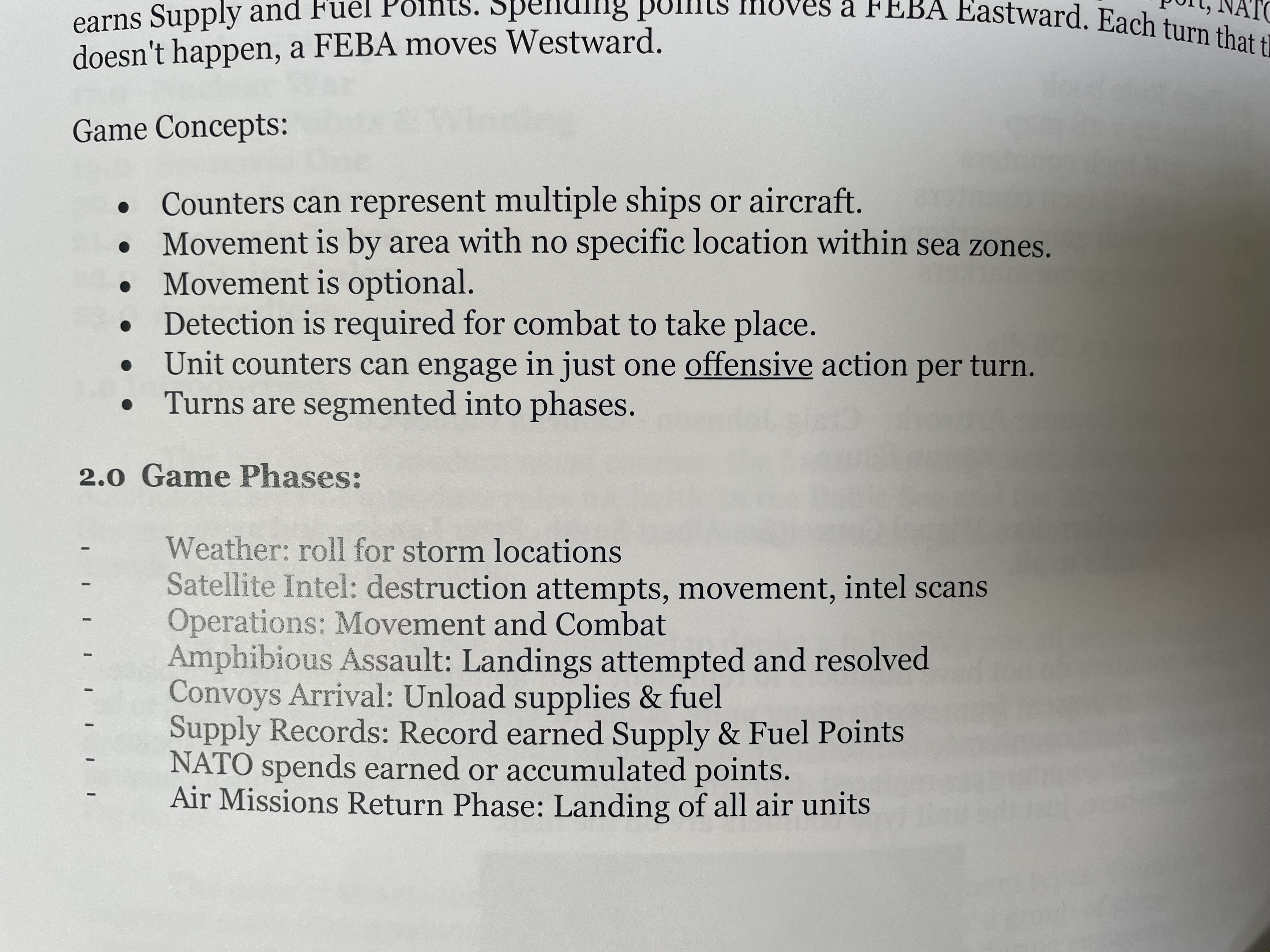
Each turn in Close the Atlantic: World War Three is divided into eight phases. As shown on page 4 of the rule book the eight phases are:
- Weather
- Satellite Intel
- Operations
- Amphibious Assault
- Convoys Arrival
- Supply Records
- NATO spends earned or accumulated points
- Air Missions Return Phase (Rule Book, p. 4)
Let’s take a look at each phase and allow me to comment on them.
Weather Phase
Weather in Close the Atlantic: World War Three is A Bad ThingTM. No air units may fly, detection rolls need to be confirmed, satellite recon is unavailable, and weapon accuracy is greatly reduced amongst other impacts.
Satellite Phase
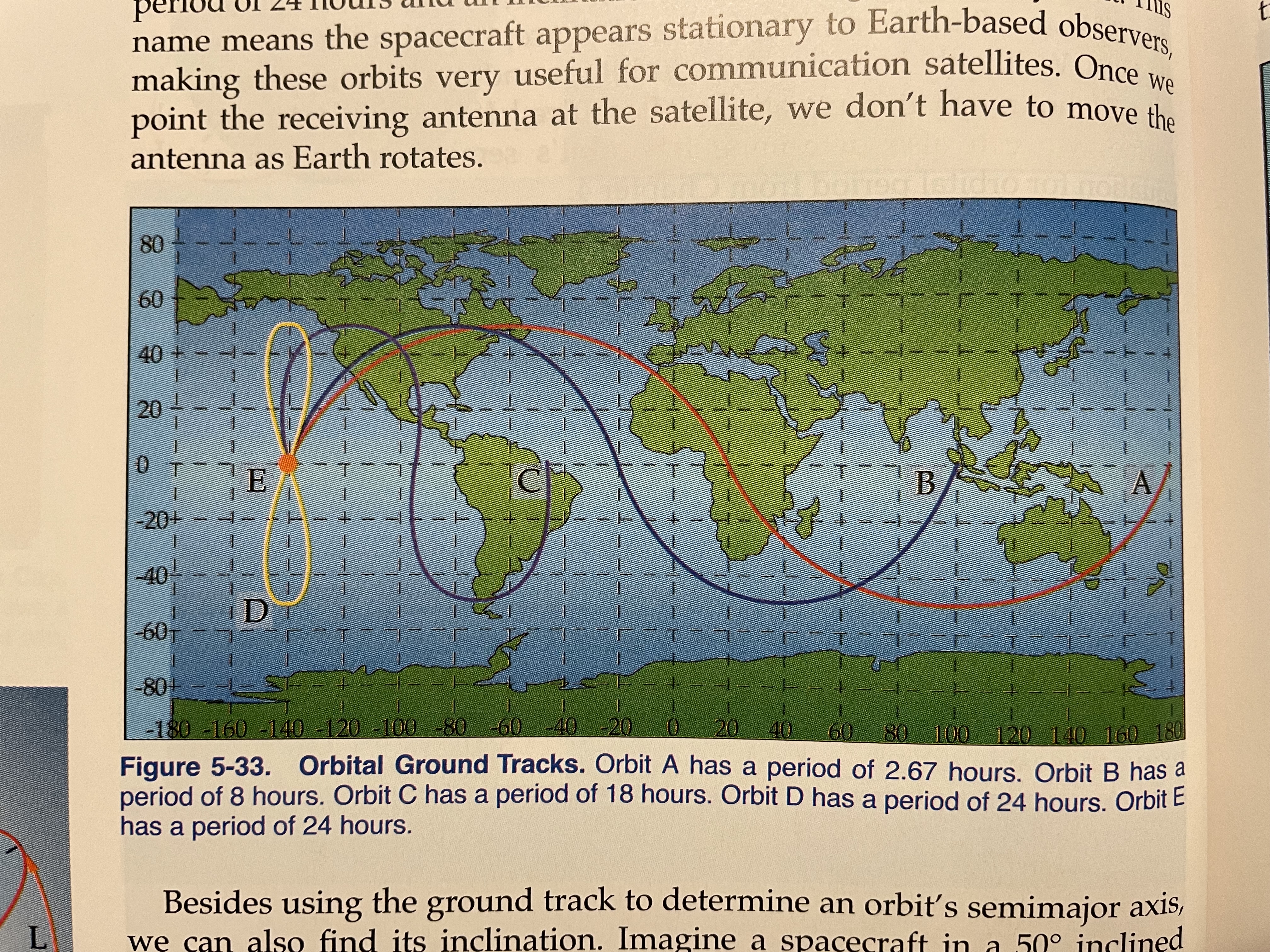
Players need to determine satellite flight paths. Satellites “move” across the map one Sea Zone per turn. I have no idea what laws of orbital dynamics these rules are supposed to depict. Again, I am forced to defer to the designer and trust that the rules are properly fit to design intent.
Operations Phase
The heart of the Close the Atlantic: World War Three game. This is where the layout and logic of the rule book clearly starts to fail as the heart is bypassed several times. On page 7 of the rule book—in what should be a separate text box—one finds a “sequence of play” that goes like this:
- Initiative
- Weather
- Move
- Actions/Reactions
- Contact
- Lock on
- Combat
- Reserves
- Score
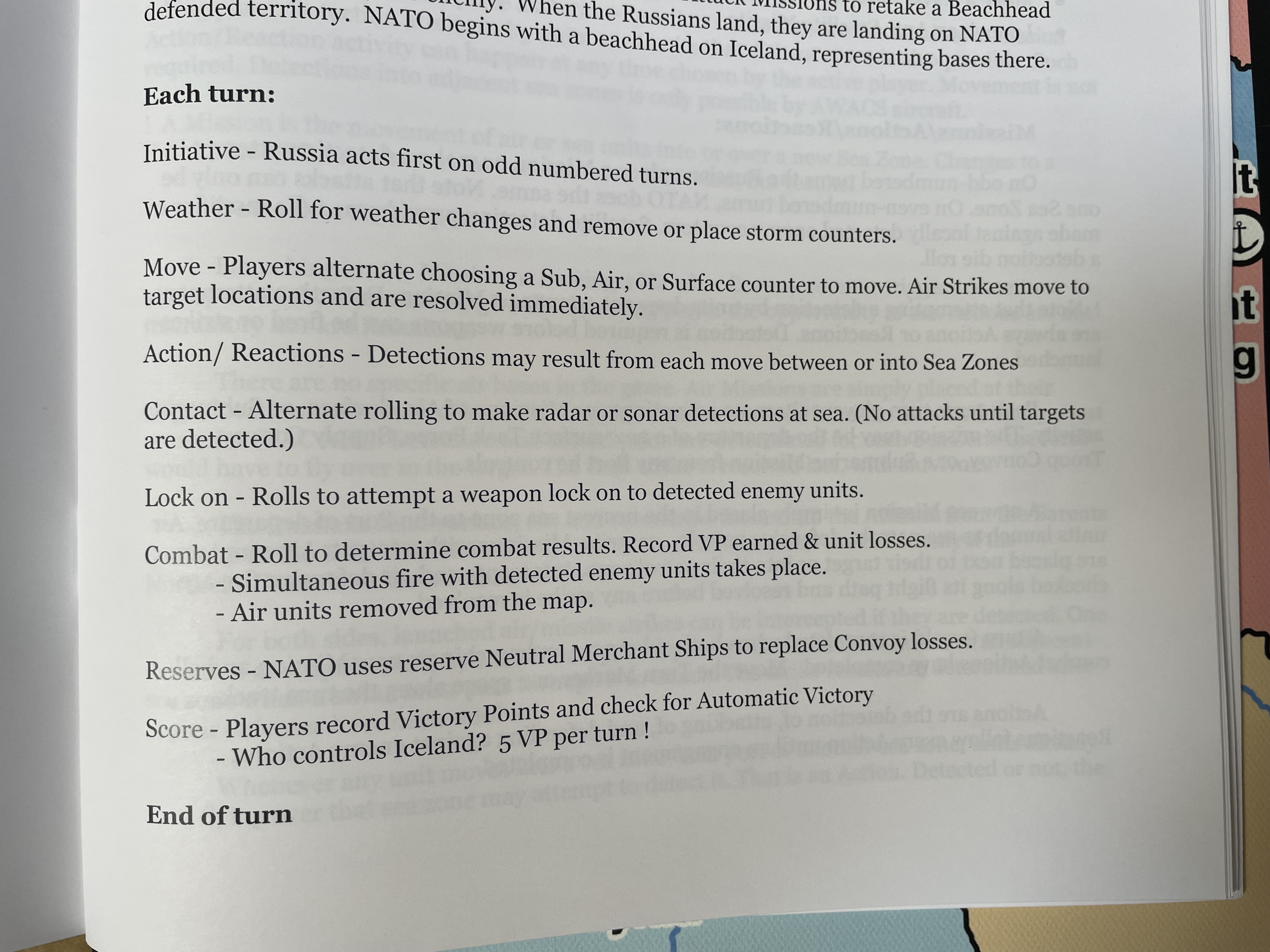
That is close to the original eight phases on page 4 but certainly not the same. Not only does this new sequence have nine steps (as compared to eight phases) but the terminology is far different. What one seemingly discovers after reading this second sequence of play on page 7 is that the the flow of game seemingly looks more like this:
- Initiative
- Weather
- Satellite Phase
- Movement
- Actions/Reactions
- Detections (remember satellites)
- Contact
- Lock on
- Combat
- Amphibious Assaults
- Convoy Operations
- Supply Phase
- Scoring
Or at least one would think that is the sequence of play. If you skip ahead to page 32 of the rule book, however, one finds a third, “Detailed Sequence of Play: (for all scenarios.)” that goes like this:
- Weather Phase
- Weather rolls
- Merchant ship Removal
- Satellite Phase
- Destroy satellites
- Detect then move
- Operations Phase
- Move
- Detect (Action/Reaction)
- Combat Actions
- Non-moving counters Action/Reaction and combat
- Record Hits and VP from combat
- Amphibious Assault Phase
- One landing per side
- Convoy Phase
- Unload Supply Convoys & Troop Convoys
- Supply Phase
- Record points earned
- Air missions land
- End of Turn
- Advance turn marker (Rule Book, p. 32)
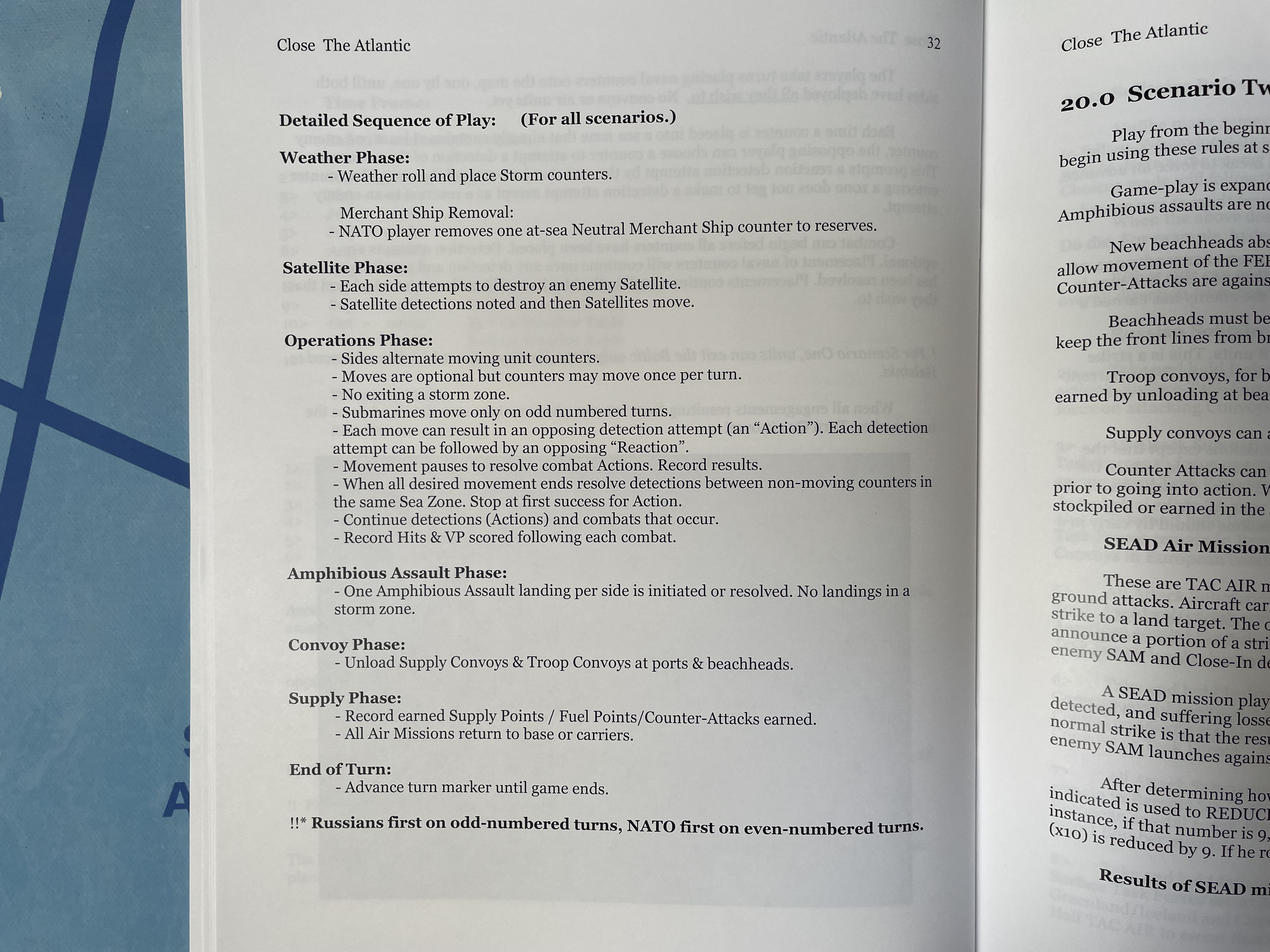
The detailed sequence of play now has seven phases—not eight like on page 4 or the nine steps on page 7. The terminology has again changed and remains different across the three different sequences of play. Further, there are some game actions that remain unclear as to when they take place. For instance, the forward edge of the battle area (FEBA) is tracked and moves based on different game events. Are FEBA moves instantaneous or are they all tracked and executed in one fell swoop? Not sure….
Vampire!
To better learn the rules of Close the Atlantic: World War Three I set up a classic encounter based on Red Storm Rising. Here I will try to do a single Russian TAC AIR strike versus a NATO Carrier Task Force (Carrier TF).
- Weather – For the purposes of this example the weather in the Sea Zone with the NATO Carrier TF is Clear.
- Satellite Phase – There is a Russian satellite in the Sea Zone containing the NATO Carrier TF. This should result in a +1 to all Russian radar detections. NATO attempts to shoot down the ASAT but fails? Don’t know…the rules state, “Roll 1d10 with a ‘6’ required for success” (Rule Book, p. 6). Roll under or roll over? Other rolls generally seem to be ‘roll under’ so I assume the roll of [9] is a failure.
- Operations Phase
- Before launching the TAC AIR strike (at High altitude) the Russians must detect the NATO Carrier TF. The Russian roll to detect the NATO Carrier TF is 7 or less with a -1 die roll modifier from the satellite; the die roll of [1] is a success. (Rule Book, pp. 9, 10, 11, 13)
- The number of striking TAC AIR aircraft is randomly generated by rolling a d100; a roll of [96] means this is a big strike of 96 aircraft each carrying two anti-ship cruise missiles (ASCM) for a total of 192 inbound vampires! (Rule book, pp. 21, 23)
- In previous turns Russia cleared the North Atlantic of NATO ships and aircraft so the TAC AIR can proceed to the Sea Zone with the NATO Carrier TF unmolested. (Rule Book, p. 11)
- The NATO player has one TAC AIR counter escorting the NATO Carrier TF. Or do they? I cannot find any rule in the book that says a Carrier TF automatically includes a TAC AIR counter—it is seemingly implied in places but not specifically stated. There are rules for deploying land-based air but I cannot find corresponding Carrier TF rule. I decide it makes sense to allow the Carrier TF to have a single TAC AIR counter so I do so. A random die roll reveals this is 75 aircraft each with 2x air-to-air missiles (AAM) for a total of 150 AAMs. (Rule Book, pp. 21, 23)
- The movement of the TAC AIR counters to the Sea Zone counts as an Action meaning the NATO Carrier TF has a Reaction; the NATO Carrier TF attempts to detect the inbound Russian TAC AIR counters using radar needing a die roll of 8 or less for High Altitude bombers; a roll of [4] detects the inbound strike. (Rule Book, pp. 9, 11, 13, 21, 23)
- At this point the rules again become murky. Using the rules as written, the Russians will get the next Action and could use it launch 192 cruise missiles. Doctrinally, given that NATO detected the inbound strikers they should(?) get a chance to “shoot the archers, not the arrows” and be able to strike the bombers before they launch. That is not, however, the ways the rules seem to be written so we are forced to accept that the short-legged FA-18 and F-35s from a U.S. carrier (reduced in Close the Atlantic: World War Three to a single generic TAC AIR counter) cannot do what the F-14 Tomcats of lore were able to do. Maybe that is a true reflection of the day but I digress…
- There are two chances to intercept the inbound missiles, once at “maximum” range and again at “half-way.” The NATO Carrier TF elects to use the AAMs in place of Long range surface-to-air missiles (SAMs) of which the NATO Carrier TF carries only 64. The 150 AAMs are used at maximum range and roll a [67] means 67% of the 150 AAMs or 100 hit reducing the inbound ASCM strike from 192 missiles to 92. (Rule Book, pp. 21-23)
- The NATO Carrier TF now fires but needs to lock on first; a roll of 8 or less is needed and a die roll of [5] “locks on” the SAM radars. A combat roll for the 64 SAMs is a [71] meaning 71% hit for 44 more ASCM go down leaving 48 still inbound. [By the way, the rule book does not say you will need a calculator to play…but it should.] (Rule Book, pp. 21-23)
- The NATO Carrier TF gets one last Close-In defense die roll using a single d10. The roll of [3] leaves 45 missiles to hit. Even using the Optional combat results variant (divide the number of hits by 2 to determine number of ships sunk) that still leaves 22 ships sunk. (Rule Book, pp. 21-23, 39)
- A Carrier TF consists of 1x Carrier, 2x DDG, and 4x Frigates for a total of seven ships. The NATO Carrier TF is killed three-times over. (Rule Book, pp. 16, 26, 39)
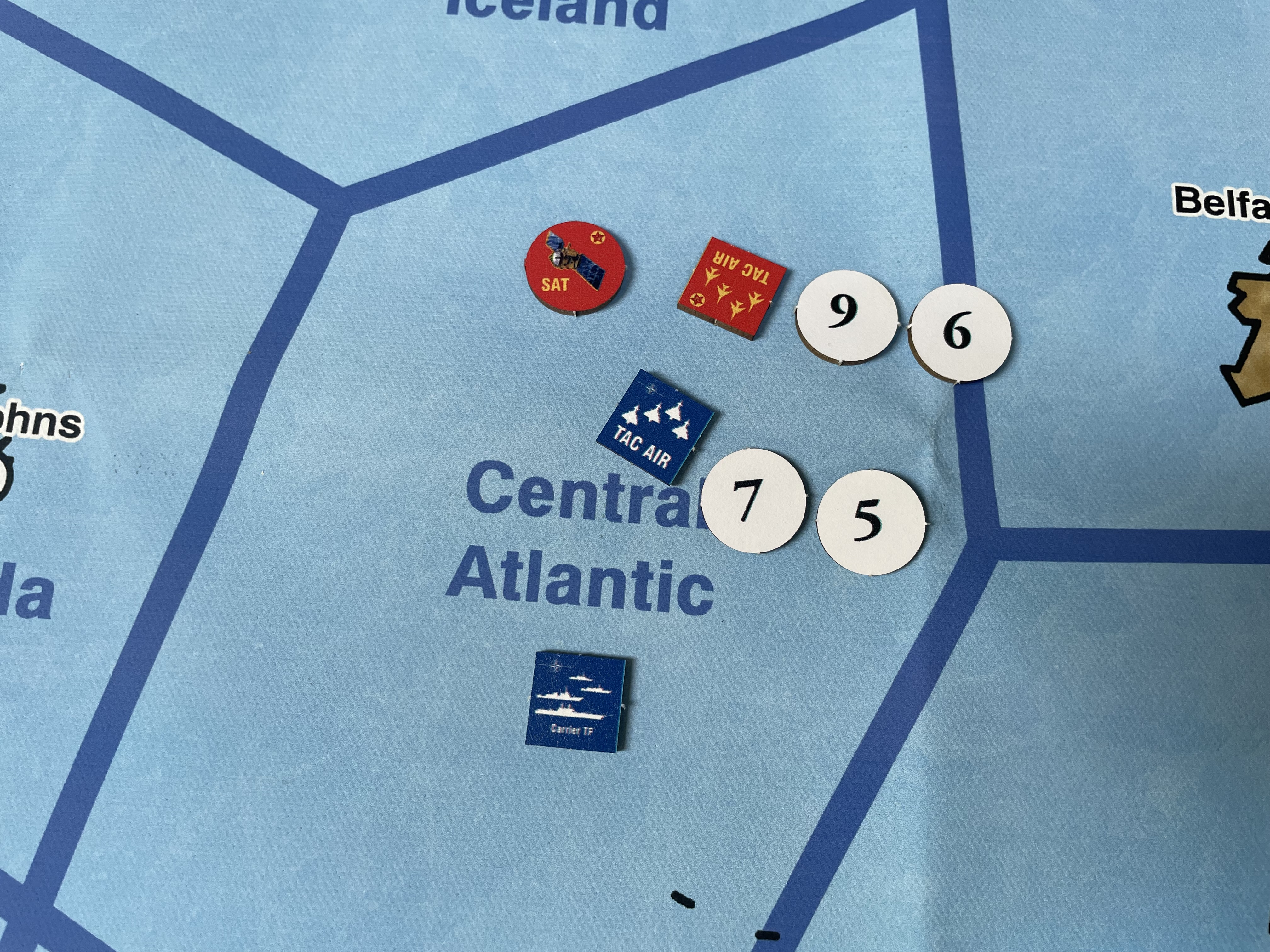
Looking at the combat rules of Close the Atlantic: World War Three again, perhaps I should have “gamed” the system and used the NATO TAC AIR interceptors twice (once at “maximum” range and again at “half-way”). The rules do not say you cannot do so nor do they talk about expenditure of interceptor ordnance. Using the rules as written, perhaps I should have taken both defensive shots using AAMs (150 each time) versus a long-range intercept with 150 AAMs and a second using only 64 SAMs. Using the same die rolls the ASCM strike would have gone from 192 to 92 to 0 (106 theoretically shot down in second engagement) thus saving the NATO Carrier TF. That approach does not technically violate the rules, but certainly breaks what little “realism” Close the Atlantic: World War Three possesses.
Knock it off!
At this point I feel it is not worth your time to discuss the different game phases of Close the Atlantic: World War Three further given the discombobulation of the rules. The rule book needs a careful parsing; to a great degree it will be up to the players to decide how they are going to play the game because the rules are often contradictory or unclear (even gamey) on how to execute certain game mechanisms. As already mentioned there are at least three different “sequences of play” to be found in the 44 pages of the rule book! There might be a good game in the rule book but as presented it is hard to find and will take much player effort to work out.
I get it; writing rule books is hard. Writing rules are a particular challenge because the rules have to communicate not only a story but the mechanical steps needed to execute actions to build that story. Before those action steps can be written the flow of the game model needs to be clearly understood with branches and sequels accounted for and properly connected. This means it needs to be laid out in a logical flow using language based on an understood (or defined) terms of reference.
Clancy 2024?
Then there is the setting which the rules are supposed to communicate. The ad copy for Close the Atlantic: World War Three tells us the game is set in the modern day (or very near future):
“Close The Atlantic” is a 1-4 player naval combat game set during the 21st century. NATO and Russian forces are on the brink of World War III. Will you be able to protect or conquer Europe? The choice is yours…
Close the Atlantic, ad copy
The ad copy theme is what caught my attention and helped me press the purchase button. Now that I have the game in hand, I see that the game is a very abstract, elevated view of conflict. The question I have to ask myself is, “Which conflict?”
To me, the “conflict” promised in Close the Atlantic: World War Three—modern day convoys battling across the Atlantic to reinforce Europe in the wake of a Russian attack on NATO—is what is written in the rule book yet the conflict when played out looks and feels more like the scenario in Tom Clancy’s novel Red Storm Rising. I mean, look at the example I used above. Close the Atlantic: World War Three looks and feels like a “Cold War Gone Hot” wargame. Indeed, beyond the text in the ad copy, there is very little in the design of the game or components that says “today” about the setting of the game. The map admittedly reflects post-Cold War place names but the naval forces are all abstracted; one cannot tell if they are technology of the 1980’s or of the 2020’s. Based on the component art and rules in the rule book, I have no problem imagining Close the Atlantic: World War Three as another entry in the seemingly popular “Cold War Gone Hot” genre of wargames. The designer’s insistence that this is a game of “today” is, frankly, not clearly communicated by the look and feel of the game.
I will be among the first to admit that the shape of future conflict in the Atlantic between a resurgent Russia and the U.S./NATO is a very open question. The question is even harder to answer as one tries to divine any lessons from the War in Ukraine or the future of the Russian Navy in the next few years or even after that conflict ends. That said, in 2019 Magnus Nordenman wrote The New Battle for the Atlantic: Emerging Naval Competition with Russia in the Far North (Naval Institute Press) which made an attempt to explain the nature of the then-modern Russian naval threat.
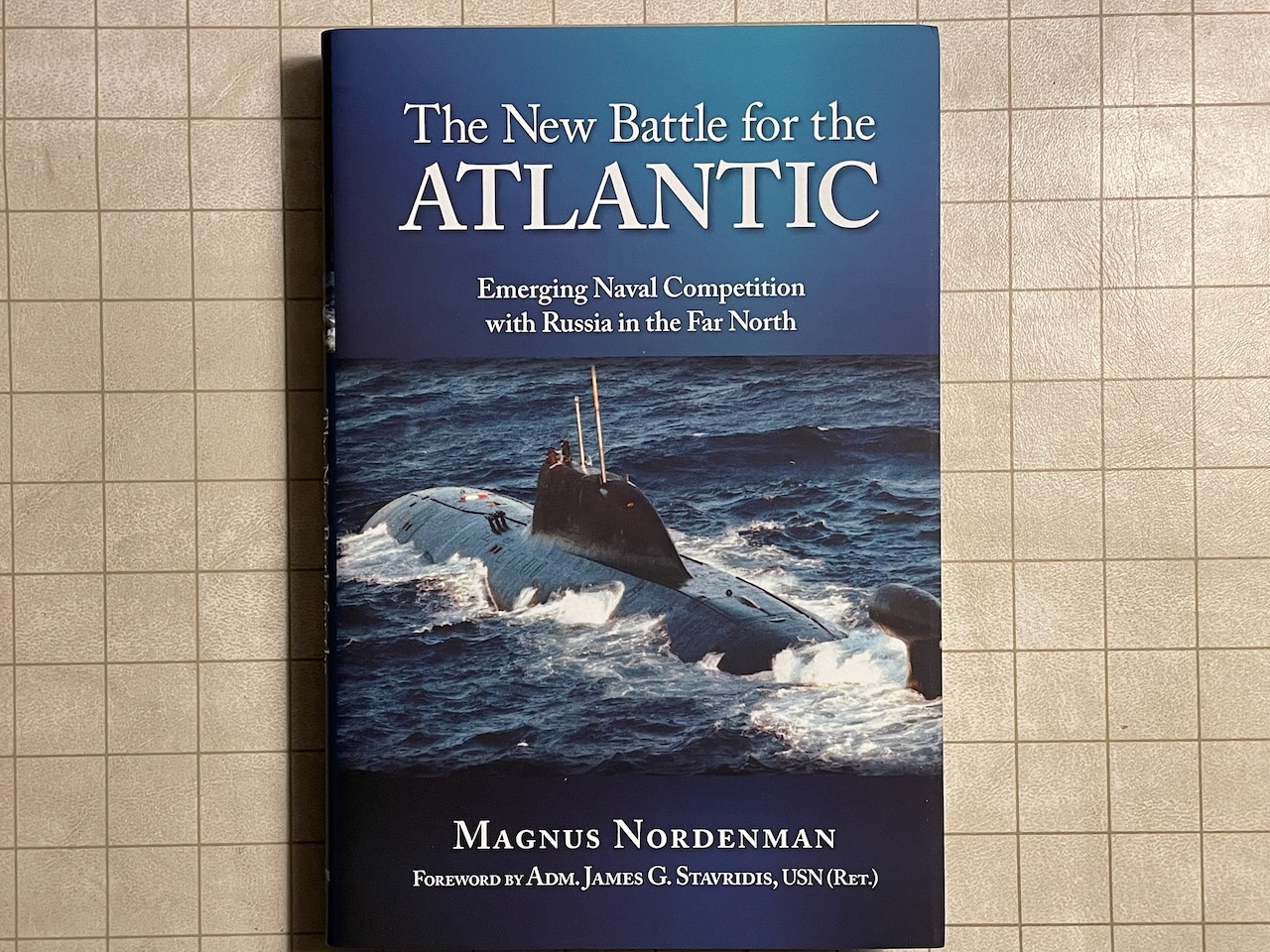
Nordenman believes the Atlantic Ocean remains a vital link between the U.S. and Europe but the form of conflict is not necessarily going to strictly “repeat” what historically occurred in World War I or World War II or was imagined in the 1980’s. NATO, according to Nordenman, is now challenged by a Russian Navy with new strategies dependent on quality rather than quantity of weapons. Russian submarines armed with Kaliber land attack cruise missiles are a particularly worrisome threat vector. In Close the Atlantic: World War Three, however, only “Boomer” submarines—armed with nuclear submarine-launched ballistic missiles (SLBMs)—can fire at ports or FEBA locations; other submarines have no ability to conduct conventional strikes against ports or airfields. [Citation: “Strike Missions are attacks by missile ships and planes against enemy land, air, or sea assets.” (Rule Book, p. 11)]
In mid-2022 Russia released their Maritime Doctrine of the Russian Federation. The doctrine detailed five “Regional Directions in the National Maritime Policy” which stated:
49. The main regional directions of the national maritime policy are the Arctic, Pacific, Atlantic (Azov, Black Sea, and Mediterranean basins), Caspian, Indian Ocean and Antarctica regional areas.
Maritime Doctrine of the Russian Federation, section 49
The Russian focus on the Arctic over the Atlantic was recognized by some as early as 2018:
The NATO Alliance must return to a deterrent posture similar to that of the Cold War in order to prevent potential Russian aggression, but the locus of action is much further north than Iceland. The real “Gap” where NATO must focus its deterrent action is the Greenland, Svalbard, North Cape line at the northern limit of the Norwegian and Greenland Seas. It is again time to consider deterrent action and potential naval warfare in the “High North.”
Steve Wills, “A NEW GAP IN THE HIGH NORTH AND FORWARD DEFENSE AGAINST RUSSIAN NAVAL POWER,” cimsec.org, 17 July 2018, https://cimsec.org/a-new-gap-in-the-high-north-and-forward-defense-against-russian-naval-power/, accessed 9 Nov 2024
In 2021, the U.S. Navy’s Office of Naval Intelligence (ONI) published their foreign capabilities guide on the Russian Navy. Interestingly, ONI ascribed primarily a defensive mission to the Russian Navy which is responsible for Layered Defense of the motherland out to a range of 1,000 kilometers—the range of Tomahawk land attack cruise missiles. The 1,000 kilometer threat rings reach into the Norwegian Sea but not deep into the Atlantic. In Close the Atlantic: World War Three the this area is roughly the upper right quadrant of the map; the rest is beyond the threat rings.
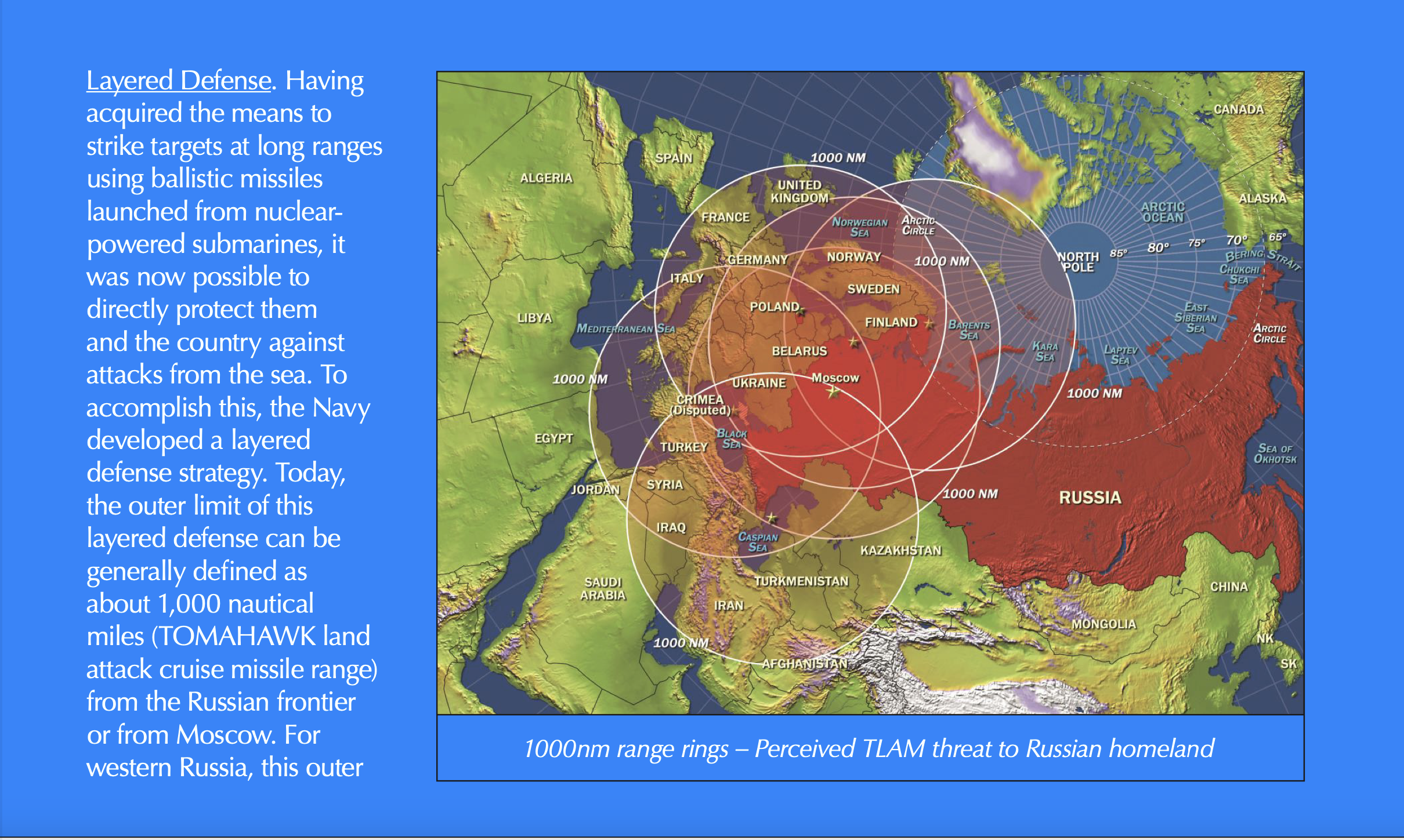
Taking the above viewpoints of future conflict into consideration makes Close the Atlantic: World War Three appear as a missed opportunity. The ad copy hints that the designer has something to say on next Battle of the Atlantic but the game design fails to deliver an explicit message. Perhaps the designer sees the naval wars of tomorrow as the same as the naval wars of not-yesteryear? Perhaps, but their silence provides no explicit, or even nuanced, understanding for me.
Lone sailor
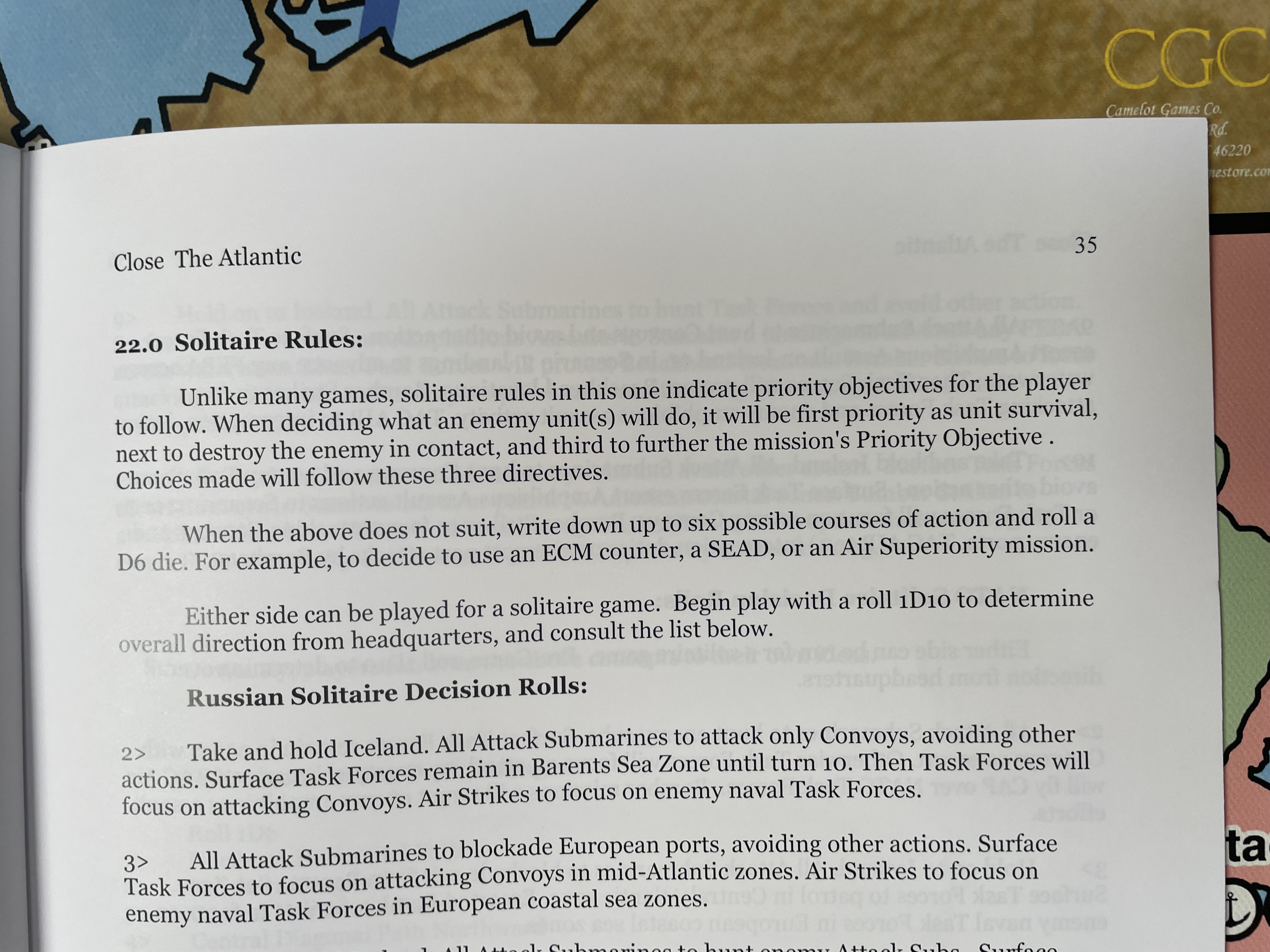
I also should mention that Close the Atlantic: World War Three has solitaire rules. The rules are not so much “rules” as they are “guidelines” for how the non-player side is supposed to be played. In practice one rolls a d10 to get the priority objectives for the game. That is a solitaire game in a sense…but a very loose one at that.
Close on the Atlantic? Not yet…
Close the Atlantic: World War Three is a game with potential. It starts with the theme: modern naval warfare in the Atlantic. The production values of the game are very good, from the canvas-like map to the counters the game is top notch. Where Close the Atlantic: World War Three comes up a short is the rule book. Further, the constant die rolling for random unit sizing and the need to use a calculator at multiple steps in the combat process also makes Close the Atlantic: World War Three feel…lifeless. Even with the use of random die rolls the game still feels very deterministic. As mentioned above, the rules also invite “gamey” solutions.
I have no reason to doubt that there is a good game in the box, it just appears at this point to still be hidden behind rules that need to be more tightly written and are yet to flow together in a logical, clearly explained manner. Maybe I will work on it…in all that other free time I have in my life, eh? Or maybe designer Michael Raymond needs to take another swing at the rule book and work on an update. We will see which happens first.

Feature image by RMN
The opinions and views expressed in this blog are those of the author alone and are presented in a personal capacity. They do not necessarily represent the views of U.S. Navy or any other U.S. government Department, Agency, Office, or employer.
RockyMountainNavy.com © 2007-2024 by Ian B is licensed under CC BY-SA 4.0
 Rocky Mountain Navy Gamer
I left a lengthy comment reply to your review but it seems to have been wafted away in the breeze.
Thank you for your analysis and comments. I will definitely revisit my rule book to attempt to clarify the points that you found issue with.
In creating this game, inspired by Clancy’s ‘Red Storm Rising’, I hoped to provide a non-tech game, free of tables of detail on weapons, sensors, and platforms – a la ‘Harpoon’ game style. I fully expected ‘grognards’ to find it less appealing.
I shall continue to work on improvements, and thank you for your suggestions.
Well, this grognard definitely does not find your game unappealing! Quite the contrary, I WANT this game to work because I WANT to (occasionally) play a less complex wargame.
I sense there is a good game within, it just needs some clarity in the rule book.
By all means, PLEASE do not give up. I may have come across a bit harsh, likely because I can feel the game is right there just a hair out of reach.
By no means am I going to give up. A rules revision is being done. I thank you for your interest and comments. However, let me clear up a part of your review that does need addressing.
The engagement, according to the image shown, takes place in the Central Atlantic sea zone. The reviewer states: In previous turns Russia cleared the North Atlantic of NATO ships and aircraft so the TAC AIR can proceed to the Sea Zone with the NATO Carrier TF unmolested.
Two points; it would be impossible for all NATO units to be cleared,and NATO also has land-based air forces. The Russians must have flown from somewhere, passing over NATO naval units or NATO held land, such as Britain, Norway, France, and so on. Such fly-overs would result in detection attempts and possible interceptions or SAM fire.
In addition, the example states that these TAC AIR units carry cruise missiles.
On page 23, the rules state: Strike TAC AIR missions carry 2 AAM weapons and 2 SSM missiles. Thus, the inbound Russian strike is with 192 SSM missiles. This is a mute point given the results, but worth noting.
I will return to address some of your valid issues in further comments.
Thank you again.
Michael Raymond, designer
I admit there are discrepancies and omissions in the rules, which will be corrected in a revision, under way. However, I’d like to address some points in the battle example written by the reviewer.
The engagement, according to the image shown, takes place in the Central Atlantic sea zone. The reviewer states: In previous turns Russia cleared the North Atlantic of NATO ships and aircraft so the TAC AIR can proceed to the Sea Zone with the NATO Carrier TF unmolested.
Two points; it would be impossible for all NATO units to be cleared,and NATO also has land-based air forces. The Russians must have flown from somewhere, passing over NATO naval units or NATO held land, such as Britain, Norway, France, and so on. Such fly-overs would result in detection attempts and possible interceptions or SAM fire.
In addition, the example states that these TAC AIR units carry cruise missiles.
On page 23, the rules state: Strike TAC AIR missions carry 2 AAM weapons and 2 SSM missiles. Thus, the inbound Russian strike is with 192 SSM missiles. This is a mute point given the results, but worth noting.
Thank you, Michael! Your point is valid; I should have made it clearer that this was an example of play done mostly with the intention of demonstrating the battle sequence. It certainly would take place within the larger situation.