
My father never met a Louis L’Amour book he did not read. If you do not recognize the name, Louis L’Amour was an American novelist and short-story writer best known for his Western novels and frontier stories. Born in 1908 and passing in 1988, he published his first full-length novel, Hondo, in the United States in 1953 where it sold more than 1.5 million copies and ultimately was turned into a film starring none other than John Wayne.
L’Amour grew up reading many historical boys’ novels that taught him about war and politics. His drew upon his extensive knowledge about the American frontier, his family’s frontier heritage, and personal experiences to write over 100 novels and stories throughout his lifetime that sold over 300 million copies making him one of the bestselling American authors ever. Beyond the books, more than forty-five of his stories were made into films and movies.
One day I was speeding along at the typewriter, and my daughter – who was a child at the time – asked me, “Daddy, why are you writing so fast?” And I replied, “Because I want to see how the story turns out!”
. . . Louis L’Amour
Space westerns
Although there were always L’Amour books in my house growing up, I read fewer than one might imagine. That is almost certainly because when I started my serious reading years a simple movie, called Star Wars, had released. My reading focused on space cowboys instead of the cowboys of the Old West. That said, I did read a few L’Amour books mostly from the Sacketts Series.
Little did I realize it at the time, but Louis L’Amour westerns formed a foundation for much of my preferred “space western” style of roleplaying games. A 2021 blog shared this checklist of distinct characteristics that make up a space western:
- A strong lead character, often physically adept and righteous. Much like a white-hat cowboy.
- An animal sidekick. In many Westerns, this is the hero’s horse, but it can manifest as other things. R2-D2, for example, might be Luke’s horse equivalent. Or Ein, the Welsh corgi from the space Western anime, Cowboy Bebop.
- Western literature has popularized the outlaw character, the rogue. Picture characters like Han Solo.
- Wide, aesthetic shots. In space Western films and shows, wide landscape shots or panning scenes hark back to classic Western cinematography like in A Fistful of Dollars.
Looking back over my roleplaying game collection, I can definitely see a space western trend. The original Traveller RPG (GDW, 1977) was settingless and I always tended towards telling space western stories using those rules. Traveller 2300 (GDW, 1986) or 2300AD (GDW, 1988) draws heavily on space western tropes. The Serenity Role Playing Game (Margaret Weis, 2005) and the Firefly Role-Playing Game (Margaret Weis, 2014) are perhaps the quintessential space western RPGs. Edge of the Empire (FFG, 2013) is my preferred FFG Star Wars Roleplaying Game which like The Expanse Roleplaying Game (Green Ronin, 2019) and even ALIEN: The Roleplaying Game (Free League, 2019) lean heavily into tropes from the Old West. More recently, the Cowboy Bebop Roleplaying Game (Mana Project Studio, 2019) draws deeply from the western genre.
Riding out of the sun
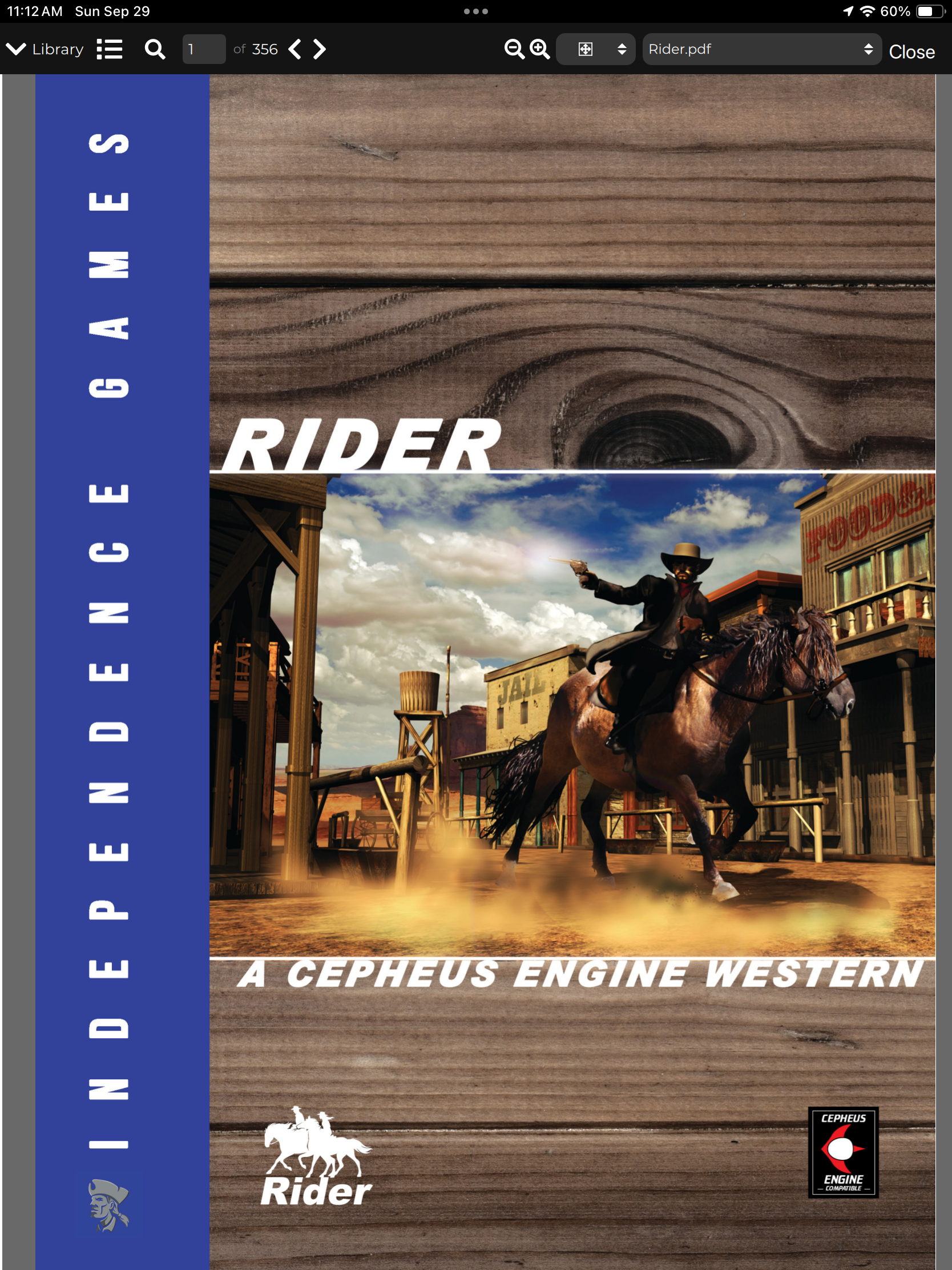
Though I have played roleplaying games for 45 years, one genre of RPG I never owned was a game set in the Old West. That has now changed with my acquisition of Rider: A Cepheus Engine Western Roleplaying Game written by John Watts from Independence Games and published in 2021. Rider is a complete, standalone game product that includes the core rules, character generation, and setting in one 356 page product.
John Watts offers eight common themes around which a Rider campaign can be built. Players of Traveller (at least those who go beyond the space opera Third Imperium setting) should instantly recognize these and find comfort in play.

Rider uses the Cepheus Engine system reference document as the basis of the game mechanisms but adjusts for the Old West setting. The most noticeable change is in characteristics where Social Status is replaced with Charisma. Another characteristic, Reputation, is also added (though Independence Games seems to have forgotten to add it to the character sheet).
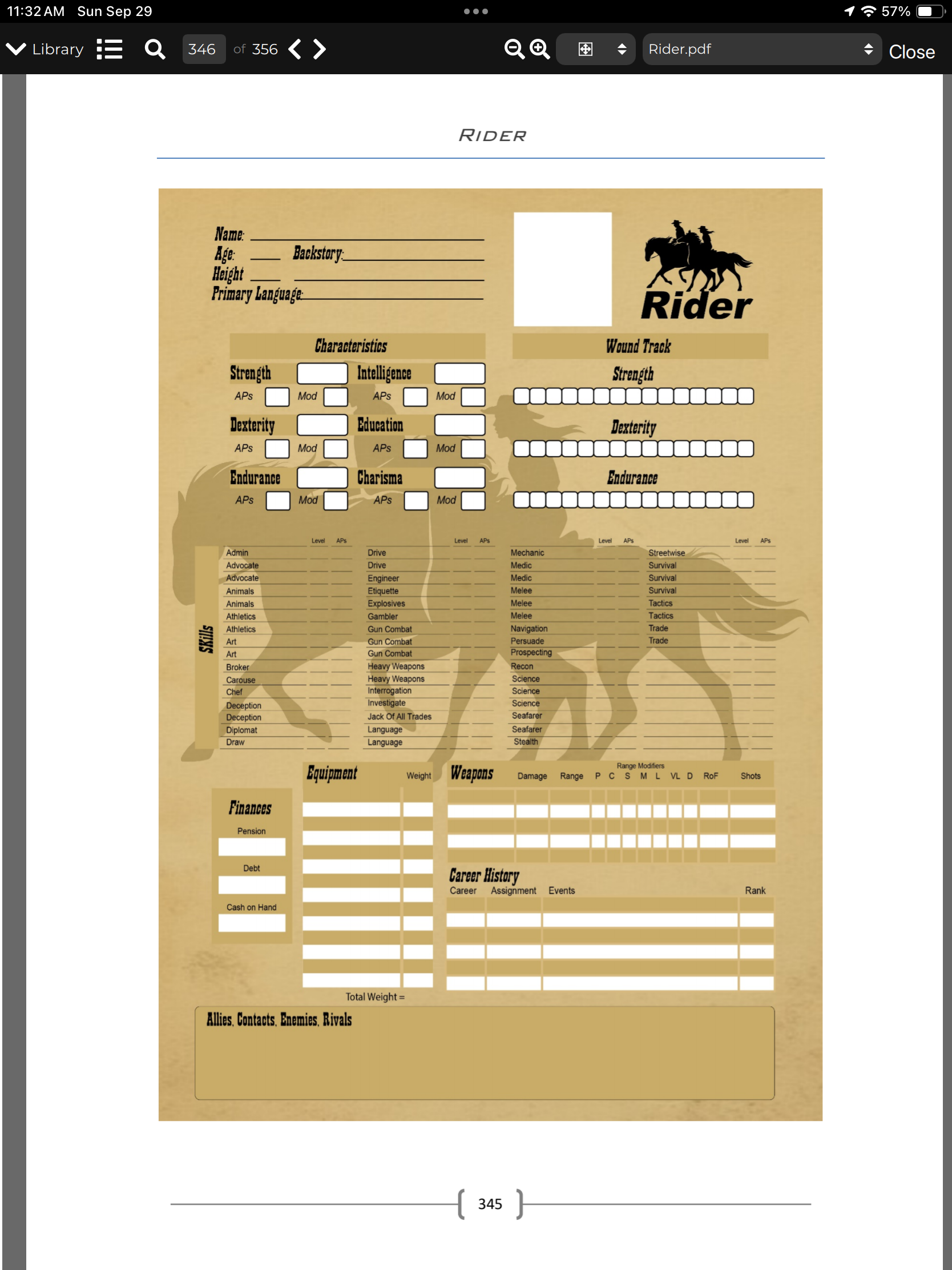
Character generation in Rider starts with a backstory, the chance of college, and then onto a career. John Watts draws upon many tropes taken from the western genre of stories in the backstories and careers that a few more “sensitive” players might take some exception to but, overall, the treatment of sensitive issues is respectful and balanced.
Gambling was a popular pastime in the Old West and Rider has special rules for several different card games. Watts writes that, “One way to play out these games is to actually play the game itself and allow the results to work themselves out through the course of playing a game of cards” (Rider, p. 209). That method does not, however, account for player character skills. So rules for Faro, Poker, Five Card Draw, Five Card Stud, and Straight Poker are provided. There are even rules for cheating!
In addition to the usual combat rules, in Rider there are detailed examples of personal combat (shootouts). Yes, using the rules for Rider one need not play out that shootout in a quick round of combat but can make a full story out of it like the final duel—all seven minutes of screen time—in Once Upon A Time in the West.
Rider also has rules for chases that can be as exciting as the movies.
Comfortable saddle
While Rider may be an Old Western, the use of the Cepheus Engine makes the game more like a familiar, old friend to me. For players who have not played an Old Western RPG setting before, the relatively rule-lite approach used by Cepheus Engine make learning the system easy. The setting of Rider, though drawing on tropes of the past, does so with respect and acknowledgement of some of the more troublesome elements of the genre. When playing Rider one is nonetheless assured that the focus will be on adventure and rollicking good stories.
Feature image courtesy WordPress Generate with AI.
The opinions and views expressed in this blog are those of the author alone and are presented in a personal capacity. They do not necessarily represent the views of U.S. Navy or any other U.S. government Department, Agency, Office, or employer.
RockyMountainNavy.com © 2007-2024 by Ian B is licensed under CC BY-SA 4.0 
 Rocky Mountain Navy Gamer