
September 13, 1999. Breakaway Day. The day the Moon was blasted out of Earth’s orbit by a massive explosion of nuclear waste dumps on the Far Side of the Moon. How much life on Earth changed that day. Do you ever wonder what happened to the 311 inhabitants of Moonbase Alpha?

If you have no idea what I am talking about then you obviously are not a fan of the 1970’s television series Space: 1999. If you know of what I speak they you are likely happy to hear that Modiphius Entertainment, in collaboration with Anderson Entertainment, is releasing Space: 1999 – The Roleplaying Game. This roleplaying game (RPG) is scheduled for release in early 2025 but you can pre-order now and get a digital pdf version of the Breakaway Quickstart Guide to start your adventuring.
Personally, I am very happy to see a Space: 1999 RPG released. If you search the archives of this blog you will find a few mentions where I was looking for such a product. I even talked about starting my own project and searching for the right game engine to power my adventuring.
All that said, I am of mixed opinions on a 2d20-powered Space: 1999 RPG. From a setting or source material perspective, the collaboration between Modiphius and Anderson Entertainment all-but-assures the universe of Space: 1999 will be “fully” available to RPG developers. I have to wonder, however, what sort of adventuring the Space: 1999 RPG will create. Space: 1999 is…complicated when it comes to the stories it told in the two seasons it was on television. The first season was in many ways dark and raised serious questions about what it means to be human. The second season, with a new showrunner, took a lighter tone and became more of an episodic adventure-of-the-week where action dominated.
With the celebration of the 50th Anniversary of Space: 1999 premiering on television I also wonder what sort of legacy the fans of Space: 1999 expect in an RPG. Fans that have been part of the fandom since the beginning are, well, of a certain age that is perhaps not the demographic that will drive sales for Modiphius. When looking at the fandom surrounding Space: 1999, perhaps the most well recognized and vocal members are those that are fans of the beloved Eagle Transporter. These fans seem to have little problem dropping over $500 USD for a special limited edition 36″ Eagle replica based on a Mattel toy of the late 1970s. Will a tabletop roleplaying game draw that same, uh, investment?
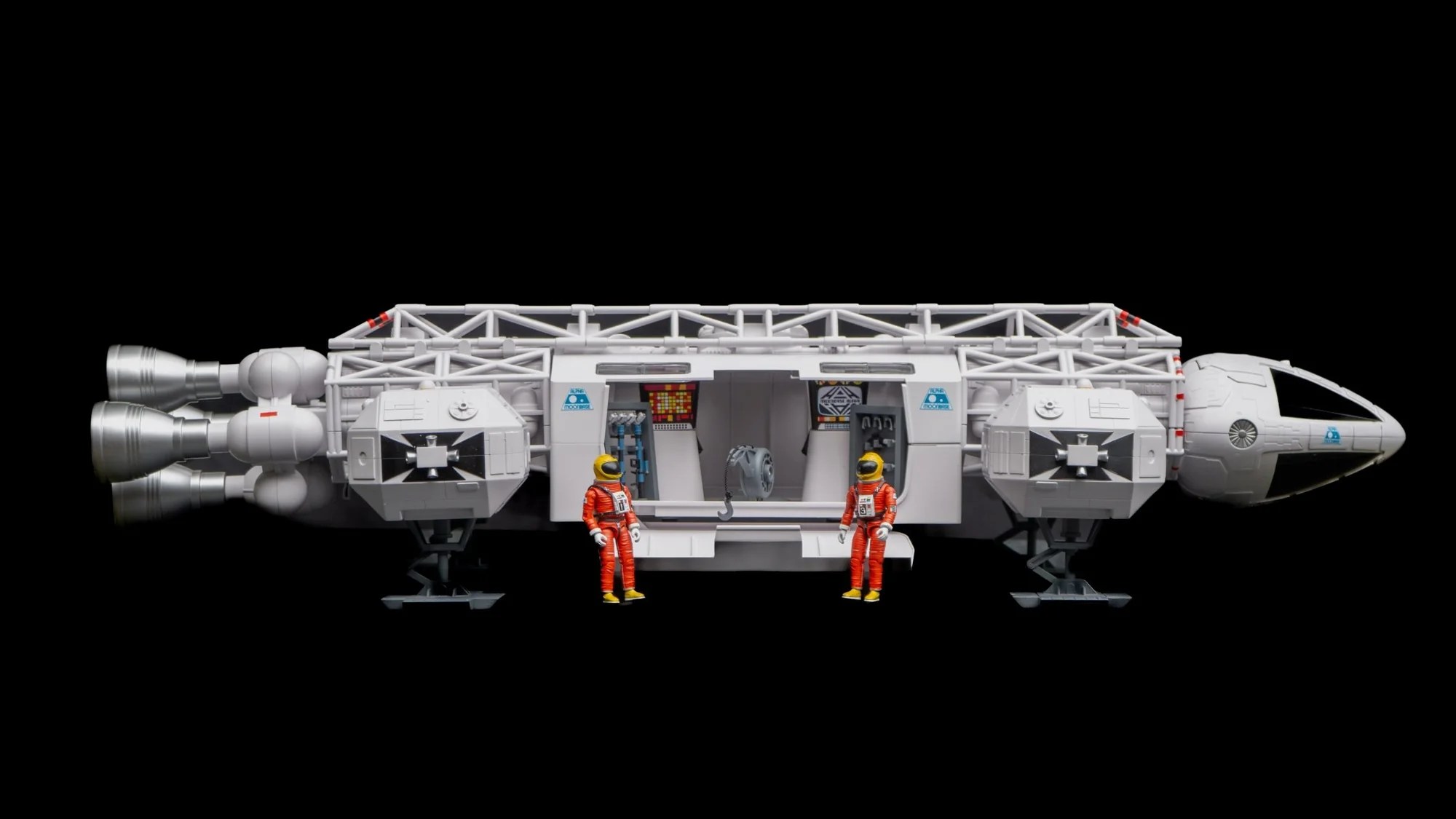
All of this makes me wonder what kind of adventuring the Space: 1999 – The Roleplaying Game can deliver. With only a few blog entries on gerryanderson.com, press material for the pre-orders, and the Breakaway Quickstart Guide available, I dug in to see what I could discern.
Sci-fi darkly
It is hard for many science fiction fans alive today to imagine but the late 1960’s and early 1970s was not a great time for science fiction on television. I remember only a few series myself. Between 1966 and 1969 there was the original Star Trek television series which I later watched in syndication. Given my young age, the episodes I liked were the ones where adventure dominated, though later in life I came to respect the deeper storylines some other episodes provided (and like many, often ignore Season 3 where the show—to use a modern term—jumped the shark in several ways).
From 1970-1971 there was Gerry Anderson’s UFO, another show I watched in syndication. I of course was in love with the fantastic technology. Again, it is only later in life that noticed the rich character development done (albeit in a somewhat uneven manner).
In 1975, however, a new television series premiered that I was able to see from the beginning. I love—and still love—Season 1 of Space: 1999. The episode “Dragons Domain” was so scary yet cerebral that it is still a favorite TV moment all these years later, cheesy special effects be damned.
The first season of Space: 1999 featured several stories that drew upon horror themes or existential dangers to Moonbase Alpha. The first season was, despite the increasingly colorful sets and costumes, a bit dark in (story) tone. Looking back, I think my young self enjoyed these more “grown-up” themes that made watching the show seem like I was secretly getting away with something from my parents. The second season brought in a new showrunner and the tone changed into something more like a “monster of the week” adventure. Note too that the late 1970’s was in the days before science fiction television shows had any real story arc (we would have to wait until Babylon 5 in 1993 for that).
Interestingly, Space: 1999 was cancelled a mere month before science fiction in movies changed forever with the premier of Star Wars in May 1977. Much like television, science fiction on the big screen was very much unlike today. The classic 2001: A Space Odyssey released in 1968 and was very cerebral; the slow pace of the film was far from the flashy action that Star Wars brought.
Silent Running in 1972 was also not an action-adventure film though it did at least feature space ships and robots. I have to wonder how many environmentalist of today were inspired by this movie.
Logan’s Run in 1976 did not take place in space but leaned heavily into a post-apocalyptic storyline that questioned much of where society was heading.
With the pending release of Space: 1999 – The Roleplaying Game from Modiphius Entertainment I wonder what sort of roleplaying game (RPG) it will be, especially given that the fifty years since the TV show premiered science fiction on the small screen and cinema changed so dramatically.
Action, mystery, horror, investigation, surreal, oh my
Modiphius Entertainment and Anderson Entertainment (the holders of Gerry Anderson intellectual property or IP) apparently are not limiting the tone of Space: 1999 – The Roleplaying Game. As posted in “Space: 1999 RPG Datafile #3: How to Make Your Game Feel Like an Episode” the “Episodes of Space: 1999 are extremely varied. They might be action tales, mysteries, horror episodes, investigative stories or even surreal experiences.”
Some insight into how one might play is available through the Breakaway Quickstart Guide, a 51-page product delivered to you with a pre-order of the core rulebook. When I look at an RPG, especially one based on a known IP, I look at two major parts of the rules; characters and the game engine. Both characters and the game engine need, for me, to be reflective of the setting and appropriate to building drama and narrative through play.
Moonset(ting)
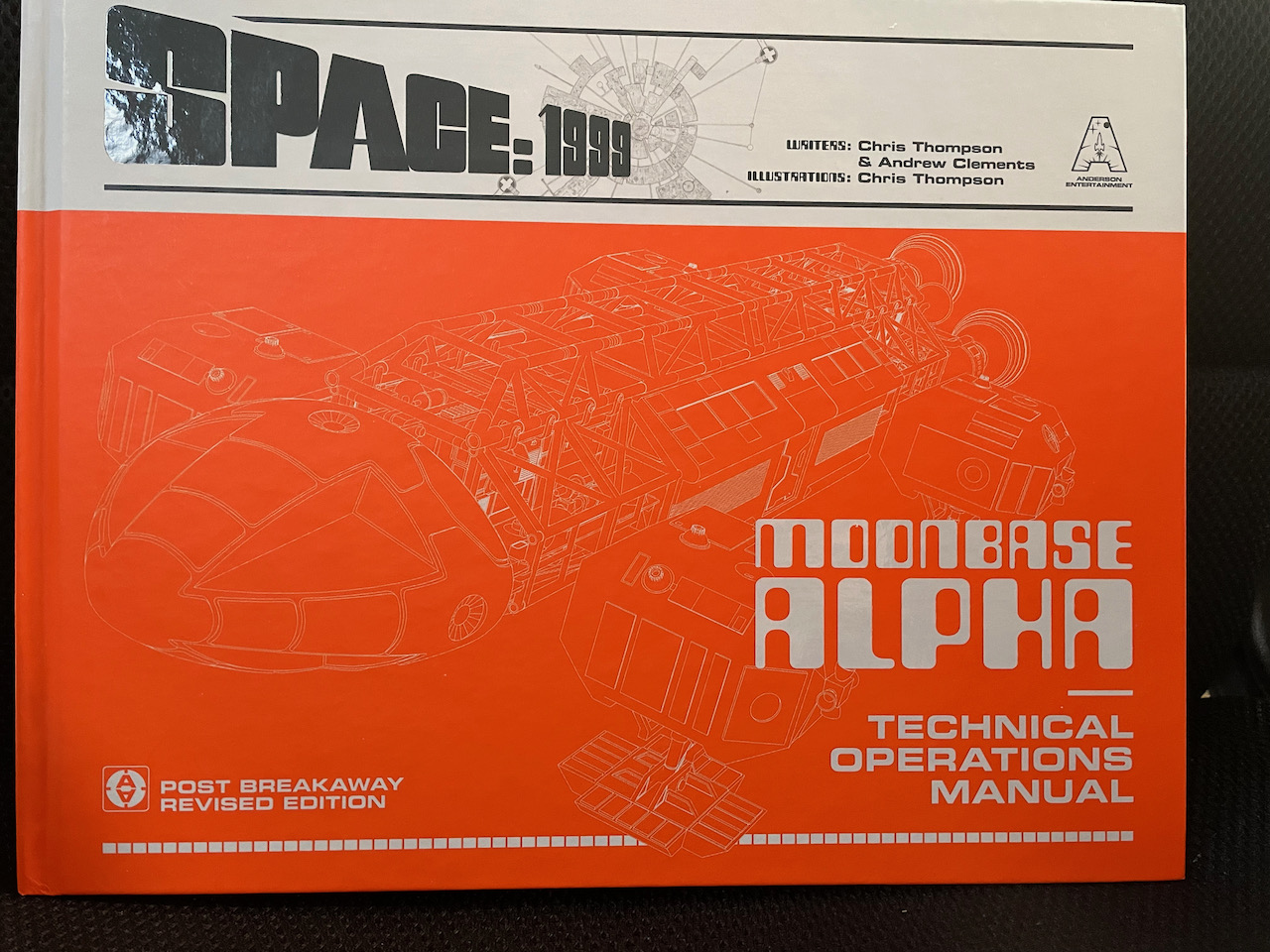
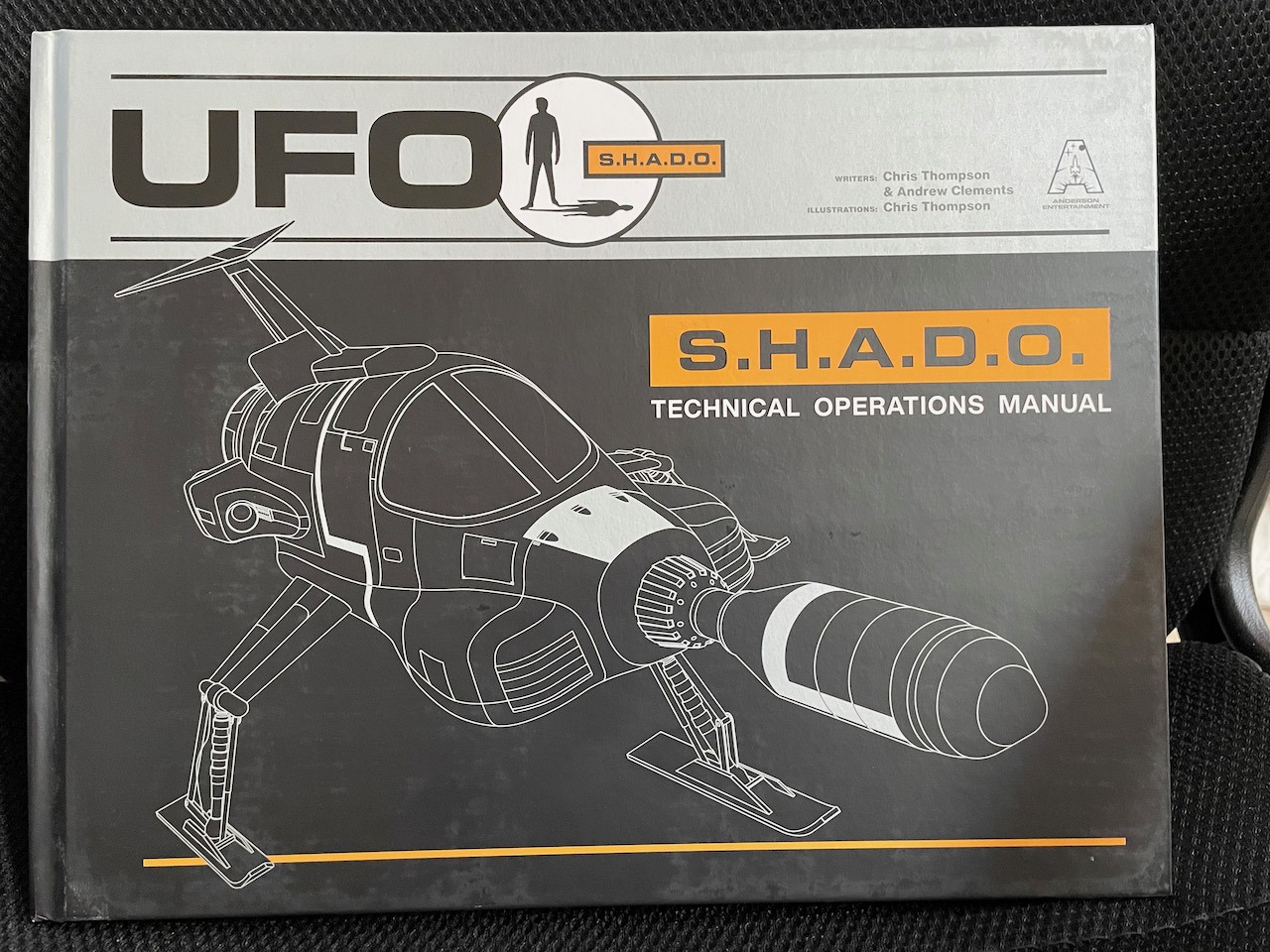
My hopes for the Space: 1999 – The Roleplaying Game are buoyed when I see that Modiphius Entertainment apparently has a very tight working relationship with Anderson Entertainment in regards to the source material for Space: 1999. I welcome this relationship but also wonder just how far the Modiphius license extends. In particular, I make no secret of the fact I consider UFO and S.H.A.D.O. to be part of the Space: 1999 universe. Further, I also fully accept the Archaia comics Space: 1999 – Aftershock and Awe as canon. Given the material in the Space: 1999 – Moonbase Alpha Technical Operations Manual, which has call-outs to UFO in it, I think the RPG will very likely reflect the connections in some manner.

Skilled attitudes in 2d20
This is how Modiphius Entertainment in the Space: 1999 Breakaway Quickstart Guide explains the 2d20 system:
As you might expect in the 2d20 system, when you attempt an action you roll 2d20 to see if you succeed. So the first thing to do is pick up two d20s and calculate the target number needed. The target number is the sum of the skill that most suits the task and the attitude that most suits the nature of the task. Usually, the Gamemaster decides the skill and the player decides the attitude. But certain situations may predefine the most appropriate attitude.
Each d20 that rolls equal to or less than the target number is considered a success. If you roll a 1, that die counts as two successes (a critical success). If you roll a 20, that die gives you a complication.
Before you roll, the Gamemaster decides the task’s Difficulty (a value ranging from 0–5, but usually at least 1) which is how many successes you need to get to succeed. If you get more successes than you need, you gain Momentum points, one for each success beyond what was required to equal the Difficulty.
If you need help on a test you can spend Momentum points to gain more dice. However, the Gamemaster can spend Threat to aid non-player characters and make the player characters’ actions harder (see later).
Space: 1999 Breakaway Quickstart Guide, p. 10
Let’s break that down a bit further. Character have Attitudes (rated 4 to 8) and Skills (also rated 4 to 8) which means the target number will usually range from 8 to 16. Character skills may have a Focus, which means any roll made using that skill+focus combination scores a Critical Success (2 successes) on any roll under their Skill level. Traits, Complications, or Assets can increase or decrease the Difficulty Number which itself ranges from 0 “Simple” to 5 “Epic.” A character might also have a Talent that can be brought into play. The Difficulty Number is the number of successes needed.
Using an example from the Breakaway Quickstart Guide, “As the mission begins Akiko (Pilot) should make an Average (D1) Bravery + Flight test to position the survey Eagle in the best place.” Akiko has Bravery 5 and Flight 7 for a target number of 12. Rolling 2d20 the results are [18] and [1]; the [18] is a failure but the [1] is a Critical Success (2 successes) meaning Akiko not only passes the test but adds 1 Momentum to the Momentum pool.
Momentum and Threat are the metacurrency of the 2d20 game engine powering the Space: 1999 RPG. Players earn and spend Momentum while the Gamemaster uses Threat. A common use of Momentum and Threat is to buy extra d20s for a test. This is obviously important given more challenging tests will require more successes than 2d20 can deliver meaning one must be very luck (roll [1]’s for Critical Successes) or use the right skill for the Focus bonus or have lots of Traits, Assets, or Talent to bring to bear.
The 2d20 game engine, as shown in the Breakaway Quickstart Guide, appears to be geared more towards an action-adventure style of play. This is somewhat in keeping with the design intent behind the 2d20 game engine. As the 2d20 SRD tells:
This system is meant for creating and playing games that emulate and celebrate action-packed, story-driven fiction. It thrives when paired with a setting or theme where competent, determined, often larger-than-life protagonists face tense and perilous situations, and where collaboration and teamwork are vital to success.
It aims to pair the action of the story with a degree of mechanical impact, so that what happens in the narration has direct consequences in the game, and vice versa, and relies on players and Gamemaster alike being active participants in both the fiction and the gameplay.
As I explore look at the 2d20 game engine and Space: 1999, I am growing increasingly concerned that the game may be better suited for a lighter Season 2 tone of adventuring rather as compared to the more dark Season 1. Then again, perhaps I am jumping to a conclusion too early and need to see if a 2d20-powered Space: 1999 adventure can be its own “Season 3” which finds the balance between the previous two.
Do it yourself Alphans
There are no character generation rules in the Breakaway Quickstart Guide—pre-generated characters are provided—so it is unclear to me at the moment if the RPG uses a life-path or point-buy approach to character generation. When it comes to characters, I am personally fond of RPGs that place generally ordinary people in extraordinary circumstances and let them hero their way out of the situation…or not.
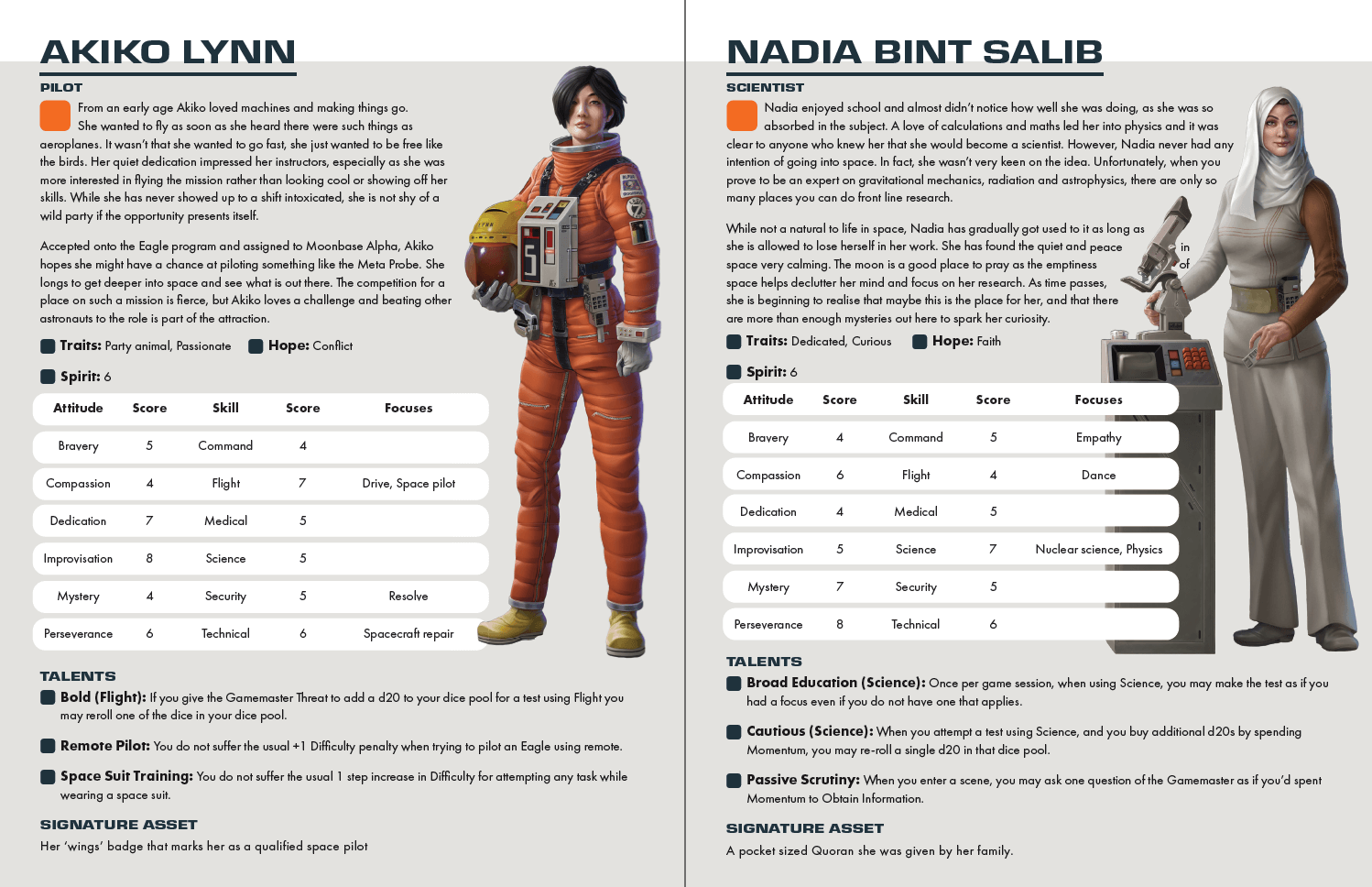
When comparing the Attitudes and Skills of characters in the Breakaway Quickstart Guide with the character generation rules in the 2d20 System Reference Document, it is clear that Modiphius is using a variant of the 2d20 game engine that likely better supports narrative game play.
Breakaway Quickstart Guide vs. 2d20 SRD
Breakaway QS Guide
✓ Skills
Command (Charm), Flight (Athletics), Medicine (Cool), Science (Education), Security (Strength / Perception), and Technical (Practical Intelligence / Dexterity).
✓ Attitudes
Bravery, Compassion, Dedication, Improvisation, Mystery, and Perseverance.
2d20 SRD
✓ Attributes
Agility, Brawn, Coordination, Insight, Reason, and Will.
✓ Skills
Fight, Know, Move, Operate, Survive, and Talk.
Characters in the Breakaway Quickstart Guide also have Traits, Hope, and Spirit. Spirit is described thusly:
Spirit is a measure of a character’s willpower as well as their physical and mental reserves. It is what lets them get up when they are defeated and hurt. One point of Spirit can be used to allow a character to resist a defeat when in combat (see later). While rest can restore spirit, the player characters in this adventure won’t have much opportunity to do that so their spirt will have to last them the whole adventure! A character with no spirit left must immediately rest for at least an hour to regain a point, and cannot do anything until they do.
Breakaway Quickstart Guide, p. 20
Hope goes hand-in-hand with Determination which does not appear on the character sheet. The Quickstart Guide relates:
Each character also has a Hope which is a personal drive for what they find fulfilling. Hope is used to play out short scenes to advance the character’s needs and desires. Each character can usually play out a ‘hope scene’ once per game session. The scene should involve a single test as part of the narrative, usually Difficulty 1. If the test in the scene is a success then the character feels they have advanced or experienced their hope satisfactorily and they regain 2 Spirit. While other characters can be involved in a hope scene only the character of the player who called for the scene can gain Spirit from it.
Breakaway Quickstart Guide, p. 20
“Traits,” the Quickstart Guide notes, “are things about your character themself, such as their appearance (‘neat’) or personality (‘charming’)” (Breakaway Quickstart Guide, p. 13). Taken as a whole, Traits, Hope, and Spirit support a more narrative-style of roleplaying over a straight-up action-oriented game. All of this leads me to believe the Breakaway Quickstart Guide, and the Space: 1999 RPG in turn, seemingly favors a more narrative style of play.
Eyeing Eagles
In many successful science fiction stories, spacecraft are just as much a character as any actor. Look no further than the USS Enterprise in Star Trek or the Millenium Falcon in Star Wars or Serenity in Firefly. In Space: 1999 the iconic spacecraft is the Eagle Transporter. The fandom absolutely loves the Eagle; see the many model kits or the limited edition monster replica mentioned above for how much they view the Eagle as the physical embodiment of Space: 1999. The Breakaway Quickstart Guide makes mention of the Eagle (spoiler alert – it has a prominent role in the quickstart adventure) but treats the ship as really nothing more than a background prop. Now, I am not advocating a full set of shipbuilder construction rules ala Traveller or Cepheus Engine but the fans will expect (demand?) their Eagles. How Modiphius intends to treat the beloved icon may be a factor that makes—or breaks—Space: 1999 – The Roleplaying Game.
Tone deaf
Based solely on the Breakaway Quickstart Guide I can see how gerryanderson.com equivocates on the tone of the RPG. Admittedly, the Breakaway Quickstart Guide is only a snippet of the full rules; it remains to be seen what other tools Modiphius gives players or Gamemasters to set the tone of adventure in Space: 1999 – The Roleplaying Game. The fact the rules in the Quickstart Guide seemingly favor a more narrative style of play inspires some hope in me that the game will support more Season 1 style of stories over Season 2 adventures. From the fandom’s perspective, I too am interested in seeing how the Space: 1999 RPG uses spacecraft and characters to build a story.
For More Information

TABLETOP ROLEPLAYING GAME- Sign Up to the Brand New Space: 1999 Roleplaying Game!
- Space: 1999 RPG Datafile #1: What is an RPG?
- Space: 1999 RPG Datafile #2: Where to Start
- Space: 1999 RPG Datafile #3: How to Make Your Game Feel Like an Episode
- Pre-order from Modiphius US
- Pre-order form Gerry Anderson UK (with or without orange dice set)
Feature image courtesy via blackgate.com
The opinions and views expressed in this blog are those of the author alone and are presented in a personal capacity. They do not necessarily represent the views of U.S. Navy or any other U.S. government Department, Agency, Office, or employer.
RockyMountainNavy.com © 2007-2024 by Ian B is licensed under CC BY-SA 4.0 
 Rocky Mountain Navy Gamer
1 thought on “TTRPG Roll 24-36 ~ 2d20 breakout for Space: 1999 – The Roleplaying Game, Breakaway Quickstart Guide (Modiphius Entertainment, 2024)”