
BLUF: The latest release in the Five Parsecs From Home (5PFH) line of solo adventure wargaming, Five Parsecs From Home: Tactics, moves the product line closer to becoming a full-fledge set of miniatures rules for playing future skirmish battles solo while also laying the foundation for development into a complete roleplaying game (RPG) system.
The ad copy for the new Five Parsecs From Home: Tactics – Solo and Co-Op Adventure Wargaming (Modiphius Entertainment, 2024, digital with hardcover forthcoming) promises big battling things:
SCALE UP YOUR CAMPAIGN!
Unleash bigger battles, wider conflicts, and new stories, spanning solo, head-to-head, and campaign play in this completely stand-alone scenario-driven variation of the popular Five Parsecs from Home tabletop game.
Tactics takes adventure wargaming from starports and back alleys to the battlefields of Unified Space. This scenario-focused version of Five Parsecs from Home is all about creativity:
The 212-page, full colour, Royal-size (15.6cm x 23.4cm) hardcover features:
- Play solo or with friends, in single games or campaigns, with or without a Game Master.
- Make your own scenarios for the troops you choose, playing games your way.
- Tactics allows you to take Five Parsecs beyond small skirmishes to multi-unit battles: Big tanks, big monsters, big events, and platoons of troops slugging it out.
- Features an array of troops, characters, creatures, and situations.
- Packed with random tables to keep you facing the unexpected.
- Tactics is also a stand-alone game, yet fully compatible with 5PFH, with rules for transferring characters and events between the systems.

Going big
Speaking for myself, the primary selling point of the Tactics module for 5PFH is the promise of taking battles in the core rule book from small unit skirmishes up in scale to those involving larger, multi-unit battles. I admit that upon opening my paid digital download copy the first interior artwork I saw discomforted me.
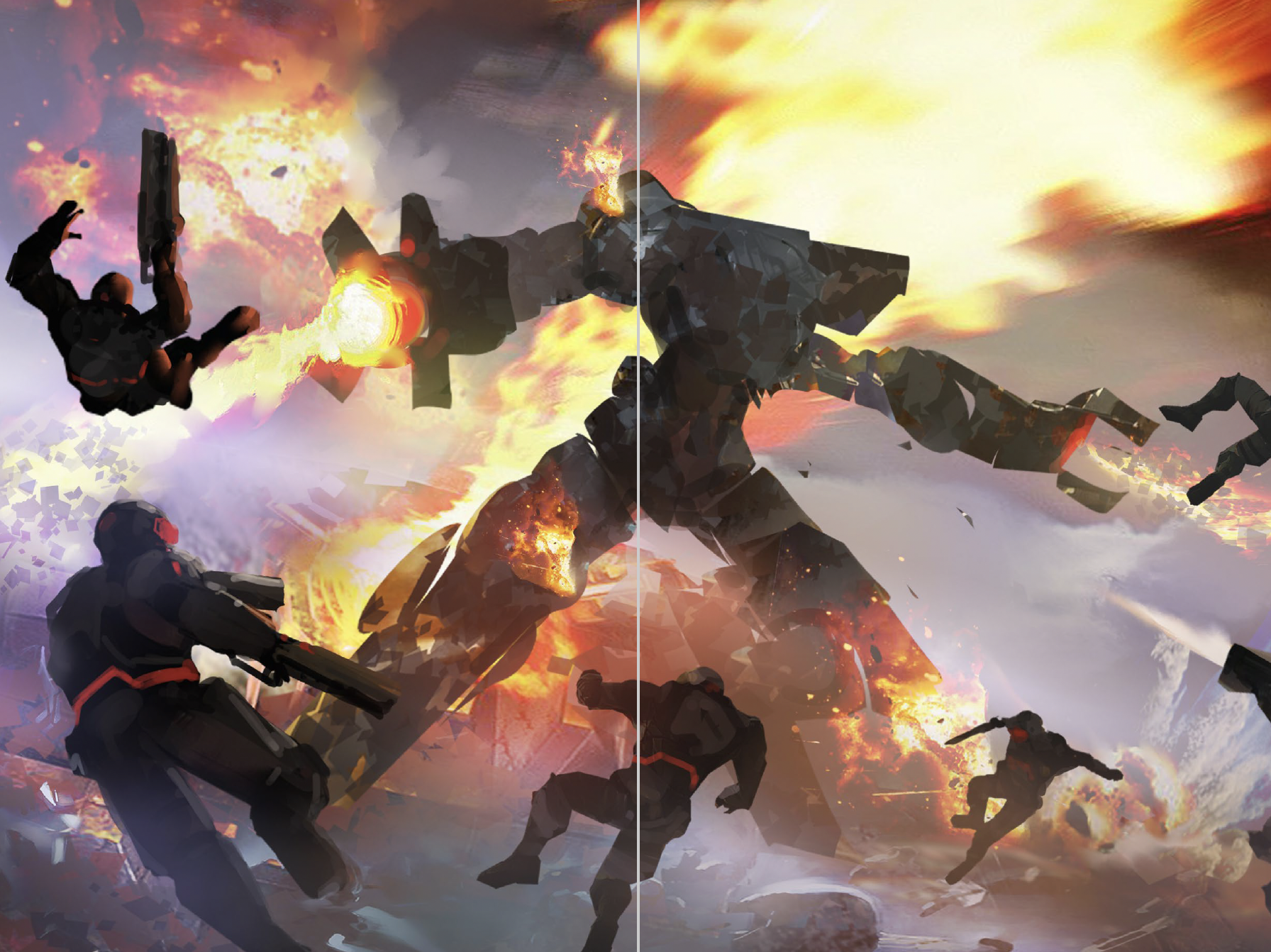
When I read in the ad copy “Big tanks, big monsters, big events, and platoons of troops” I did not imagine big Mecha. Thankfully, 5PFH: Tactics is not another wannabe Mecha battle game. Instead, Tactics delivers an expanded, yet compatible, set of combat and solo campaign rules that allow one to take the small-unit skirmish battles of Five Parsecs From Home and build them into larger battles in both size and equipment.
Tactics is perhaps best thought of as tool kit for a 5PFH battle game generator. Do I want larger units, as in a platoon of infantry? Tactics has rules for that. Do I want to add vehicles to my battlefield? That’s included in Tactics. Modiphius themselves call Tactics a tool kit: “This is a standalone game, but fully compatible with Five Parsecs from Home, allowing you to cross over characters and events for a fully featured space adventure. Tactics is also a toolbox for you to employ however you see fit” (Tactics, p. 6).
More directly, 5PFH: Tactics aims to be what Modiphius calls “scenario-driven” miniatures gaming:
There are (at least) three wings of miniatures gaming. The two big ones are the competitive style – with point values and army lists, aimed at pick-up games – and the adventure style – procedurally generated and typically solo, such as Five Parsecs from Home.
The third style is scenario-driven, created for the occasion, and featuring a wide array of possible troops, characters, creatures, and situations. Five Parsecs from Home: Tactics is this third style, and is all about creativity, making your own scenarios with your own troops fighting in them, and playing games in your own manner.
Tactics, p. 6
Direct combat
The combat rules in 5PFH: Tactics are aimed to deliver what Modiphius calls “Directed Scenario Gaming.” The two key elements of Directed Scenario Gaming are defined as:
- It uses a purposefully created scenario rather than a generic set-up sequence or a randomly generated scenario.
- It is actively run or Game Mastered rather than being strictly and only played by the rulebook. (Tactics, p. 18)
Modiphius goes on to note that Directed Scenario Gaming is really nothing new:
This is not really a new style of gaming: In fact, it is arguably the original way many science fiction miniatures games were played in the 1980s. It was never really given a name then and has fallen by the wayside since. With a return to form, it was time to coin a term, so here we are: Directed Scenario gaming. I hope you like it.
Tactics, p. 18
The scale of a 5PFH: Tactics game is perhaps best thought of as “it’s designed to fit on most any table.” 5PFH: Tactics recommends use of several different scenario sizes:
- “The Skirmish Scenario” played on a 2’x2′ or 3’x3′ table with an 18″ neutral zone in the center; six rounds are played.
- “The Battle Scenario” played on a 2’x2′ or 3’x3′ table with an 24″ neutral zone in the center; the game ends after 18 in-game minutes of time.
- “The Grand Battle Scenario” played on a 4’x4′ table with a 30″ neutral zone; the battle ends after five rounds. (Tactics, pp. 74-79)
A fourth scenario style is “The Evolving Objective Battle” which is played on a 3’x3′ or 4’x4′ table. Unlike other scenarios, the objectives are randomly placed in different sectors across the board. Per the rules, “In the Evolving battle, the exact nature of an objective is not known until an infantry figure from your side comes within 2″ of it (if in the open) or enters the terrain feature (if within a feature).” At that point, the objective is randomly determined and, if completed at the end of the round, victory points are awarded (Tactics, p. 81).
In many ways, the combat rules for Tactics are being-to-being (or robot, or…whatever) skirmish rules but with crew-served weapons on vehicles and off-board support available. Interestingly, the longest-range crew-served weapon in the Tactics rule book is the Anti-tank missile with a range of 96 inches (240 cm) (Tactics, p. 177) which is notably bigger than any table size recommended.
Fighting AI
Though a “solo adventure wargame” the AI opponent in 5PFH: Tactics is not a “bot” in the sense many tabletop wargamers likely think. As Modiphius explains:
When playing solo, an “AI” governs how enemy forces behave. In this context, “AI” is a high-tech way of referring to the rules which determine where and how the enemy moves and fights – a series of priorities for the enemy. Instead of iron-clad flowcharts, these are principles you use to determine what the enemy might do in each situation. It is assumed that the player will still provide some input and moment-to-moment decision making.
…
The AI is not intended to account for every possible situation and is occasionally “dumb” on purpose. If in doubt, players can still decide based on their own priorities. For example, if a position is so narrow that one squad member must be left out of Cover, that should not be a trooper with a valuable support weapon.
If you want to make the enemy feel more alive and less predictable, you can supplement the AI with the AI Battle Plan system (see page 58). This system helps create a livelier experience that remains focused on the combat aspects of the game. The effect is to increase the feeling of being engaged in a living, unpredictable battle against an enemy trying to get the better of you (as well as occasionally making mistakes).
Tactics, p. 55
Point defense
Modiphius recognizes that many of the players of 5PFH: Tactics are almost certainly “bring your own model” gamers who do not necessarily have pre-scripted formations of units ready out-of-the-box. For this scenario-driven miniatures game 5PFH: Tactics uses a point-based method for building an army. While the term “army list” is liberally thrown about, the actual rules offer several options:
Points Value Updates
The book provides points values for each unit, so it is playable straight way. These values should present a decent baseline experience. While this is not intended to be a tight competitive game, points systems do benefit from adjustment over time, based on player experiences. For this reason, we will offer occasional points value updates in a downloadable form. You can download the most up-to-date points value sheets at http://www.fiveparsecs.com.
Freeform Army Building
You may prefer to not use the Army Builder, and instead select your troops freely. Select any figures you like, organize them into squads or designate them as individual figures, and then outfit them with any weapons you like. To determine the value of each unit, simply add up the total points value of the figures, weapons, and abilities selected.
Tactics, p. 133
If you are not catching the hint yet, 5PFH: Tactics allows players to bring their own crew or squad to a battle. Where does that squad fit into the larger campaign. Glad you asked…
Campaign story
The rule book for 5PFH: Tactics offers two options for campaigns called The Operational System or Campaign Story Generation.
The Operational System describes itself this way:
This is not intended to be a detailed system that tracks every battalion. Instead, it helps generate the overall strategic picture and contributes to your story. The battles played on the tabletop influence this, though it also assumes those actions are only a small part of a much larger affair. It is very possible for an area to experience strategic defeat even if your battle was tactically successful.
In conclusion, this is a narrative system, not a hard tactical one. It is concerned with the outcomes of specific, dramatic contests in the game world, and not with the hour-to-hour deployment of units.
Tactics, p. 92
As the 5PFH: Tactics rules specify, one tabletop battle is played out for each operational turn. At the same time, Operational Combat can be used to determine the outcome of other battles in the larger campaign that happen “off-screen” yet can still impact a campaign (Tactics, pp. 92-100).
The second option of Campaign Story Generation leans heavily into building a narrative behind—if not driven by—tabletop battles:
The primary source of story in a campaign is always the gameplay on the table: What happened, who did it, and who did they do it to? These story beats happen organically as you play and are always connected directly to your characters and troops. Often, events on the table take on a life of their own as we bring seemingly unconnected elements together.
Tactics, p. 101
The randomness of Campaign Story Generation is just enough to prevent one from calling this mode of 5PFH: Tactics play a “choose your own adventure.” Though that is not the concept, in execution it comes closer than perhaps the developers intended.
(War)Game master
Unlike many wargames that have basic, advanced, and then optional rules, 5PFH: Tactics uses the power of a Game Master (GM) to act in an Active or Passive manner. The role of an Active GM is described as:
An active GM tends to administer the scenario on the fly, making adjustments and adding (or removing) new elements as the game unfolds. This might mean adding reinforcements if it looks like one side is being obliterated, or adding some tension to a scenario that is slowing down. This is similar to the GM in a roleplaying game, where it is expected that there is a frequent interplay between players and GM.
Tactics, p. 109
A Passive GM by contrast:
A passive GM tends to set up the scenario and run any active elements (such as GM controlled troops), but not otherwise make changes after the game has started. Using the above example again, the GM might state that the technician looks around but does not find anything, unless the scenario details outlined that cutting the power was an option.
Tactics, pp. 109-110
The tools a GM, either Active or Passive, in 5PFH: Tactics has at their disposal are what one might commonly find as rules…in a roleplaying game (RPG). When called upon to adjudicate an outcome, the GM could use the power of fiat, but the rules recommend instead an ability test be made. The difficulty of the test is a ladder array of difficulty with various die modifiers are suggested. If the test is successful, the event occurs. All-in-all a very RPG-like approach for the GM, and far from a more typical wargame referee that usually acts only to ensure the rules are explicitly followed (Tactics, pp. 110-131).
RPG adventure wargaming
While 5PFH: Tactics markets itself as a scenario-driven variant for solo adventure wargaming the rules in many ways are remarkably similar to a mass-combat system for a roleplaying game. 5PFH: Tactics includes:
- A setting.
- Rules for combat.
- “Story Points” used to modify outcomes to keep with the narrative.
- Campaign rules.
- GM rules.
- Building your army.
- A “ironmongery” of weapons, equipment, and vehicles.
- A “bestiary” of races.
- A method of converting characters from 5PFH into Tactics and vice-versa.
Hopefully picked up on a change of tone in my writing across this post. What started out as a post about a solo play wargame adventure morphed into a discussion of something sounding much more like a set of mass combat rules for a roleplaying game.
That, indeed, is what Five Parsecs From Home: Tactics feels like—mass combat rules for a roleplaying game. Taken all together, the Five Parsecs From Home core rule book , the Five Parsecs From Home: Compendium, and Five Parsecs From Home: Tactics pretty much make a complete roleplaying game. Within those products one finds rules for character creation, skills and specialties, combat, weapons, and travel as well as a setting timeline.

Modiphius has even gone as far as offering a 5PFH line of miniatures.
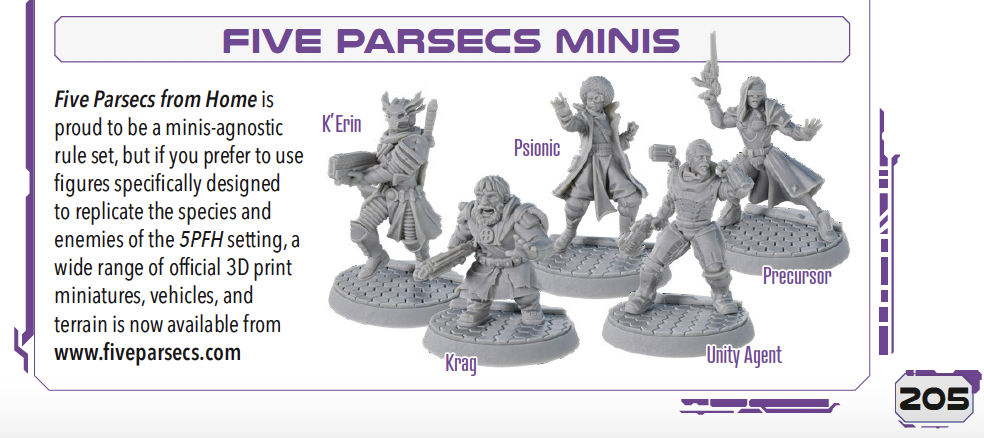
Given the success Modiphius had with the Fallout RPG line, I wonder when a Five Parsecs From Home RPG product will drop.

Feature image courtesy WP AI with prompt automatically generated from early version text of post
The opinions and views expressed in this blog are those of the author alone and are presented in a personal capacity. They do not necessarily represent the views of U.S. Navy or any other U.S. government Department, Agency, Office, or employer.
RockyMountainNavy.com © 2007-2024 by Ian B is licensed under CC BY-SA 4.0 
 Rocky Mountain Navy Gamer