
If you are a follower of this blog you likely remember I did an extended “learning” series on Bruce Maxwell’s new Designer’s Signature edition of Air & Armor: Würzburg, Tactical Armored Combat in Europe from Compass Games published in 2024. In my learning series I lamented—more than once—on the length of the rule book fearing it was an indicator of complexity in learning that could translate into complexity in play. After my first play I am happy to report that my fears were unfounded…for the most part.
Thermopylae
This past holiday week, I played the first scenario in Air & Armor, [47.1] THERMOPYLAE, which describes itself as:
Design Note: This introductory scenario is intended to provide new players with a quick way to familiarize themselves with the game system. Unlike any other scenario, it can be played in two ways: 1) using just the rules through Case 23.0 or 2) using the entire rule set. I recommend that new players stop reading the rules after Case 23.0 (plus Case 31.0) and use this scenario to master the basic movement and combat mechanics of the game…. This scenario depicts a meeting engagement at a choke point where neither side can outflank the other.
[47.1] THERMOPYLAE
Although in my Air & Armor learning I pushed ahead and studied the rules beyond Case 23.0, for this scenario I dialed back my enthusiasm and instead used Maxwell’s recommended first approach.
Punching out
When punching out the countersheets for Air & Armor one needs to pay close attention to Case [4.5] UNIT ERRATA which guides players to replacement counters on countersheet six. Even with replacement counters clearly identified I cringe at the thought of discarding incorrect counters for fear that I got the original and replacements mixed up.
There are also LOTS of counters in Air & Armor—1140 on the five original countersheets and another 228 on the “replacement” Countersheet 6. The ratio of unit counters to markers is somewhere to the left of ridiculous; my rough estimate is a ratio of a little less than 3:1 game markers to unit counters. Further, I don’t see too many Compass Games sets on CUBE4ME to help storing the many different game markers so I am worried about getting the box ever closed properly again.
Stepping Off
In play, the rules for Air & Armor proved relatively easy to play with. The player aid Sequences Cards make stepping through a turn mostly straightforward—as long as one pays attention to the Errata File.
[Intelude – Where you gotta errata?]
[Regarding errata…like more than a few Air & Armor players I am confused. My copy of Air & Armor arrived with a four-page errata file labeled, “AIR & ARMOR ERRATA FILE (2-18-24).” When I was working through my learning series, I downloaded an updated errata file labeled, “AIR & ARMOR ERRATA FILE (6-1-24)” that came out to seven printed pages. Sometime in late June, the later errata file was apparently removed from the BGG files and replaced by “Air & Armor: Würzberg Official Clarification Sheet” that is a mere two pages. Maxwell explains:
“Folks, this file is an addendum to the errata sheet included in the game. They are two different documents. Combined, they constitute all of the errata for the game. Most of this “errata” is not errata at all, but rather represents my effort to upgrade the Wurzburg rules to the same standard as the upcoming V Corps and BAOR games so that all of the games use the same standard rules set. This is always a challenge as a series evolves.”
So…the Clarification Sheet is an addendum to the “errata sheet included in the game” which for me was the 2-18-24 version. Does that make the 6-1-24 errata file, not “included in the game” and now apparently not available through BGG official or not?]
While applying the rules for Air & Armor movement and combat in the THERMOPYLAE scenario proved easier than I anticipated the set up left me doubtful. Recall that units in Air & Armor each have a number of Steps representing a reinforced company or a battery of guns. When placing units on the board, they must first be assembled by marrying a Unit Counter with a Step Marker per Case [11.1] UNIT ASSEMBLY:
Each player has a set of TO&E Cards that show the specific Unit Counters that comprise each primary and parent formation. These cards also show the number of steps associated with each type of Unit Counter in that formation. When setting up a formation on the map before play begins, or when entering a new formation onto the map as a reinforcement, the owning player assembles the units for that formation by pairing Unit Counters and Step Markers in any way he chooses, as long as 1) the total number of steps allocated matches the number available for that specific type of Unit Counter and 2) no unit is ever assembled with more steps than can stack in a single hex (nine-steps of maneuver units for the WP and four steps of maneuver units for NATO, see Stacking Limits, 14.2). There is no requirement that a player use all the Unit Counters available, but he must use all the steps available.
[11.1] UNIT ASSEMBLY
In the THERMOPYLAE scenario of Air & Armor, the Warsaw Pact (WP) player is assigned the East German 4th Motor Rifle Division. Conveniently, each brigade in the division has three counters and nine steps, making it easy to assign three steps to each counter. The NATO player, on the other hand, has amongst their units the US Third Brigade which is composed of armor (three counters with four steps) and mechanized infantry (five counters with eight steps). While the rule book tells me how to assemble a unit, I have no historical or game set-up guidance to draw upon. While I recognize the decision for step allocation is left up to the player, for an introductory scenario to provide no guidance seems like an oversight. I feel like I am lost but I really don’t know. Give me a hint?
Without some step allocation advice, the THERMOPYLAE scenario in Air & Armor taught me the rules of play, but I am left unsure what lessons to draw from the scenario as I am unsure if the performance of either side was predicated on the initial unit assembly, for better or worse.
Not the wurtz reaction
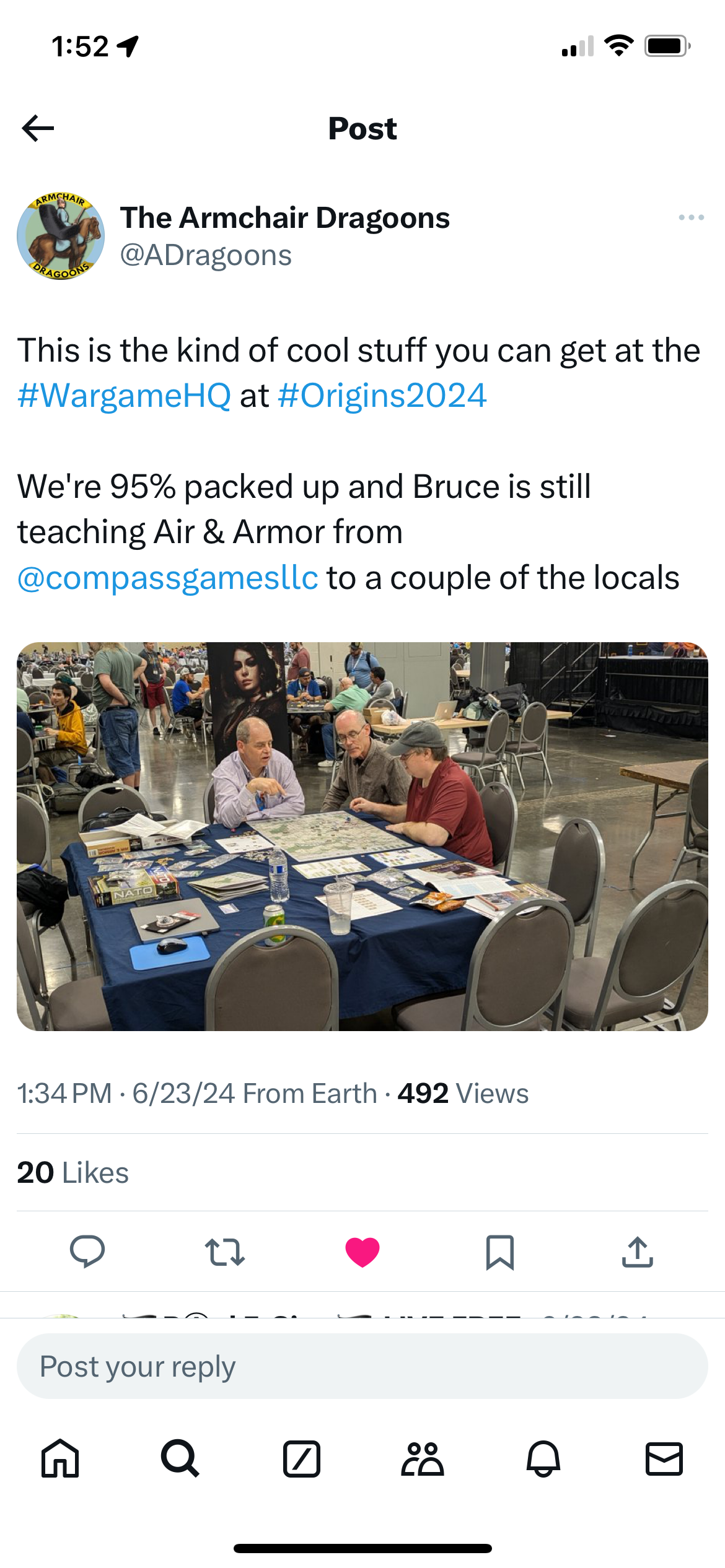
Overall, my first play of Air & Armor was a good experience. The game, however, has so many moving parts it didn’t totally click for me on the first pass. That said, the game creates enough interesting decisions that I will keep it on the table for a bit as I work my way through the rules again. Next up I plan on replaying THERMOPYLAE but with the full rules. Maybe next year I can get to Origins and play it with Bruce in a teach and play.
Feature image courtesy RMN
The opinions and views expressed in this blog are those of the author alone and are presented in a personal capacity. They do not necessarily represent the views of U.S. Navy or any other U.S. government Department, Agency, Office, or employer.
RockyMountainNavy.com © 2007-2024 by Ian B is licensed under CC BY-SA 4.0 
 Rocky Mountain Navy Gamer
I salute your perseverance.
I think I would likely have given up having seen the size of the rule book.
I should probably try a high level game sometime, I always play tactical level. But I fear I’d miss my toy tanks and tin soldiers.
Regards,
Frank
Once I got playing it sorta came together. The actual rules are not that complex; the complexity of learning the rules comes from their presentation.
Just hit him up at Fall Assembly!
Need dates to set aside on the calendar…