
There are many roleplaying games (RPGs) out there. So many, in fact, that it is almost certain one can find a RPG they really enjoy. It is equally almost certain that you will find a RPG that you dislike. Some people judge RPGs by the setting; I judge based on both setting and game mechanisms with the later perhaps having a bit more weight. That later weighting certainly explains to me why I found a small indie published RPG, Offworlders by Chris Wolf, available for free through DriveThruRPG with a setting that should be right in my wheelhouse instead very off-putting.
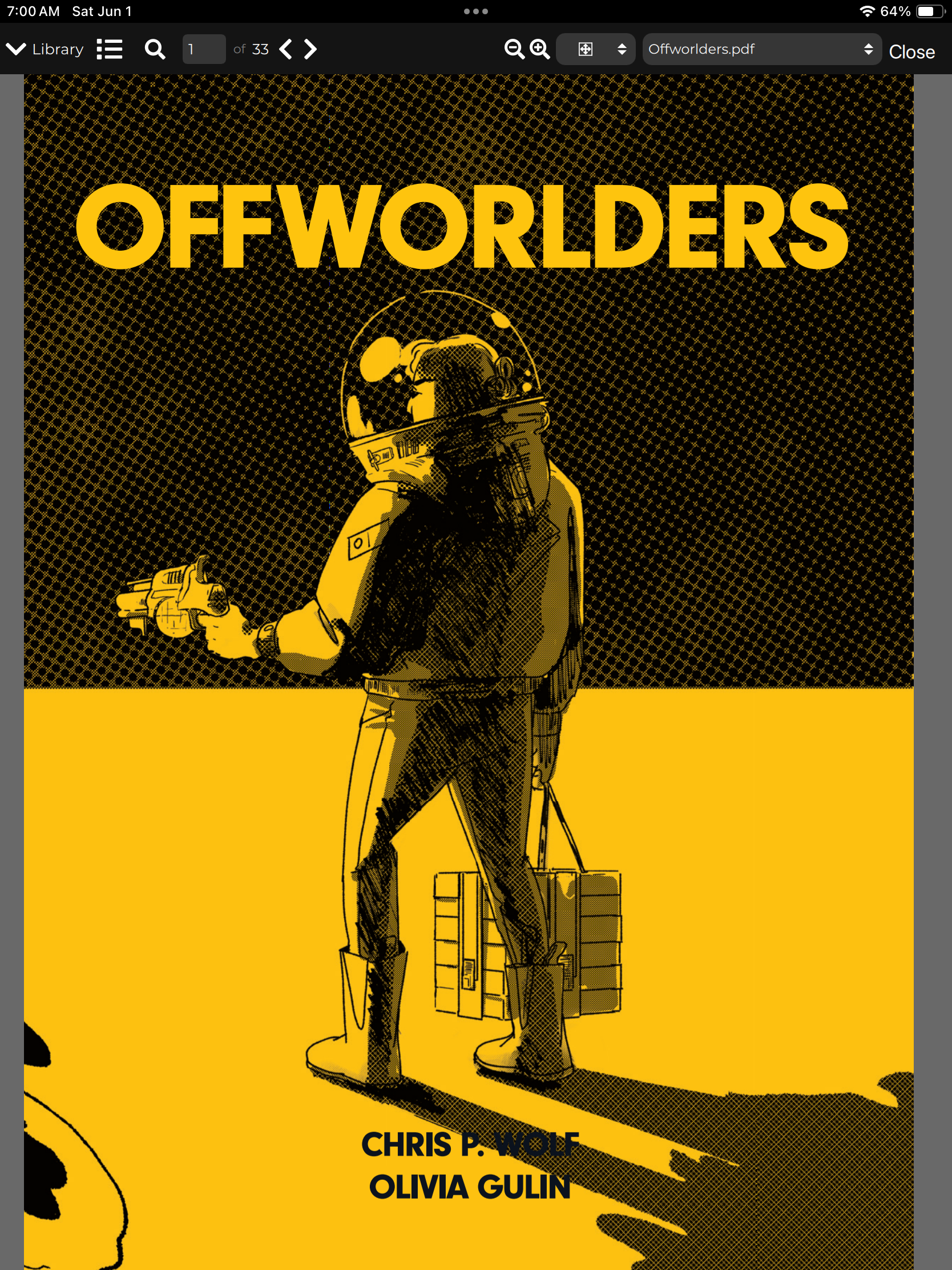
The free 33-page indie published RPG Offworlders written by Chris Wolf and illustrated by Olivia Gulin sounds very much like my preferred “space western / scoundrels” sci-fi settings of interest:
Offworlders is a science fiction roleplaying game about adventurers, outlaws, and guns for hire making their fortune on the rough end of the galaxy. It is designed to be straightforward enough to pick up and be ready to play in just a few minutes as a one-off game, but with enough meat to play a short campaign as well.
The player characters in Offworlders are the owners of a small starship in a time when humans have spread to many worlds. Together, they explore the universe, completing profitable jobs and overcoming dangers.
You’ll fly between planets, taking on dangerous work that no one else wants. You’ll fight ruthless pirates, explore drifting derelicts, and go toe-to-toe with weird alien monsters, just to make enough credits to keep your ship flying. You’ll overcome these challenges by the skin of your teeth and come out stronger on the other side. On long voyages, your characters will learn about each other and grow together.
Offworlders, p. 2
In terms of game mechanisms, Offworlders draws inspiration from Traveller and other RPGs: “Offworlders is inspired by World of Dungeons by John Harper. It also owes inspiration to Dungeon World by Sage Latorra and Adam Koebel, as well as Traveller by Marc Miler and Stars Without Number by Kevin Crawford” (Offworlders, p. 3).
Traveller-ish conversations
Offworlders is, but its own declaration, a conversational roleplaying game:
A game of Offworlders is a conversation. The game master will describe the scene around the player characters, populating it with details and people. The players will respond to that world, describing how their characters interact with it, asking the GM about details, and saying wha their characters say to each other and the NPCs.
You’ll take turns, but you’ll take turns like you do in a conversation. Sometimes you’ll speak for longer to get something done, and often you’ll step back to let someone else have the spotlight.
Unlike many other games, you’ll never split up into a specific order to take formal turns. Just let things flow naturally, and let whoever the action is centered on describe what their character does. If you’ve been in the spotlight for a while, invite someone else to speak.
Offworlders, p. 2
Though conversationally driven, Offworlders does have a “core mechanic” built around a 2d6 die roll. The core game mechanism is very Traveller-like where one of four Attributes—which are nothing more that die roll modifiers—is chosen to be added to that 2d6 roll along with a skill modifier. Roll higher for levels of success but rolls of under 7 are failure.
Offworlder attributes
Character creation in Offworlders focuses on those attribute modifiers. Character creation starts with an archetype and adds skills, attributes, and gear. The process is very streamlined; a new character can be created in literally less than a minute. Offworlders has a game mechanism for character advancement that uses a combination of XP and conversations during long trips:
When the characters are on a long trip together through space, they tend to learn alot about each other…
On their turn, each player must ask another player about their character. It could be about that character’s past, or their goals, of just something about their personality. If the player answers the question honestly, they earn 1XP.
Offworlders, p. 15
At this point I admit I stopped my exploration of Offworlders. While the setting of Offworlders is certainly interesting to me, and the core game mechanism easy to learn and play with, the gamification of “let’s share our deepest inner feelings” is not why I play RPGs. The other problem presented by the “sharing” XP game mechanism is what to do if a player doesn’t answer honestly. Who judges that? More importantly, do you want a session to potentially become derailed because you suspect a player lied in a portion of the game that nebulously crosses between in-game and metagame play?
Off-put
I get that some RPG players like using games as ways to explore or express their deep inner feelings. For myself, however, I prefer to play for adventure. Offworlders starts off sounding like a great adventure game, but as I read too many red flags start flying.
First, the stated conceit of the game is the players WILL succeed; “You’ll overcome these challenges by the skin of your teeth and come out stronger on the other side.” I strongly believe that dealing with risk is important and without the chance of failure no real character—and more importantly player—growth can happen.
Second, the forced social niceties dampen player agency: “If you’ve been in the spotlight for a while, invite someone else to speak.” I strongly believe that managing the spotlight is the role of the GM and not the player. The player may be on a roll, maybe with the creative juices flowing or hot dice. The GM, or even the other players, should already be empowered at the table to jump in with their ideas. If the players don’t necessarily have that power, a situation I see most often occur at game conventions where a pick-up group of players have don’t necessarily understand all the gaming cues, then it is the role of the GM to make sure the spotlight shifts appropriately.
Finally, the metagame incentives to get in touch with player-character feelings (“If the player answers the question honestly, they earn 1XP”) totally turns me off. It is also nearly unenforceable. Suppose your player-character is SECRETLY on the run from a rogue government biomedical experiment. Another player-character asks, “Are you on the run from the law?” How do you answer? Honesty gets 1 XP, but maybe that SECRET is between the PC and the GM. If the PC answers the other PC, “No” the answer is honest between them but not between the GM. So 1 XP, or no?
I totally understand this is a matter of personal preference and there are those out there who absolutely live for this sort of RPG. Not me. Yes, I know I can ignore this rule. I also try, out for respect for the designer, to play a game at least once using the Rules as Written in order to explore and try to understand what the designer’s intent with the game is. In this case, however, the wording of the designer using the term “must” ruins almost any chance of me even exploring that option.
Offworlders is a fair example of what a lite-RPG can be as it is a fairly open design. However, I frankly have a hard time ignoring major conceits put forth by the designer. The reality is that there are many other RPGs out there that not only have great settings and game mechanisms but more importantly I can play without having to set aside the designers message.
Feature image courtesy Chris Wolf
The opinions and views expressed in this blog are those of the author alone and are presented in a personal capacity. They do not necessarily represent the views of U.S. Navy or any other U.S. government Department, Agency, Office, or employer.
RockyMountainNavy.com © 2007-2024 by Ian B is licensed under CC BY-SA 4.0 
 Rocky Mountain Navy Gamer
I feel sorry for your gaming group. What a close minded rube you are.
Thank you!
For me, there is a sweet spot in rules elegance & complexity: Where the rules can adjudicate most situations, without being a burden. I’m not a fan of games with super crunchy rules. Nor do I much enjoy “lite” games, which can break down like when we played soldiers as children: “I got you!” … “No, you didn’t!”
And touchy-feely RPGs, I don’t mind if there are few elements like that in the rules. Free League games often do that, which you can engage or ignore. But when entire core systems are built on navigating feelings? That’s a hard pass in our group.
I’m with you on your reaction to this game. OTOH, I sat up straight when you wrote ” there are those out there who absolutely live for this sort of RPG.” Really? And they call that an RPG? Shouldn’t that sort of storytelling/therapy game have its own name?
This reminds me of an online topic I participated in recently. Can’t remember the details, but the conceit was that our type of “RPG is an adventure/game” must change its name. Because RPG is a better label for some other type of game. After fifty years. Yeah, OK.
Some people like roleplaying an action adventure while others prefer a soap opera. I’ve written elsewhere that my preferred RPG style is a bit of escapism adventuring. I get enough drama in my office every day that I have no interest in “exploring my deepest feelings” and sharing vulnerable secrets in a fictional wanna-be therapy session. I try not to begrudge those who like that sort of thing. Good for them; I fully admit that “Dr. Phil: The RPG” is not my thing.