
Bottom Line Up Front – A rules-lite war game that doesn’t try to do too much, but what is does try to do it does well. Ebb & Flow: The Final Communist Offensive in Korea, 22 April-10 June 1951 by Ty Bomba in Paper Wars #105 (Compass Games, 2024) has far better written rules and seemingly better development that too many other magazine-packaged war games.
Flow over ebb
Unlike too many magazine war games that seemingly suffer from under-baked game rules, Ebb & Flow: The Final Communist Offensive in Korea, 22 April-10 June 1951 feels well developed. The game mechanisms used are well-proven but assembled together in an interesting manner to support themes attributed to combat in the Korea War.
Sizing it up
The scope of Ebb & Flow is grand. The game attempts to portray a vital time of the Korean War. As Ty Bomba’s accompanying article, “Ebb & Flow: The Final Communist Offensive in Korea” relates:
Their next offensive, variously referred to in Chinese historiography as the “Fifth Offensive Campaign” and the “Spring Offensive Campaign,” was decisive, though not in the way its planners hoped it would be.
Lasting from 22 April until 2 June [1951], it was the single largest and longest lasting of all the communist offensives in Korea. It was also the largest campaign fought anywhere in the world since the end of the Second World War. In it, some 700,000 Chinese, along with 100,000 North Koreans, attacked US/UN forces totaling about 340,000.
Bomba, Paper Wars #105, 23

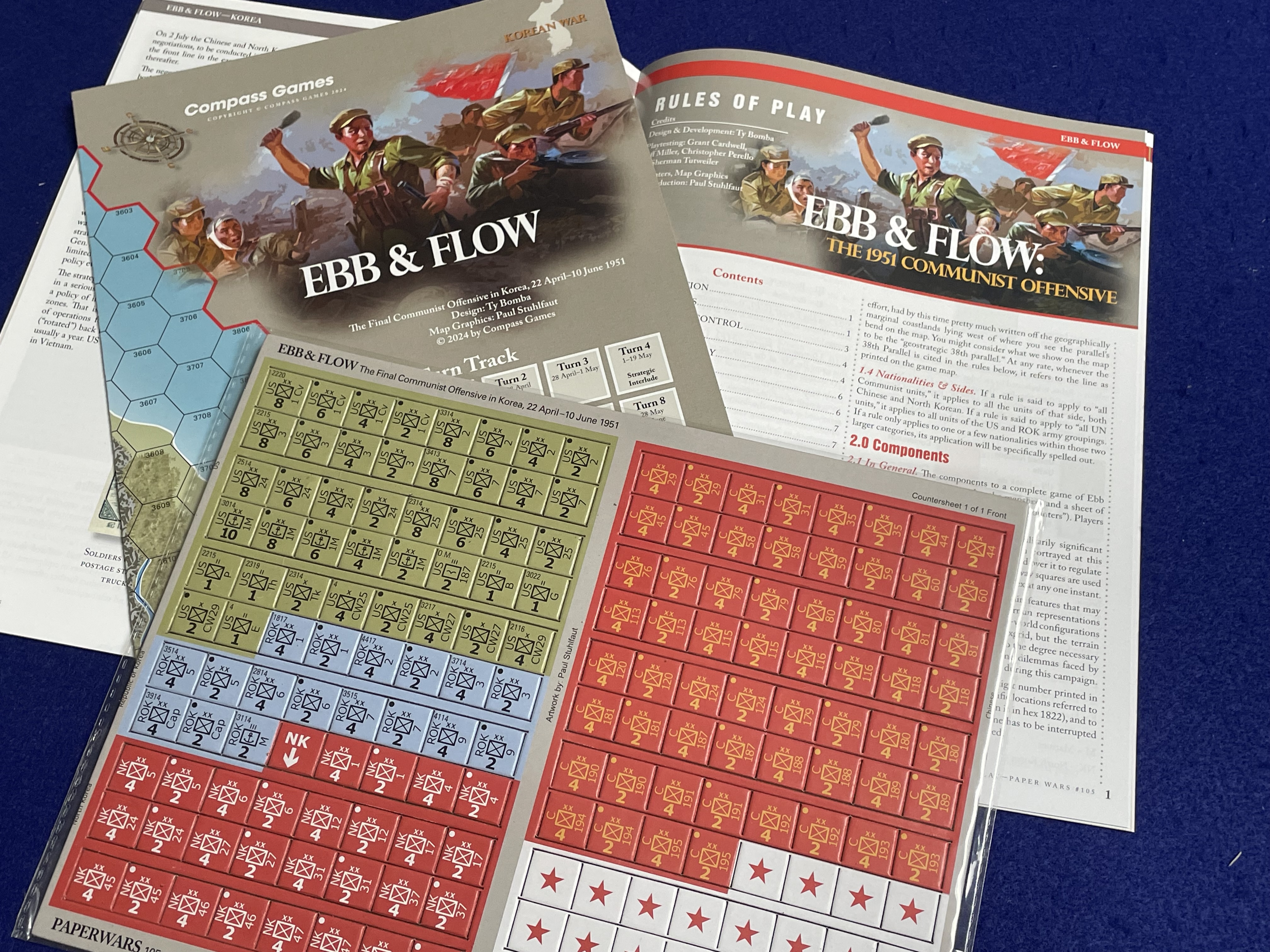
Not only was the offensive big but so is Ebb & Flow though not in ways one might expect. At first glance the game looks fairly standard for a magazine game; the paper map is 22″x34″, the rule book is 12 double-column pages, and the counters are on single sheet. While the physical components of Ebb & Flow may seem standard how they are used makes the game “big.”
To start with, the hexes in Ebb & Flow are a chunky 7/8″ on a playing area of roughly 46 x 22 hexes which makes the relatively small Korean peninsula feel big. Like the real Korean peninsula the impact of terrain on maneuver is also easy to see at this scale as natural avenues of approach or attack corridors become apparent.

The single sheet of 176 counters in Ebb & Flow are a respectable (“big enough”) 5/8″. More important then their physical size is what each counter represents. If you pay attention to the Army Organizational Charts you realize that those 176 counters only brings nine (9) ROK units and 19 U.S./UN units to the campaign. They are opposed by 14 North Korean and 30 Chinese units. For the odds-ratio inclined out there, that immediately looks like the North Korean/Chinese player has about 3:2 odds in their favor. This is just enough of a unit imbalance that the U.S./UN player will get that feeling of masses of North Korean or Chinese units raining down upon them in waves of attacks.
Big steps
With so few units represented (28 U.S./UN and ROK and 44 North Korean and Chinese) what are the other 104 counters used for? Although there are few combat units depicted in the game each is actually made up of several counters. Combat units in Ebb & Flow can be composed of up to 10 steps/Combat Factors. Every step is a side of a unit counter. This means units like the mighty U.S. 1st Marine Division, starting with a Combat Factor of 10, is portrayed in the game using 5 of the 176 counters. Other U.S. divisions are 8-step units (four counters).

The impact of these “big step” units becomes apparent when you realize that most ROK, North Korean, and Chinese divisions are 4-step units (2 counters). The effect of these stepped counter units is that U.S. combat formations are powerful…but relatively few while the North Korean and Chinese are plentiful but not as powerful. That is until multiple units attack together like a massive human wave…

Moving clear or overcast
Ebb & Flow uses a simple movement system that depends not only on terrain but also the weather. The movement factor for U.S./UN and is 10 for Clear weather turns and 8 for overcast turns. North Korean/Chinese units get 4 movement points on clear turns and 6 in overcast. This simple differentiation in movement factors between sides not only represents the different mobility classes (foot versus vehicles) but also captures the effect of airpower (clear skies means more U.S./UN airpower restricting North Korean/Chinese movement) without having airpower counters in the game. Nice design for effect…
Combat power shifts
Combat in Ebb & Flow is a simple mechanism with big thematic action. Combat uses a Combat Results Table (CRT) but not the classic odds format. When resolving combat players determine the combat differential and then roll a single d6 for that column. Instead of die roll modifiers, Ebb & Flow uses combat shifts to move left/right to a different column of the CRT. Generally, if you have a more favorable condition the shift is to the right one or two columns, and if negative the shift is to the left. Combat shifts are an easy way to modify combat and are used for many conditions like naval gunfire support (10.22 UN Naval Gun Support) or the like again without the need for another counter.
Harder to see
One criticism of many magazine games is that the lack of publication space means player aids are limited in number and content. Ebb & Flow has those issues, though not in a game-stopping fashion. There are several rules concerning combat modifiers that are easy to miss and cry out for a player aid. These combat shifts and modified losses in combat shown below are found in the rules but not on the tables or charts on the game map.

Bugging out
Rule 10.18 UN Defender Retreat is perhaps the most thematic rule in the game of Ebb & Flow. If the U.S./UN player wants to avoid a step loss, they may instead retreat the defending force (aka ‘Bugging Out”). The risk, however, when bugging out is that if the unit retreats into a hex with a friendly unit or stack those units moved into join the retreat. This quite literally means to stop a retreat will mean accepting losses or risk a line of empty hexes possibly stretching into the UN rear area.
To balance out the bugging out rule, both players have access to the standard advance after combat (see 10.19 Advance After Combat). The UN player, however, also has access to a special rule for more than one advance after combat opportunity. Rule 10.20 UN Momentum Attacks allows UN units that advance after combat to immediately attack again.
Interlude
Another very interesting rule not often found in war games is rule 5.3 Turn 4 Strategic Interlude. As the rule tells us:
Turn 4 is the “strategic interlude turn. Historically, it was the period that came after the Communists had ‘shot their initial bolt’ and paused to regroup and reorganize for a final push. Similarly, the UN command, rather than try to take the initiative during this lull, was content to use the respite to consolidate and recoup, preferring to face the next Communist effort—before finally going over to a counteroffensive.
Bomba, Ebb & Flow, 5.3 Turn 4 Strategic Intelude
The practical effect of rule 5.3 is that turn 4 becomes a “reset” turn with no combat and the opportunity to bring back some destroyed units. The “strategic interlude” means the Spring Offensive becomes two parts: an initial three-turn all-out scrum followed by a reset turn and then maybe seven (7) more grinding turns.
Police action
Ty Bomba in his article “Ebb & Flow: The Final Communist Offensive in Korea” describes the end of the communist offensive. Reading through the words one can easily see where the rules the a game of Ebb & Flow describes the situation:
It was by then obvious the objective of the Chinese was the recapture of Seoul [4.1 Communist Sudden Death Victory, para 1]. The withdrawal of I Corps forced back the rest of Eighth Army all across the front [10.18 UN Defender Retreat].
…
To take advantage of the lull [5.3 Turn 4 Strategic Interlude], the Allied high command issued an order for an advance of about 40 miles back to Line Kansas. Starting on 9 May [Turn 4-5], US/UN forces made attacks north [10.20 UN Momentum Attacks]…
…
That combination of stiff resistance by the US 2nd Infantry Division [8-steps, see 2.11 Step Strength], the orderly withdrawal of ROK forces on the coast [careful application of 10.18 UN Defender Retreat], and the arrival of reinforcements from around Seoul [5.6 US & ROK Regular Replacements], together stopped the communist advance. As in all previous Chinese offensives, their attack lost most of its power after a few days [max 11 turns, see 4.6 Drawn Games]. That’s how long it took for the combination of their own heavy casualties—due to their almost total reliance on “human wave ” mass attacks [10.21 Communist Human Wave Attack Penalty]—and poor resupply caught up with them [7.6 Communist Supply Sources].
…
The counteroffensive had secured key positions in the area around the towns of Hwachon [hex 3014] and Inje [hex 3414] by 27 May [Turn 8]. Even so, rain [5.7 Weather] and effective Chinese delaying actions [8.3 Effect of Enemy Zones of Control (EZOC) on Movement] blocked efforts to fully close their escape routes, precluding the complete destruction of any enemy division.
Bomba, Paper Wars #105, 25
All that played out in a few short hours on a single 22″ x 34″ map with 176 counters and 12 pages of rules. Unlike the Korean War, playing Ebb & Flow is anything but a stalemate.
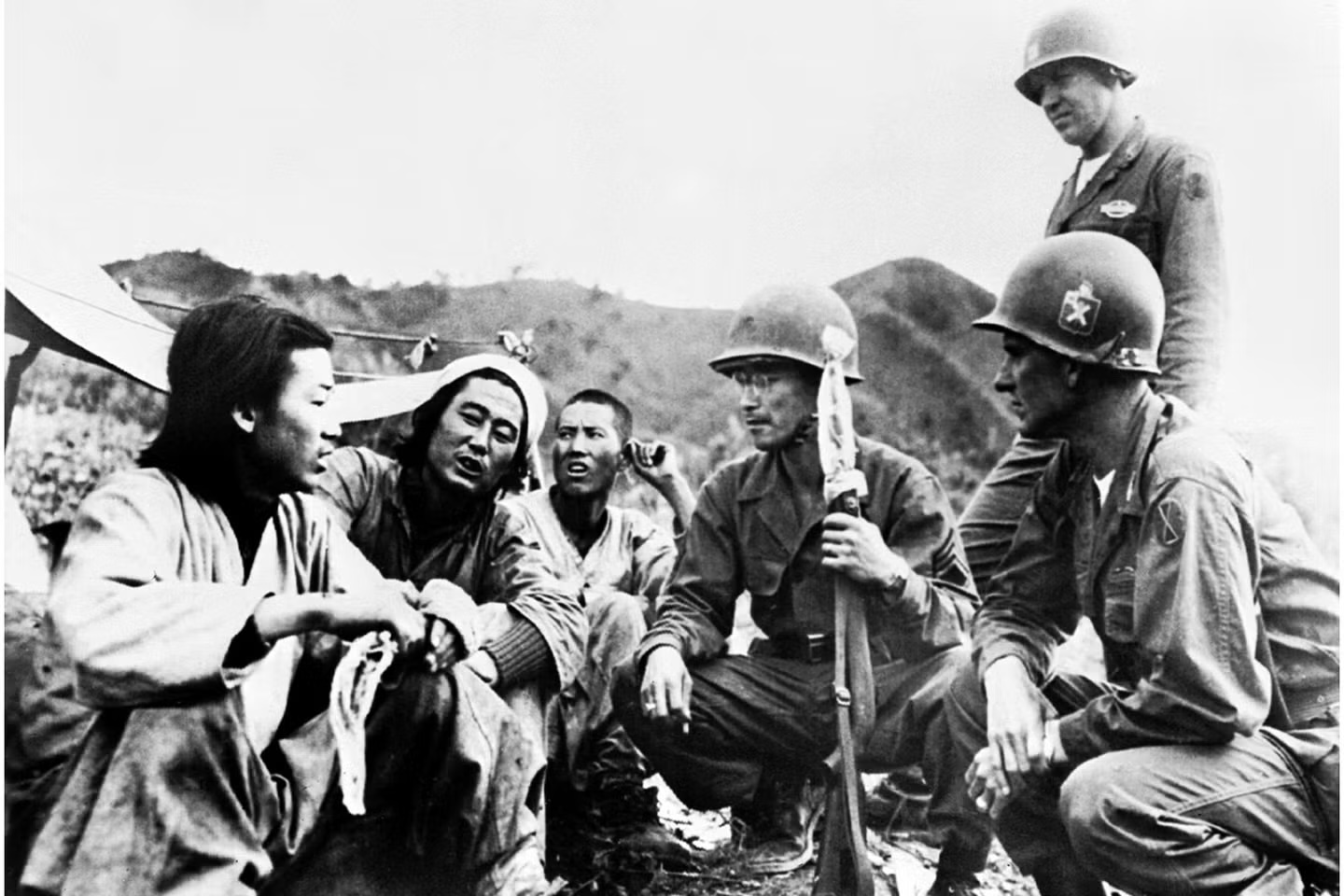
Feature image courtesy RMN
The opinions and views expressed in this blog are those of the author alone and are presented in a personal capacity. They do not necessarily represent the views of U.S. Navy or any other U.S. government Department, Agency, Office, or employer.
RockyMountainNavy.com © 2007-2024 by Ian B is licensed under CC BY-SA 4.0 
 Rocky Mountain Navy Gamer
1 thought on “Wargame SITREP 24-09 ~ Going with the Ebb & Flow: The Final Communist Offensive in Korea, 22 April-10 June 1951”