
In an article for The Armchair Dragoons, I wrote about my experience learning how to fire a main tank gun in the roleplaying game War Stories: A World War 2 RPG (Firelock Games, 2022).1 Most surprising to me was just how involved and wargame-like the War Stories tank fire combat procedure is. That experience sparked my curiosity and compelled me to experiment further. This time I turned to my long-time, dearly beloved Traveller roleplaying game and a set of miniatures rules I’ve long admired but never really deeply studied. What I found was more war stories that try to roll hot but are actually uncool complex and an adventure wargame I hadn’t realized was already sitting on my shelves.
Space Hammer Experiment
Hammer’s Slammers, written by the late David Drake, is my favorite military science fiction series. I own several Hammer’s Slammers-related wargames, including the 1984 Mayfair Games Hammer’s Slammers that some (unfairly in my opinion) dismiss as simply “Panzerblitz in spaaaace!” For today, however, I am going to compare tank combat in the Hammer’s Slammers universe using the Hammer’s Slammers supplement for the roleplaying game Mongoose Traveller 1st Edition (2009) and the miniatures wargame rules for Hammer’s Slammers: The Crucible (Pireme Publishing, 2010). For this example I am drawing from the story “Rolling Hot”1 and the engagement on the planet Prosperity at Kawana where the 1st Battalion of the 4th National Armored Regiment fought Task Force Ranson. This allows us to pit a Hammer’s Slammers M2A1 ‘Ursa’ blower tank against a TR64A Thyseen Gladius Light Tank. We are going assume the blower is shooting at the light tank at “medium” range.

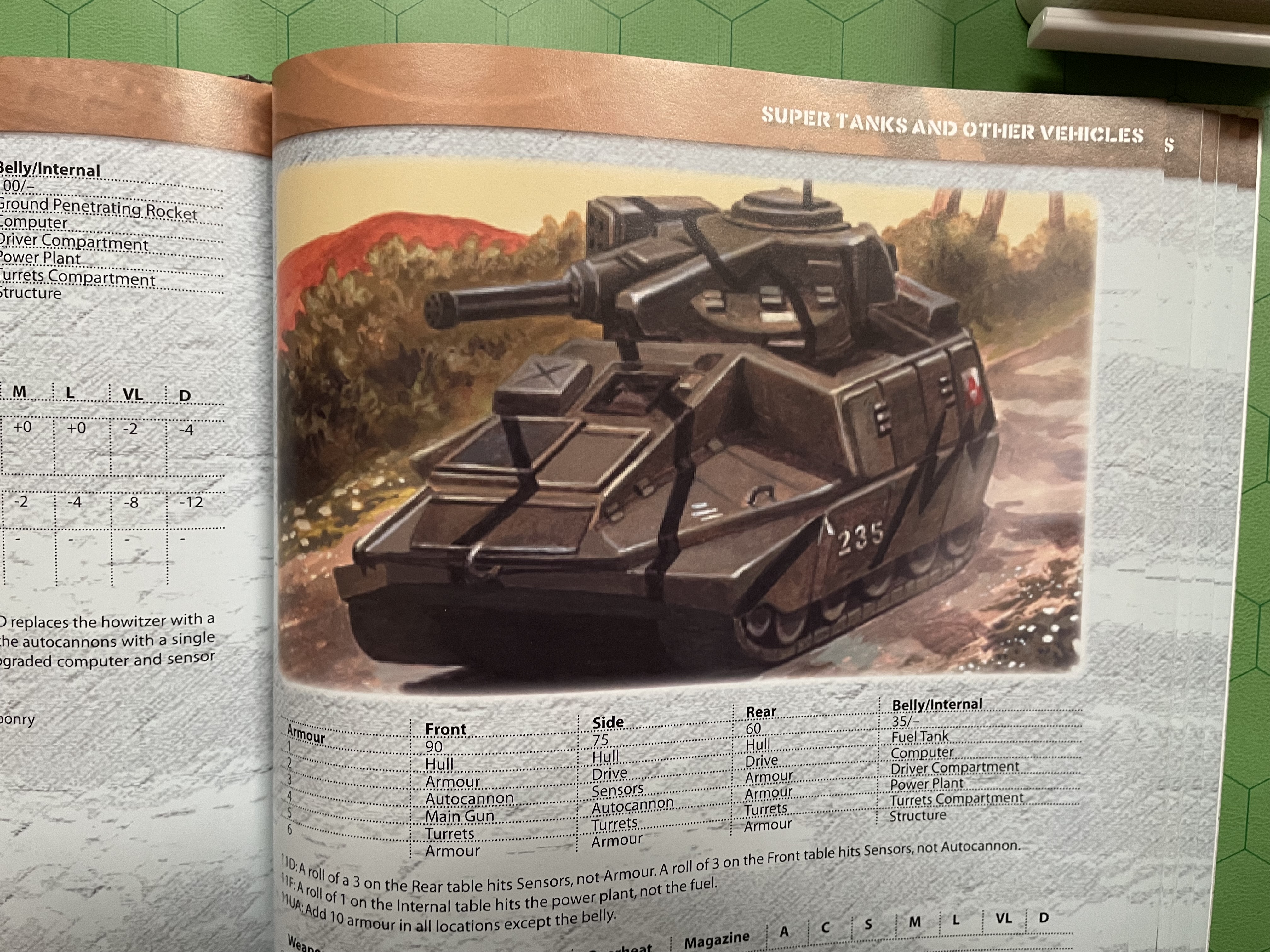
Mongoose Slamming
For a roleplaying game (RPG) one has to start with a character. Using the character generation rules in the Hammer’s Slammers supplement let’s us define key aspects of Hans Wager, the tank commander/gunner of Blue Three:
- Dexterity Attribute – 7 (DM +0)
- Service Skill – Gunner (Turrets) -1 [In the Hammer’s Slammers supplement the Gun Combat skill is for Infantry, Heavy Weapons skill is for combat cars and tribarrels, and Gunner (Turrets) skill is for the main guns on tanks.]
Like many RPGs, Mongoose Traveller 1st Edition (hereafter MgT1e) breaks combat into Turns, Rounds, and Actions. Per the Combat rules in the core rule book, in each Round (representing six seconds of time) a character can take one Significant Action, one Minor Action, and as many Reactions as they like (MgT1e, 60). The various actions a character can take in vehicle combat are defined in the Vehicles combat rules of the core rule book (MgT1e, 67) and expanded upon in Chapter 9: Vehicle Combat in the Hammer’s Slammers supplement (HS, 164).
One important vehicle combat rule from the Hammer’s Slammers supplement is Booster AI found on page 172. Some tanks in the Hammer’s Slammers universe use a Booster AI computer to supplement the crew.2 Per the vehicle data for the M2A1 it carries a Computer/4 (HS, 137) which in this case we assume is running the Intellect program (1 space) and Expert (Gunner) program (3 spaces) which grants the gunner a Gunner (Turrets) skill of 2 (HS, 172).
Combat Round
Roleplaying games, by their very nature, focus on characters. When a gunner fires a tank gun it is not the beginning of a process but the culmination of several actions coming together. The combat rules for MgT1e enable players to roleplay different characters in combat as each executes their unique functions and tasks. Before the blower tank fires other characters, such as the Task Force Commander and command car sensor operator, very likely attempted to do their part to contribute to the overall chance of success in combat.
When roleplaying vehicle combat with several characters, a combat round likely starts with the Task Force Commander taking the Coordinated Action (HS, 167) as their Significant Action. Coordinated Action calls for the commander to make a Tactics (military) or Leadership check to set up a task chain. The total number of steps in the task chain is determined by the Effect of the test.4 In this example, June ‘Junebug’ Ranson, commander of Task Force Ranson with Intelligence 8 (DM +0), skills Tactics (military) 1 and Leadership 1 (HS, 87) attempts a Coordinated Action to use the sensors of her M9 Combat Car with Sensors: +2 (HS, 144) to conduct a Sensor Scan (Significant Action – Sensor Scan, HS, 170) and help Blue Three to quickly target and destroy a Yokel tank (Significant Action – Attack, HS, 167).
Coordinated Action check. Junebugs roll of 2d6 = [9] plus Tactics (military) 1 is a total of 10 or an Effect of 2; a two-step task chain can be established.
Sensor Scan check. The sensor tech in the Command Car (skill Sensors 1) attempts to locate a Yokel tank on the other side of a crest Blue Three is approaching. The range is medium for a Range die modifier (DM) of +0 and a Target DM of +3 for an active tank (HS, 169). The sensor tech rolls 2d6 for [6] +1 (Sensor skill) +2 (Combat Car sensors) +3 (active Target) for a final result of 11 or an Effect of +3; according to the Task Chains DM table (MgT1e, 51) this gives gunner Hans aboard Blue Three a +1 DM to his Attack check.
He’d locked his main and cupola guns on the same axis. His left hand rotated the turret clockwise with the gunnery screen’s orange pipper hovering just above the projected crest of Sugar Knob. When the dark bulk of a Yokel tank slid into the sight picture, needlessly carated by the artificial intelligence, Wager thumbed his joystick control and laced the trees with cyan bolts from the tribarrel.
A bolt flashed white on the screen as it vaporized metal from the Yokel tank. Wagner stamped on the pedal to fire his main gun.
“Rolling Hot”
In this combat round, Hans uses his Minor Action to Aim and his Significant Action to Attack. This will be a Skill Check using Dexterity and his Gunner (Turrets) skill.
- Shooting Attack = 2d6 + Gunner (Turrets) 2 (aided by Booster AI) + Dexterity DM 0 + Task Chain Effect 1 = [8]+2+0+1 = 11
- Other Die Modifiers = Aiming +1, Medium Range +0, Attacking from a Moving Vehicle -1 = net +0; adjusted attack roll of 11.
- Aiming and range modifiers are from the core rule book (MgT1e, 61); the moving attacker modifier is from the Hammer’s Slammers supplement page 167.
- Standard Roll for Success = 8+
- Final attack roll of 11 exceeds the 8+ needed for success.
- Secondary Weapon. Per the rules for Attack in the Hammer’s Slammers supplement, main and secondary weapons can be linked into a single attack: “A single attack roll is used for both, applying the appropriate DMs for each weapon” (HS, 167).
- We are going to resolve the secondary Tribarrel first like the story tells.
- The Tribarrel has a DM of -2 at Medium Range; this makes the final attack roll 9 which is still a success.
- Tribarrel damage is 4d6+4 Destructive. Destructive reduces armor after the attack by the number of dice rolled (HS, 129). The damage roll total is [12] which does not penetrate but reduces the frontal armor of the TR64A (140 points as found on HS, 141) by 4 points (from 140 to 136).
- Main Gun. The 20-cm powergun on the M2A1 is rated as 20d6+20 SuperDestructive (HS, 136). SuperDestructive means the armor of the target is reduced after the attack by 2x the number of dice rolled on any hit (HS, 129). Damage Roll = 97.
- Armor Penetration. The TR64A has a remaining frontal armor factor of 136; the armor is not penetrated but 40 armor points are scrubbed away (SuperDestructive) against future hits (136-40 = 94 frontal armor points remain).
In the story “Rolling Hot” the next lines of text following the quote above are, “Two more Yokel shots hit and glanced from Blue Three. Their impact was lost in the crash of the 20cm main gun firing. Across the valley, the rear end of the Yokel tank jumped backward as the front became a ball of glowing gas.” Using the Hammer’s Slammers supplement…well, that’s going to take some time—and lots more die rolling.
- Second Firing. When it comes around to Hans again another Attack check is made. Let’s assume Junebug is distracted and no task chain is established leaving Blue Three on their own.
- Scan for Trouble. The Minor Action – Scan for Trouble, which is a gunner only action, explains that, “the character is scanning his surroundings (either using natural senses or electronic sensors) and is ready for trouble.” The rule recommends that, “The gunner should take this action each round” (HS, 166).
- The gunner could take the Minor Action – Scan for Trouble in place of the Minor Action – Aim.
- The rule for Booster AI states, “Booster and Minor Actions: A Booster AI running the Intellect program can perform one Significant Action per round. This means that the AI performs one of Scan for Trouble, Control Vehicle or Maintain Comms5 if not doing anything else, allowing the crew to concentrate on other matters” (HS, 172).
- For this example we are going to use the Booster AI to Scan for Trouble and let Hans use his Minor Action to Aim.
- Booster AI Minor Action – Scan for Trouble. Roll 2d6 [11] +2 (Sensor DM) +0 (Range DM) = 13; success with Effect 5 or Task Chain DM +1 (assuming the Booster AI is “aiding another character” per MgT1e, 50).
Booster AI as a character? It is not clear in the rules for the Hammer’s Slammers supplement but I wonder if the Booster AI should be treated as a character. In the rule for The Combat Round (MgT1e, 60) it is clearly stated that, “In a combat round each character [my emphasis] gets a minor action and a significant action.” The rules for the Booster AI, especially the Expert programs, allows it to take Significant Actions [Expert (Gunner) = Gunner (turrets) skill of 2 in Attack, Expert (Navigate) = Navigate skill of 2 to a skill check, Expert (Comms) = Establish Communications or Jam Communications, Expert (Recon) = Recons skill of 2 to a skill check, Expert (Drive) = Evasive Action or Navigate Hazard, Expert (Heavy Weapons) = Heavy Weapons (tribarrel) skill of 2 in Attack, Expert (Sensors) = Sensor Scan] and Minor Actions [Scan for Trouble, Control Vehicle, and Maintain Comms] (HS, 172). Characters can also take reactions, such as a vehicle driver making a Dodge. If the Booster AI is running the Expert (Drive) program with a Drive (appropriate specialty) skill of 2 that can Control (Minor Action) a vehicle or even take Evasive Action or Navigate Hazard (Significant Actions) can it not also Dodge? Further, a problem I see with “Booster AI as a character” is determining Initiative. To determine Initiative “each person rolls 2d6 and adds their Dexterity DM to determine starting Initiative” (MgT1e, 60). The Initiative order is important because, “Actions are taken in descending order of Initiative” (MgT1e, 60) and if the Booster AI is a character then its place in the Initiative order must be determined and tracked so that it can take its Significant and Minor actions when appropriate.
Of note, in the story the TR64A is almost certainly shooting back at the blower tank but we are not going to resolve that here and instead continue with and Hans’ Attack action.
- Second Shooting Attack = 2d6 + Gunner (Turrets) 2 (aided by Expert Program running in Booster AI) + Dexterity DM 0 + 1 for Booster AI Scan for Trouble Effect + 1 for Aim -1 for attack from moving tank = [10]+2+0+1+1-1 = 13; Success (even the DM -2 for tribarrel still results in success).
- Tribarrel Armor Penetration. Rolling 4d6+4 Destructive yields 20 damage which does not pentrate but scrubs off 4 armor points; TR64A front armor now 90.
- 20cm powergun Armor Penetration. Rolling 20d6+20 SuperDestructive yields 95 damage of which the armor stops 90 leaving 5 damage (and a new armor factor of 70 after this attack).
- Vehicle Damage.
- The 5 damage points translates to Two Single Hits (HS, 173).
- Hit 1 – Rolling 1d6 against the Front of the TR64A = [6] Armour which means “reduce the vehicle’s armour by an amount equal to the number of damage dice rolled”(HS, 173). The 90 front armor (remember, the SuperDestructive scrub does not go into effect until after the attack) is reduced to 70 from the 20 damage dice rolled.
- Hit 2 – Rolling 1d6 against the Front of the TR64A = [1] Hull; reduce the TR64A from 24 Hull to 23 (HS, 140).
Third Attack. Again? After the SuperDestructive armor scrubbing the TR64A still has 30 front armor left. Even if the tribarrel rolls 4d6 = [24] the damage score is only 28 which will not penetrate (again). Assuming average rolls for the 20cm powergun attack, something like 90 damage will likely be scored of which 60 are penetrating damage for a something like two Triple Hit, a Double Hit, and an Internal Triple Hit. Looking at that Internal Triple Hit alone there is a 50% chance of disabling the tank (Computer, Power Plant, or Driver Compartment hit) and only a 1 in 6 chance of outright destroying the tank (Triple Fuel Hit = Fuel Tank explodes and destroys vehicle).
Put together, the vehicle combat rules in the Hammer’s Slammers supplement are…
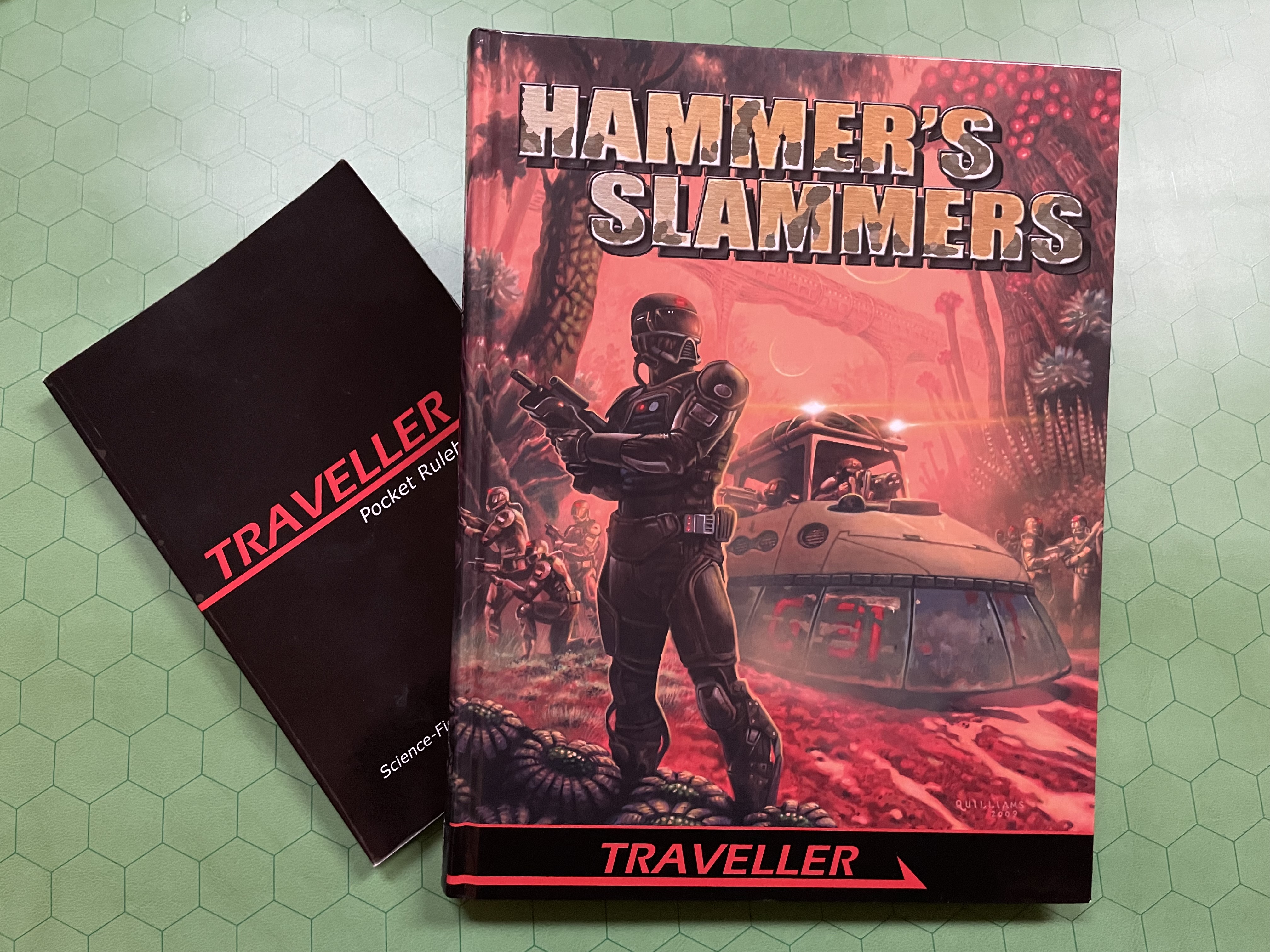
Crucible Combat
Hammer’s Slammer: The Crucible is a set of miniatures rules that describe themselves thusly:
These rules allow wargamers to re-fight the battles of the Slammers Armoured Regiment on a one to one scale, i.e. where one model equals one vehicle or one infantryman. Turning modern armoured warfare into a game, of necessity, involves a great deal of compromise. Thus the aim has been to recreate the spirit of the fast moving armoured engagements so brilliantly described by David Drake and so emphasis here is put on command, control and training rather than technology. Also a simple ‘clean’ game system is employed so that the game flows quickly; infantry warfare in particular is abstracted. The rules focus on recreating an armoured skirmish game, as opposed to an infantry skirmish game with a few vehicles in support. The game uses standard six-sided dice.
“Fighting with the Slammers – Introduction,” Hammer’s Slammers: The Crucible, 105
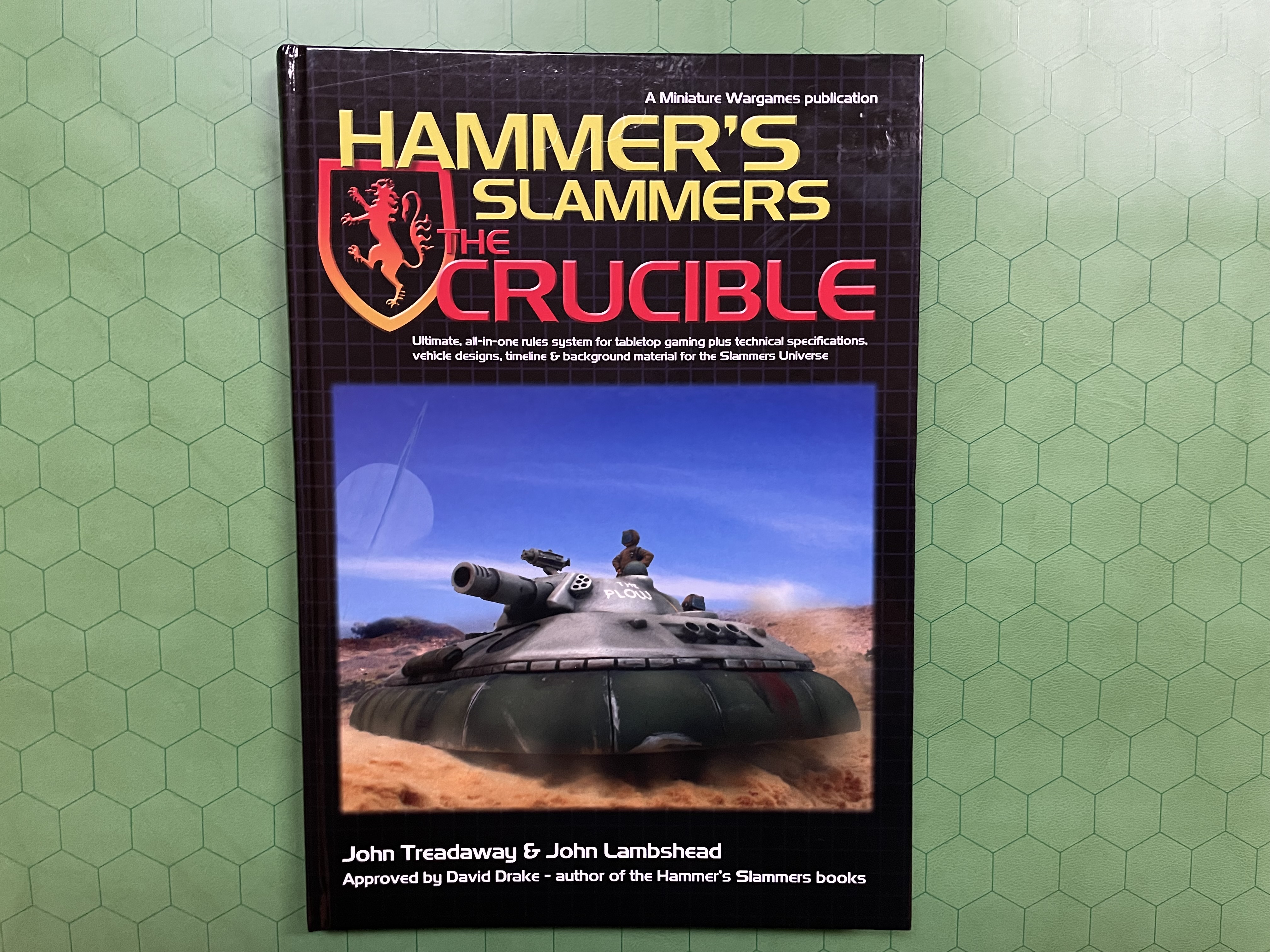
While the core rule book for The Crucible is just over 200 pages long, the “Rule Systems for Table Top Gaming” takes up just 20 pages (27 if “Scenario Optional Rules & Elite Skills” are added). Firing a tank gun takes place in Phase 5: Shooting – Direct fire (plus mortars and ATGWs [anti-tank guided weapons]) with the following steps:
- Phase 5a. Check that the firer has a line of sight to the target.
- Phase 5b. Quality Roll for each shot from firing weapon.
- Phase 5c. Attack Roll for each successful result from Quality Roll (phase 5b).
- Phase 5d. Damage Roll for each Vehicle TU [Tactical Unit] with an AR [Attack Roll] success. Removal for Infantry TU with an Attack Roll success. Suppression marker for Infantry TU with an AR failure.

That’s it. Simple sounding; let’s see how it plays.
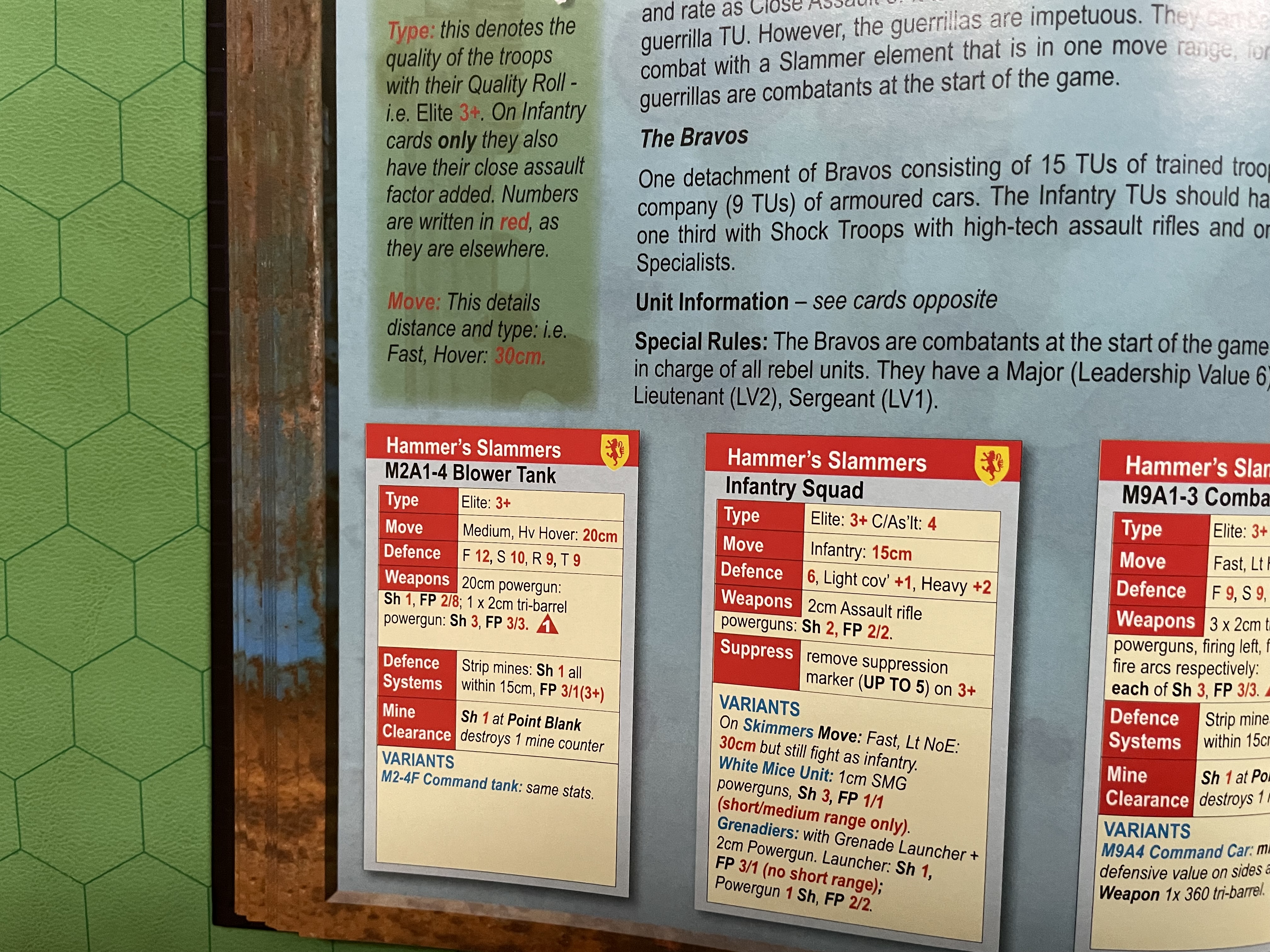
We are going to assume that Phase 5 is beginning. Blue Three, an M2A1-4 Blower Tank (the only one in The Crucible found on pages 102 and 177) is shooting at a Prosperity RNAR Thyssen Colonial Light Tank (Crucible, 185) again at “medium” range.

5 by 4
Phase 5a. For the purposes of this example Blue Three has line of sight to a Yokel light tank at medium range. If the range was Long the tank would shoot at one lower Quality Roll level; conversely, if the range was Point Blank the Quality Roll would be one higher with Elite the highest level ever possible (Crucible, 111).
Phase 5b. The Hammer’s Slammers M2A1-4 has an Elite Quality Roll (QR), meaning it “hits” on a roll of 3+. The 20cm powergun on the M2A1-4 has Shots (Sh) of 1 and a Fire Power (FP) of 8 against vehicles (Crucible, 177). The 2cm tri-barrel powergun has Sh 3, FP 3 (Crucible, 177). The tri-barrel rolls 3d6 for 1, 6, and 2 resulting in one hit. The 20cm powergun rolls 1d6 for 5 = hit.
Phase 5c. Following the story we resolve the tri-barrel first. The Attack Roll (1d6) is [1] plus FP 3 for a total of 4 which is less than the Front Defense value of 9 for the light tank; no damage. The 20cm powergun Attack Roll is 1d6 = [5] plus FP 8 for a final roll of 13. This is compared to the Front defense factor of 9 of the light tank (Crucible, 185). Using the (highly recommended) optional rule for Overkill (Crucible, 111) the difference of 13-9 = +4 is noted.

Phase 5d. A roll of 1d6 + Overkill (4) is made on the Damage Table = [3]+4 = 7 which is 6+; the light tank “Blows up.”
Yeah…that’s more like it!
Junebug’s Crucible. Some of you might be wondering how The Crucible treats a Task Force Commander like Junebug. Capt June ‘Junebug’ Ranson appears in Appendix 2: Elite Personalities where she is considered Elite possessing a Leadership Value (LV) of 8 with elite skills Tactical Genius and Command Material (Crucible, 147). At the beginning of a turn Junebug must roll a d6 to determine if she has ‘drifted off;” a roll of 1 or 2 reduces her LV to 4 for the rest of the turn (Crucible, 147). In Phase 1 of a turn Junebug rolls 2d6 and, using her Tactical Genius skill, picks which die to add to her LV in order to determine the turn order (Crucible, 107 and 131). In Phase 2 she uses her Command Material skill to roll 3d6 and pick which two die to add to her LV to determine the number of TUs that can act that turn (Crucible, 107 and 131).
Mongoose = Complex
While I have long loved the classic 2d6 sci-fi RPG rules as found in the original Traveller RPG and its many successors, I have to admit that the vehicle combat rules as implemented in MgT1e are clunky at best. While they certainly are an improvement over the vehicle combat rules in Classic Traveller which treat vehicle weapons like infantry support weapons, like War Stories the MgT1e vehicle combat rules are burdensome and complex requiring multiple steps to resolve while consulting tables and rules strewn across the core rule book and a supplement. The MgT1e rules are also anti-climatic; combat is not fast moving as in the stories but instead a slow, attritional slog requiring many repeated rolls of the dice and bookkeeping over multiple combat rounds or turns.
The vehicle combat rules complexity found in the Hammer’s Slammers is very concerning. As each Round represents a mere six-seconds of time, and each character (and enemy) gets to act in a round, when using these rules players must accept the game will come to a screeching halt until the combat is resolved. How long will that take? A recent real-world combat situation featured a pair of Ukrainian M2 Bradley Infantry Fighting Vehicles take on a Russian T-90 tank in a battle that lasted eight minutes. In Hammer’s Slammers RPG terms that is 80 rounds! Even if your group can resolve one round a minute, that is still a hour and a half of real world time for only eight minutes game time. One better hope that single engagement is the centerpiece of that session!
Hammering a new Crucible
In the case of the Hammer’s Slammers-based RPG I strongly believe the vehicle combat rules don’t have to be this complex. I strongly believe that Mongoose Publishing missed an opportunity with their Hammer’s Slammers supplement to take an already proven quick-playing Hammer’s Slammers miniatures game and incorporate it into the Traveller roleplaying game universe. The marriage of miniatures rules and the Traveller RPG is not unprecedented; the 15mm miniatures rules for Striker (GDW, 1980) complemented Classic Traveller (GDW, 1977-1979).
It is surprising to me that the marriage of the Hammer’s Slammers supplement for MgT1e and The Crucible did not happen in the late 20-oughts. Both the Hammer’s Slammers supplement and The Crucible were almost certainly written at the same time given they were each published just a year apart from each other. It seems unlikely to me that Mongoose Matt, a miniatures gamer and publisher in the UK, was not aware of John Treadaway working with Pireme in the UK and the Hammer’s Slammers Handbook from 2004 which, taken together with Hammer’s Anvils (2009), were both updated and repackaged into The Crucible in 2010 just a year after the Mongoose supplement was published. I am struck by just how similar, nay duplicative, the Hammer’s Slammers supplement and The Crucible are. Both are around 200 pages long (supplement – 206, Crucible – 202). Both include technical specifications, vehicle designs, timeline, and background for the Slammers Universe. Both draw extensively from the Hammer’s Slammer stories; indeed, both duplicate major written portions from the books. The tank and vehicle designs in both products are near identical. The vehicles in the Hammer’s Slammers supplement are credited to Old Crow Models (HS, 1). The Crucible has this to say about Old Crow Models:
Old Crow make the official resin Slammer tanks, combat cars, hog, jeep, and other vehicles for the mercenary units in this volume (28mm, 15mm, and 6mm). Unless scratch built or from GZG (see below), pretty much all of the vehicles in this book are by Old Crow.
The Crucible, 172

I am tempted to say the major difference between the two books is the inclusion of the Character Creation rules in the Hammer’s Slammers supplement but the Elite Skills optional rules in The Crucible are akin to “talents” in many RPGs. Indeed, in some ways the same scale—individual vehicles and persons—and wargame combat with roleplaying makes the Hammer’s Slammers supplement and The Crucible both Adventure Wargames in my thinking. The key difference, however, is the complexity of the combat rules. In that comparison The Crucible wins hands down for its lower rules complexity and quick-play.
Forging a New Hammer in a Crucible
How hard would it be to make the Hammer’s Slammers supplement for Traveller compatible with The Crucible? There are two areas of the rule books that certainly need to be rectified: combat and vehicle data.
Combat Rules and Skills. The combat rules for The Crucible could be dropped into the Hammer’s Slammers supplement almost wholesale. Perhaps change out the Quality Roll in The Crucible for the Attack Skill Check in Traveller—at most. Or find a way to leverage the Elite Skills option in The Crucible with character skills. Hmmm….
Vehicle Data. The back cover of the Hammer’s Slammers supplement boasted that, “With all vehicles created using the Traveller Vehicle Creation System, this book is guaranteed to be fully compatible with every other Traveller book…” Alas, the publication of Traveller: Military Vehicles later in 2009 did not include any rules for making Hammer’s Slammers vehicles. The later Traveller Supplement 5-6: The Vehicle Handbook from Mongoose Publishing in 2012 repackaged the earlier Military Vehicles and included a section of vehicle data for Hammer’s Slammers but it was impossible to use the vehicle design system to design a Hammer’s Slammers tank. Although using the vastly simplified and abstracted TU from The Crucible is not compatible with the Traveller vehicle design system, The Vehicle Handbook and the Hammer’s Slammers supplement never were compatible in the first place so what is the real difference?
Which grognard?
The word grognard has three definitions:
- noun. An old soldier.
- noun games, slang. Someone who enjoys playing board wargames, particularly the counter-heavy strategy board wargames from the 1970s and 1980s.
- noun games, slang. Someone who enjoys playing previous editions of roleplaying games when new editions of the game are available.
Personally, I am all-too-quickly approaching an age where I will be called an old sailor which still makes me a grognard. I also like playing wargames making me a grognard. Given the above example where I use Mongoose Traveller 1st Edition and not the latest Second Edition I guess that also makes me a grognard. All of which is to say that while I am comfortable being a grognard I am still uncomfortable with how much of a wargaming grognard I seemingly need to be when playing a grognard roleplaying game. Mongoose Publishing missed a golden opportunity in the late 20-oughts to team with Pireme and bring a simplified, quick-playing vehicle combat system to the Mongoose Traveller game universe. Now, 15 years later, it is up to us to try and make the adventure better ourselves.
Or should we?
RPG Ban-Hammer
Here is the intro for the Vehicle Combat rules in Cepheus Deluxe (Stellagama Publishing, 2021):
Sometimes, characters will find themselves operating a vehicle in combat, or facing enemy vehicles. The following rules allow the inclusion of vehicles, in personal combat, as well as vehicle chases. They are not intended to serve as war-gaming rules for large engagements.
Cepheus Deluxe, 97
The writers of Cepheus Deluxe clearly understand that a roleplaying game should focus on characters—not weapon platforms. Mongoose Publishing in 2009 apparently got carried away in extending the Mongoose Traveller system in a manner it is not well-suited for. As a grognard roleplaying game player I should not be surprised that the Hammer’s Slammers experiment has not been repeated in Mongoose Traveller 2nd Edition. As a wargaming grognard I should be happy—and content—that there is an awesome set of miniatures rules for wargaming in the Slammers universe. Together, those two approaches make this grognard sailor very happy.
- “Rolling Hot” (Hammer Series) (Baen Books/1989) (Reprinted in The Tank Lords and The Complete Hammer’s Slammers Vol. 2) ↩︎
- Drake wrote about Booster AI as far back as the late 1970s. A man ahead of his time… ↩︎
- Effect is the margin of success—or failure— of the task and can be a positive or negative DM to latest checks. See Effect (MgT1e, 50) and the Task Chain DM table (MgT1e, 51). ↩︎
- Since each of these actions are Minor actions and the section is even called Minor Actions the “perform one Significant action” almost certainly should read “perform one Minor action.” My interpretation of the rules is that the Significant Action for a Booster AI is running an Expert program. ↩︎
Feature image courtesy RMN
The opinions and views expressed in this blog are those of the author alone and are presented in a personal capacity. They do not necessarily represent the views of U.S. Navy or any other U.S. government Department, Agency, Office, or employer.
RockyMountainNavy.com © 2007-2024 by Ian B is licensed under CC BY-SA 4.0 
 Rocky Mountain Navy Gamer
I would really love to run a fusion game of traveller and crucible, honestly
Been playing around with that notion a bit. If I ever get it anywhere I’ll write about it here!
Great post- enjoyed reading it.
Cheers,
Pete.