
It’s been a long time since I played a World War II tactical wargame. This week I chose to play Scenario 5 “Patton’s Ghosts” in Old School Tactical: Volume 2, West Front 1944/45 (designer Shayne Logan, Flying Pig Games, 2017). The play reminded me that, while Old School Tactical (OST) is not a complex game system, the rule book is rather poorly laid out which makes (re)learning the game more painful than it should. That said, once the rules were refreshed, game play is quick and builds an exciting narrative.
Scenario setup and rules review
The Map. OST is designed to be a modular gaming system with Volume 2 covering the western front in World War II using Map 4 of the series. The mounted map lays out at 30″ x 41″. Scenario 5, however, only uses the upper left corner of the board with the lower-right corner of the playing area at hex Z10. This is roughy a 10″ x 23″ play area. Since the map board is one piece it must ALL be laid out. This means my “off-board” ends up “on the board.” The Casualty and Victory Point tracks are well away from the playing area too. Not the greatest of play area layouts.
Turns. It took me a few minutes to rediscover that in OST turns count down. In Scenario 5, which is seven turns long, the Germans setup at the start of turn 7 and the Americans enter that same turn.
Index. I’m sorry, the Table of Contents at the start of the rule book is a poor non-substitute for a rules index (non-existent).
Key Rules. Bocage on the map is considered Hedge (see rule 41/Hedge). Hedge degrades line of sight (see 54/Degraded LOS). The American Rifle Squads will almost certainly start in transport aboard M3 Halftracks so a full review of rule 74/Transport is essential. Rule 76/Rolling Cover (infantry moving on foot with an armored vehicle) might also be useful. Remember too that Melee is resolved at the end of the turn and units in a Melee are “locked in and cannot do anything else (including Rally)” according to 96/Melee. In OppFire (rule 100/Opportunity Fire) it costs one (1) Impulse Point to interrupt opponent movement but, 1) If there is no effect you still get the next Impulse unless, 2) The combat effect halts the enemy or it suffers some effect (Shaken/Broken, casualties or destroyed) in which case the moving opponent gets the next Impulse…again.
August 6, 1944. Outside of Le Mans, France
The Recon units of the 3rd Army were known as Patton’s Ghosts because they moved so swiftly and quietly that they were never detected by the enemy until it was too late. Scouting the approaches to Le Mans, elements of the 106th Cavalry Regiment surprise the reconnaissance battalion of the 9th Panzer Division. A sudden furball breaks out an lightly armed scouts from both sides begin trading blows.
OST V2, Scenario 5
Beginner’s Luck
At the beginning of every scenario in OST both players draw a Luck card. The Germans draw “Ground Attack” which will give them an airstrike later in the game. The Americans draw “Extra Grenades” which add firepower to attacks on an adjacent enemy. Does that include Melee? Technically Melee is same-hex combat so…maybe not?
Lt Muelling digs in
Lt Muelling of the 9th Panzer Division uses several small structures, Hedges, and prepared Cover in an attempt to create strongpoints, including one right next to the crossroads (the Control Hexes scored for VP each turn). The PaK 40 anti-tank gun, with Lt Muelling directly attached, is set on the south edge of the battlefield behind Hedges with some extra Cover (+1 Defense for Cover, +1 Defense for Degraded LOS).
Turn 1
By special scenario rule on turn 1 the German player rolls a single d6 for Impulse Points to represent being surprised by the Americans arrival. German Impulse Points = 4, American Impulse Points (3d6) = 15 (!). Initiative rolls see German = 9 / Americans = 4; Germans have the initiative and go first. With only four Impulse Points the Germans are going to Pass on Impulses until good OppFire situations present themselves…
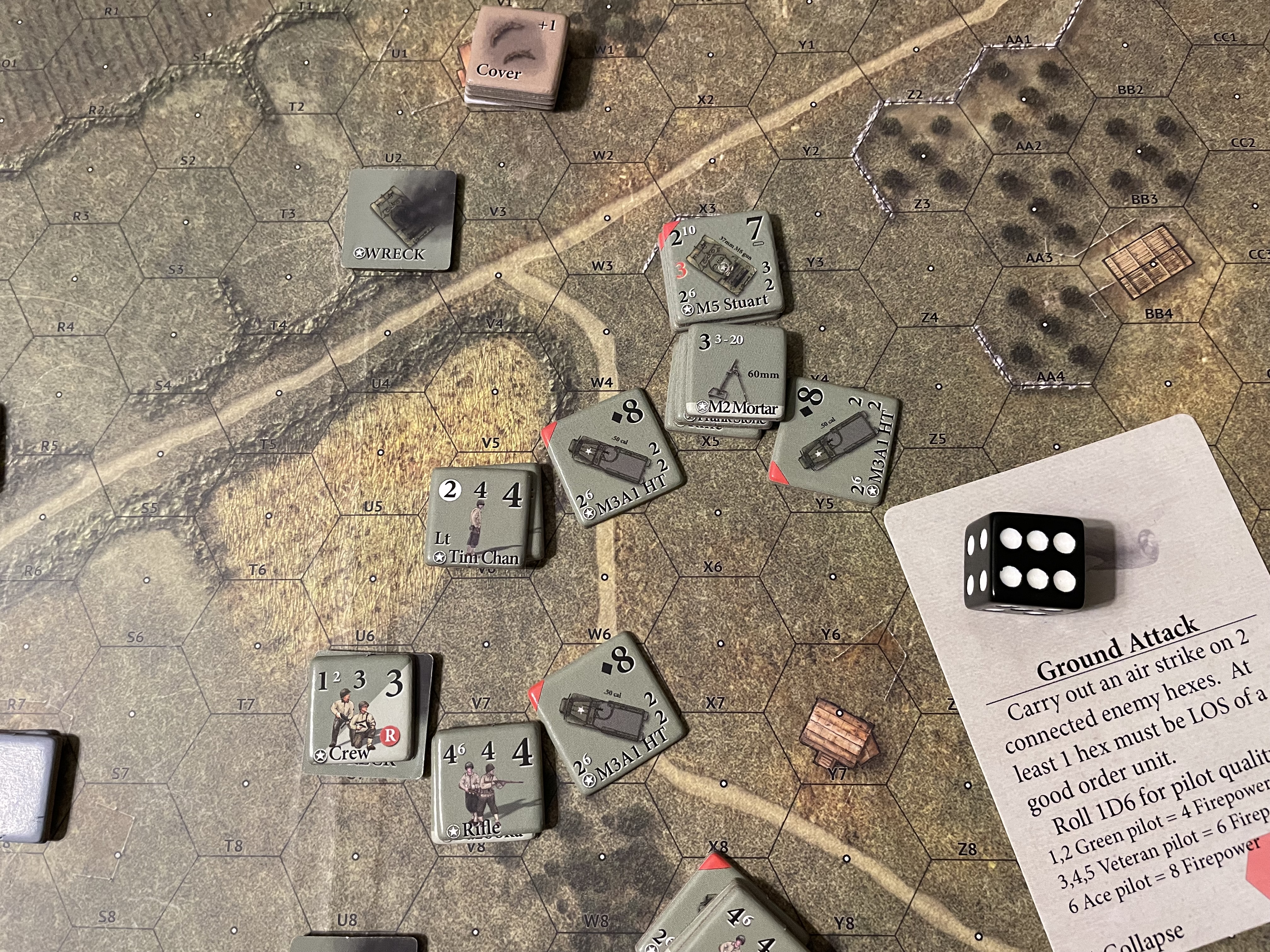
…which is exactly what happens. The German Pak40 gets two good OppFire shots and takes out an two M5 Stuart light tanks (in one tank the crew survives). A German Rifle squad dug in a small building uses a Panzershrek to (miraculously?) take out another M5. Even the Luftwaffe gets in on the action with a (rare?) air strike.
Turns 2 / 3
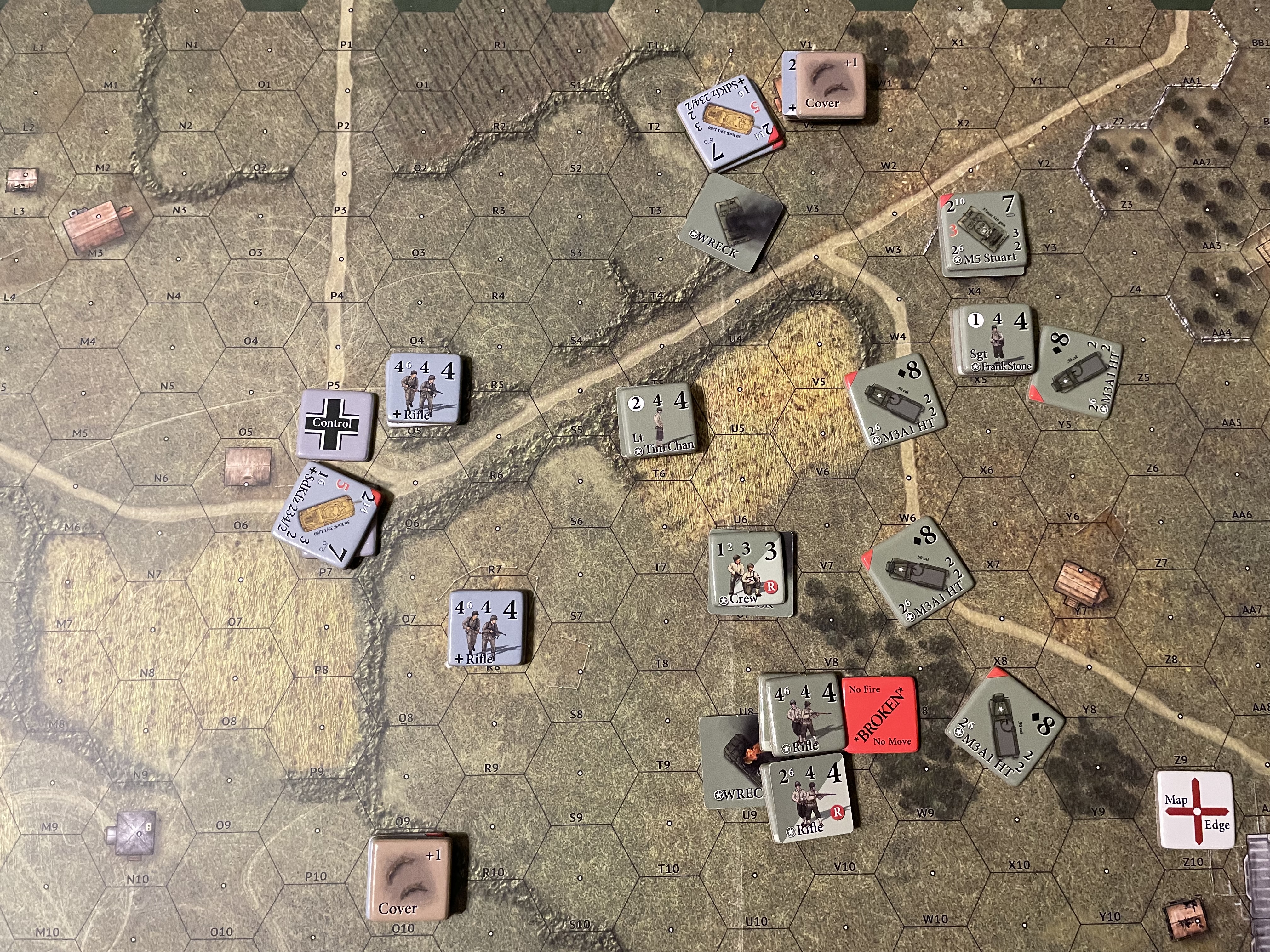
In the second turn three German armored cars enter and scream into supporting positions. Whenever the American dismounted infantry tries to move they are pinned down (Shaken or Broken combat results) and steadily lose men (Casualties). Mid way through turn 3 it is obvious the Americans will not be able to muster sufficient firepower to dislodge the German defenders. The Americans will withdraw—for now—and leave the crossroads to the Germans.
Ghostly Old School thoughts
My first wargame ever was Panzer by James Day from Yaquinto Publishing in 1979. I started with tactical armored combat in World War II and in many ways games of that kind are a wargaming comfort food to me. I generally view Old School Tactical on the lower end of the wargaming complexity spectrum; the game play is fairly straight-forward and there is just enough differentiation, and rules complexity, amongst the units to make the game feel representative of squad-level combat in World War II. Some squad-level tactical wargames give you many units and special rules for many different situations. Old School Tactical is a reminder that simpler is sometimes better. Nobody is going to claim Old School Tactical is anything close to a realistic representation of squad-level tactical combat on the Western Front of World War II. But if you want a fairly easy, fun to play wargame that makes you feel like you are there then Old School Tactical can be your game of choice.
Feature image courtesy RMN
The opinions and views expressed in this blog are those of the author alone and are presented in a personal capacity. They do not necessarily represent the views of U.S. Navy or any other U.S. government Department, Agency, Office, or employer.
RockyMountainNavy.com © 2007-2023 by Ian B is licensed under CC BY-SA 4.0 
 Rocky Mountain Navy Gamer