
Continuing my campaign development for War Stories: A World War 2 RPG by G.I. Garcia for Firelock Games (2022), I next focus on the Area of Operations (AO) for the campaign of Albert Miller, American Resistance Fighter in Holland set in September, 1944 on the eve of Operation Market Garden.
The Land
In Chapter 9: The Campaign of War Stories, the rulebook describes an Area of Operations (AO) for the campaign setting. An AO is assumed to be roughly 25km x 25km in size (p. 165). The rules for General Terrain and Environment note:
In a historical setting the terrain within the AO will largely be known. It will be varied and may include agricultural fields or hedgerows, forests, rivers and lakes, hills and mountains. Some of these wil be critical to the campaign and will be marked as Key Features (see below). The GM also needs to understand the “environment” the PCs are facing – by that we mean the military environment: are the PCs “on the front line” or “the axis of advance?”; are they in occupied or unoccupied territory?; are they “behind enemy lines?” This is important to help the GM set the tone and atmosphere of the gaming session.
War Stories, p. 167
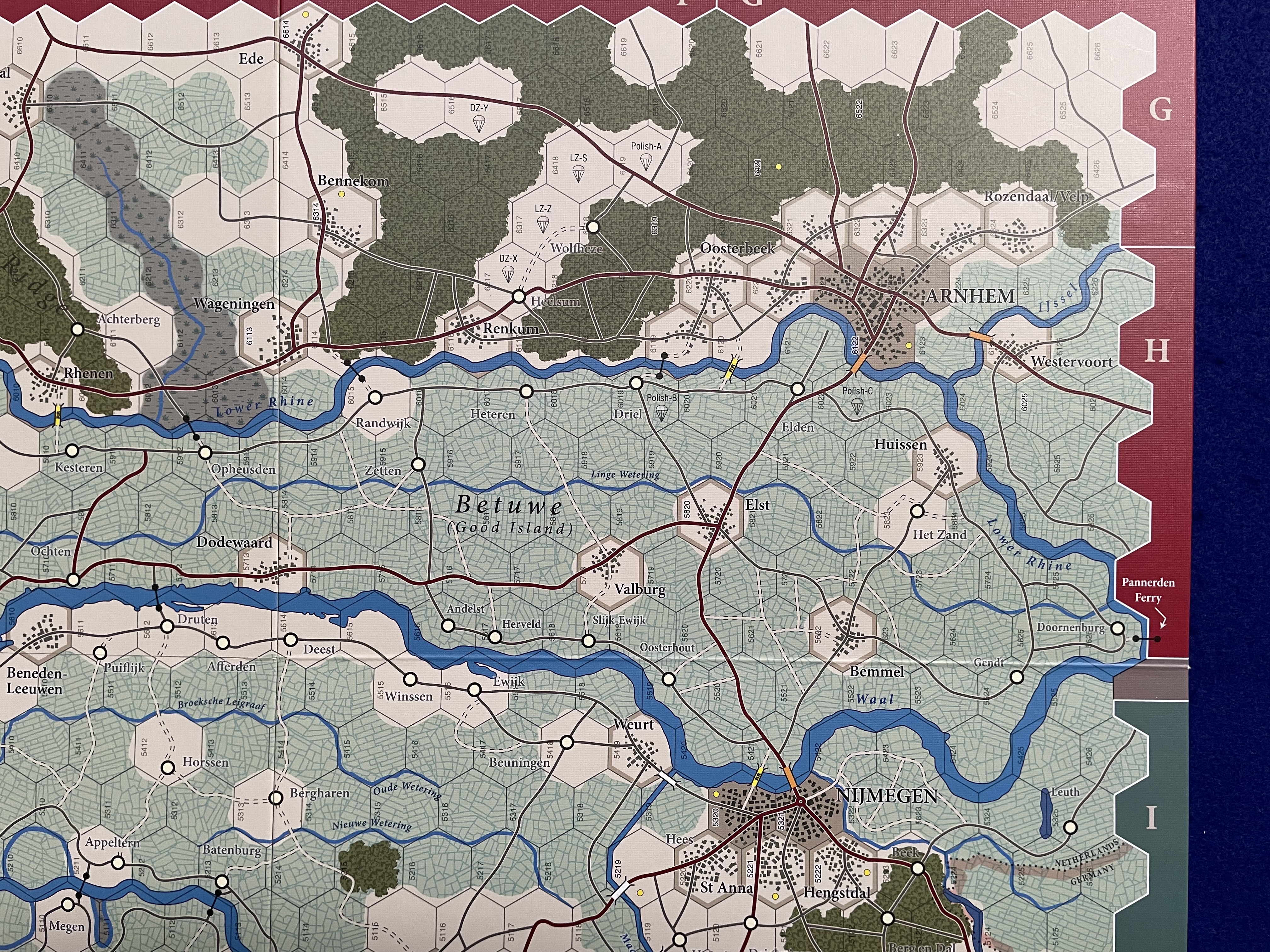
In my wargame collection is the title Holland ’44: Operation Market Garden, September 1944 by Mark Simonitch and published by GMT Games in 2017. The scale of the Holland ’44 map is about 2km per hex, which closely matches the War Stories recommended 1km hex size. Here is the northeast edge of the game map that focuses on Arnhem near where Albert and fellow resistance member Anna are working.
Here is the terrain key help deciphering the map of Holland ’44:
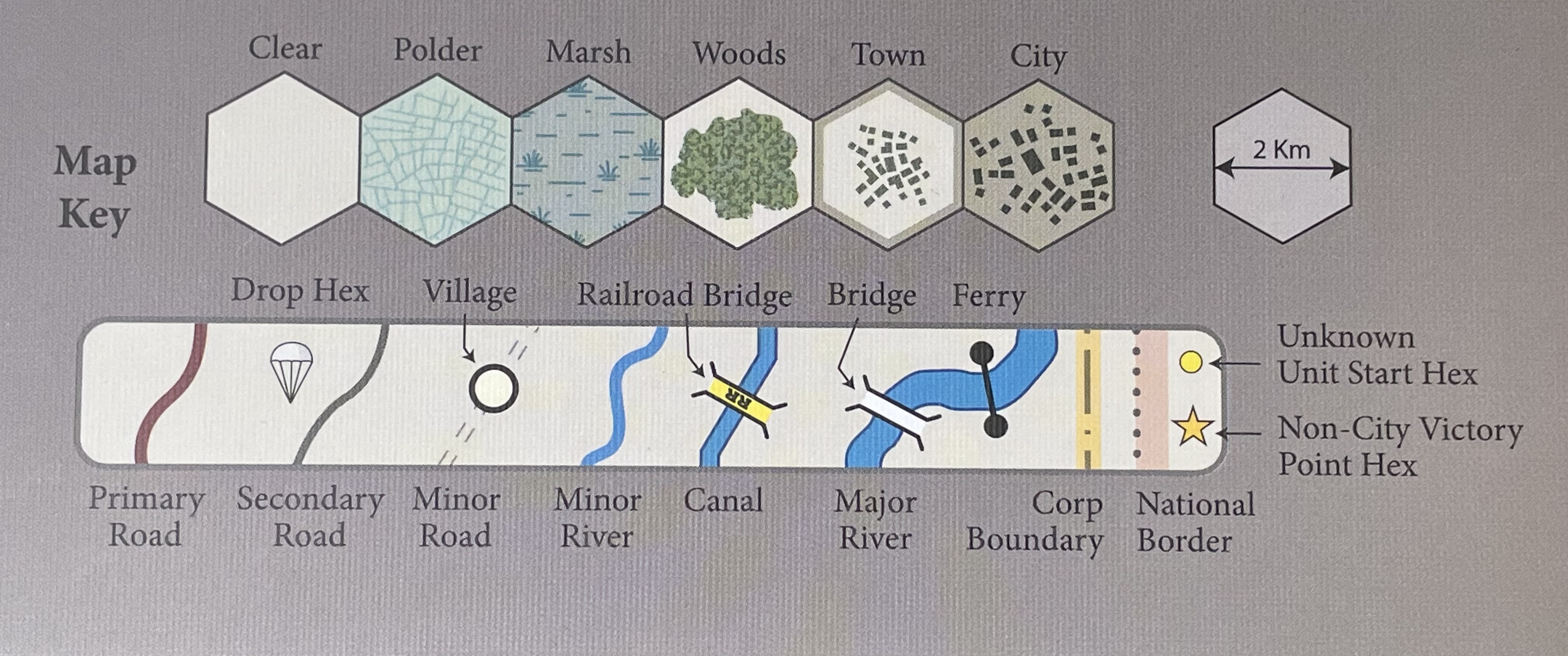
In War Stories, there are three types of terrain: Dense, Medium, and Easy (p. 166) as compared to the six in Holland ’44. A possible conversion may be:
| Holland’44 | War Stories |
| Clear | Easy Terrain |
| Polder | Medium for Vehicles, Easy for Infantry |
| Marsh | Medium Terrain |
| Woods | Dense Terrain |
| Town | Easy Terrain |
| City | Medium Terrain |
“Polder” is land reclaimed from the sea or a river. As the Designer Notes in Holland ’44 comment, “It is not very defensible terrain but any vehicles traveling across it must remain on roads. Sometimes those roads were elevated, but not always. I decided to treat Polder as Clear Terrain for Infantry Type units and something like Marsh Terrain for Vehicle Units” (Holland ’44, 34). For this War Stories campaign a similar approach to the terrain is taken.

“Mad Tuesday”
Author Antony Beevor’s book, The Battle of Arnhem: The Deadliest Airborne Operation of World War II (Penguin Random House, 2018) talks about the Dutch underground in the lead up to Operation Market Garden. Beevor notes, “Since armed resistance was almost impossible in a country lacking mountains and large forests, the Dutch underground concentrated on helping those in danger with fake identities and ration books, as well as collecting intelligence for the Allies and passing shot-down pilots into escape lines through Belgium and France to Spain” (Beevor, 21). Beevor talks about the brutal German occupation this way:
- “The occupation of the Netherlands was probably the most brutal of all those in western Europe” (Beevor, 21).
- “Approximately 110,000 Jews out of 140,000 were deported from the Netherlands, and only 6,000 of these survived the war. The other 30,000 were in most cases hidden or smuggled out of the country by ordinary Dutch people” (Beevor, 20).
- “All students were ordered to declare their support for the Nazi regime. Any who refused were arrested on 6 February 1943 in mass round-ups” (Beevor, 21).
- “Almost 400,000 citizens of the Netherlands were conscripted and sent to the Reich for Arbeitseinsatz, which effectively meant slave labour” (Beevor, 21)
- “The country’s food supply were systematically looted…Malnutrition began to have its effect, especially in children. Diphtheria and even typhus spread” (Beevor, 21-22).
“Mad Tuesday” is the name given to Tuesday, September 5 which saw the Germans in near-full retreat through the Netherlands. German officers and troops, as well as Dutch sympathizers, streamed into Germany by whatever means possible. The Dutch underground did what they could to interfere: “Wehrmacht vehicles had branches from pine trees tied to the front in an attempt to sweep away the tacks and nails scattered on roads by members of the underground” (Beevor, 11). Beevor quotes a historian as saying, “Organised Fascism in the Netherlands virtually collapsed on 5 September” (Beevor, 12). Even so, the Reichkommissar declared a state of emergency and threatened “death sentences for the slightest opposition” (Beevor, 12). The German occupiers were concerned that Bijltjesdag, the ‘day of the hatchet’ when the underground would rise up, was near (Beevor, 46).
Yet, change was in the air. As Beevor relates, “One bystander in Eindhoven noted: ‘the retreat of the Germans continued on the Monday, but at the same time a counter-movement was seen to develop: a large formation of troops, heavily camouflaged with branches of trees, marched through the city in the direction of the Belgian frontier'” (Beevor, 16).
September, 1944
Seen below is the Holland ’44 map with the at-start German forces shown. Note the “?” counters—those are unknown units (often garrison or police forces). In Holland ’44 unknown units are not revealed until an Allied unit enters or attacks their hex. Sounds to me like the Dutch resistance could aid the invasion by providing some unit identifiers for Allied Intelligence…
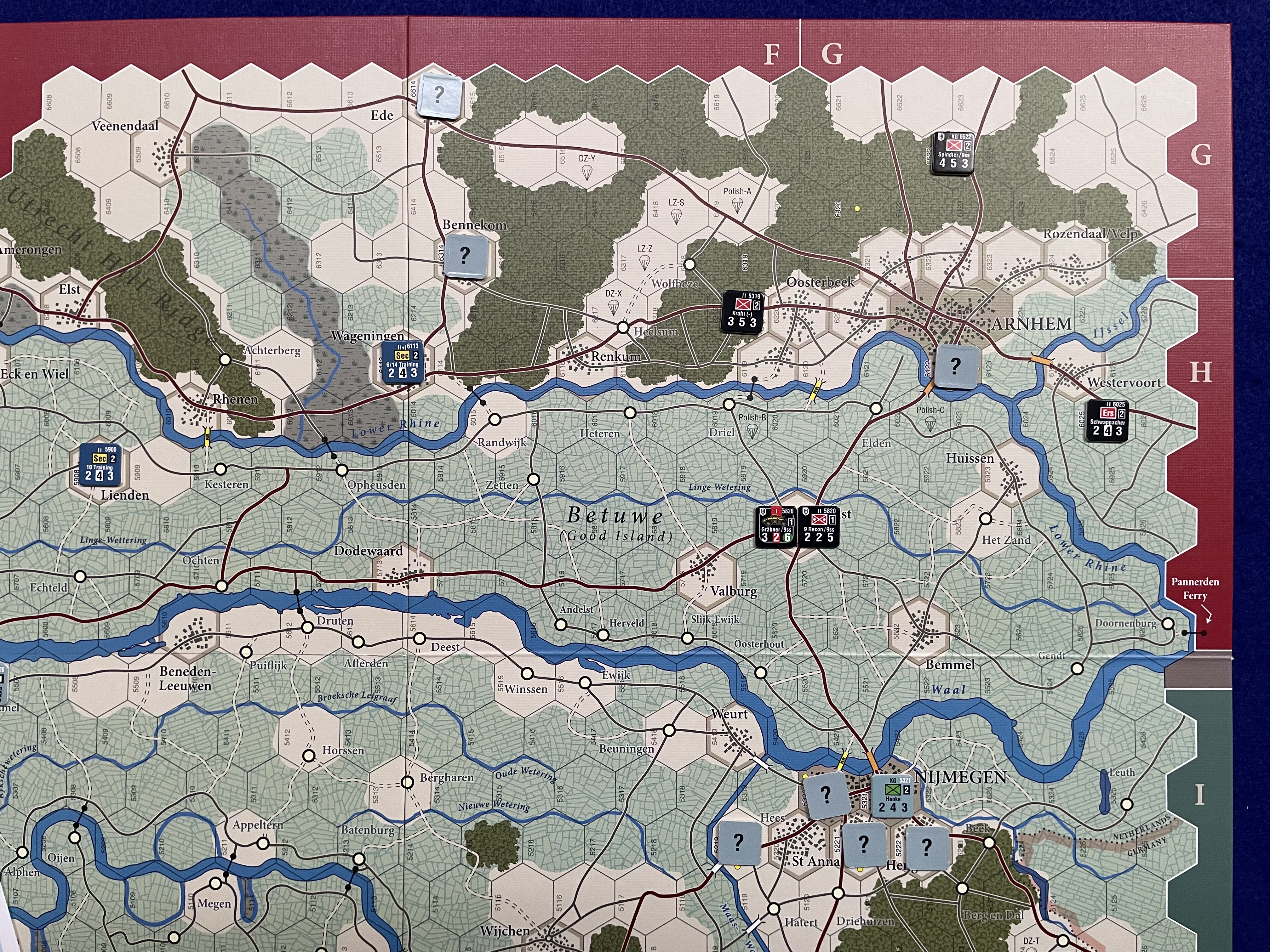
Historically, the allies did not recognize the real extent of the German SS units (black counters) refitting in the area. Beevor notes that, “[II SS Panzer Corps] presence in the Arnhem area had been known to Allied intelligence through the Dutch underground and from Ultra signals intercepts…but partly because of a belief it had been virtually destroyed in the retreat from France, and partly in a misguided attempt to avoid dismaying the troops, little mention of its presence was made in briefings” (Beevor, 50).

Campaign Forward
Given what is known of the area and the state of the underground in early September 1944 there is plenty of adventuring opportunities in this campaign for War Stories. Like I said when I stepped through the character generation for Albert Miller, this campaign developed in ways I didn’t expect.
Feature image courtesy dirkdeklein.net
The opinions and views expressed in this blog are those of the author alone and are presented in a personal capacity. They do not necessarily represent the views of U.S. Navy or any other U.S. government Department, Agency, Office, or employer.
RockyMountainNavy.com © 2007-2023 by Ian B is licensed under CC BY-SA 4.0 
 Rocky Mountain Navy Gamer
Well, this is an interesting piece. As I was born, and raised, and am still living within the boundaries of the provided map (Renkum, and Nijmegen), and have a livelong fascination with the whole Market-Garden operation, I have some quibles with this.
One: I have no idea where mister Beevor got his opnion from that the occupation of The Netherlands was the most brutal in Western Europe. According to our own official history it was one of the most civilized. We were never part of the occupied territories, like Belgium and France, or even Denmakr, I believe. The Nazis made us a special territory that was governed by a Reichscommisar, instead of a military man. And they tried to co-opt us, as fellow arians, into the whole Third Reich thing. We also had a rather large fascist movement before the war, which was enthousiastically supporting the whole occupation, and percent wise I think that we made the largest contribution to the Anti-Communist crusade agains the Soviet Union. And there were very few instances of whole villages, or large groups of hostages, being killed, like in Belgium, France, and even in Norway. So no. And most of what Beevor cites was indeed true, but the whole Jew thing was, and is, complicated because this was partly done by the Jews themselves. The Joodse Raad was instituted to facilitate the ordely relocation of the jewish population of the Netherlands to lands in the east, and they were only dimly aware of the true fate that was waiting at the end of the (railway)line. Also, this was facilitated by the rather peculiar way that religion was part of the political makeup of the Dutch population, and was therefor very important to register. Case in point is that most of the Dutch Resistance was organised along religious lines (with Socialists/Communists being one of those). And the whole starvation thing was only true from September 1944. And that was because the Dutch Railways were on strike, in order to prevent large scale rail movements to support or reinforce, the whole Market Garden operation. After which the Nazis took over the Railways, and food distribution to the civilian population was not one of their priorities. Hence malnutrition and starvation in the western part of The Netherlands.
Two: part of the reason the Allied Intelligence was hesitant, or even unwilling, to accept information from the Dutch underground, was the whole “Engeland Spiel”. In that intelligence failure a significant part of the Dutch underground, aand the SOE operatives were turned by the German SD, and were providing the British with false, misleading or only half true information. And although the Dutch Resistance, with some help from SOE, had been able to purge the double agents from the organisation by 1944, there was, within British Intelligence circles, still a lot of bad feelings about the Dutch resistance. One famous example was that during the siege of the British at the Arnhem Bridge, when they couldn’t communicate with their HQ, and only with XXX corps, because they only had one long range Radio, the Dutch resistance was controlling the phone exchange, both in Arnhem and in Nijmegen. This was apparantly told to both Frost and Uruqhart, so the para’s could have picked up any working telephone, and be connected to any other working telephone within the perimeter in Arnhem or Oosterbeek and/or the HQs in Nijmegen. But because the troops were given the order not to trust the Dutch Resustance, nothing came of this. Even the Dutch liason officer with the British para division was not fully trusted I believe.