
As a Grognard who has played wargames for over 40 years now, including many “Cold War Gone Hot” and other “modern” topic wargames, one might think I have played more than a few games on Operation DESERT STORM, the 1991 war with Iraq. Alas, you would be wrong. Wrong at least until the arrival of Desert Storm: The Hundred Hour War by designer Eric Harvey from Accurate Simulations. While it has taken 32 years for me to play a DESERT STORM wargame it is good that I waited. Desert Storm: The Hundred Hour War is an easy to learn, highly playable “traditional” hex & counter wargame with an interesting Campaign Card Draw game mechanism added to emphasize that this war was not just about military success—or failure—on the battlefield. While Desert Storm: The Hundred Hour War is easy to learn and somewhat fun to play, I hesitate to call it a simulation of the war as the viewpoint of the game is relatively narrow and the game mechanisms used don’t exactly convey the theme in a powerful manner.
Back in the day
I clearly remember the Iraqi invasion of Kuwait.
On August 2, 1990 I was home on leave having just finished intelligence school. I was supposed to be home for two weeks but it had only been a few days when the news of the invasion flashed across the TV screens. By August 4, I arrived at my new command, Tactical Electronic Warfare Squadron (VAQ) 137 ‘Rooks’, flying the EA-6B Prowler assigned to Carrier Airwing One embarked aboard the aircraft carrier USS America (CV-66). We transited the Suez Canal and entered the Red Sea just two days before the first night of DESERT STORM kicked off on January 17, 1991.

As a wargamer since 1979, in the decade before DESERT STORM I had played a few wargames about conflicts in the Middle East. The ones I remember best are Central Command: Superpower Confrontation in the Straits of Hormuz by Charles T. Kamps and published in Strategy & Tactics Magazine No. 98 in 1984. I also played lots of the 1988 Desert Falcons expansion for Air Superiority (J.D. Webster, GDW, 1987). Although I had heard of this big monster game called Gulf War by Mark Herman for Victory Games in 1984 I owned Aegean Strike (1986) instead.
Pacific pivot
After DESERT STORM and the fall of the Soviet Union, I was stationed on the Korean Peninsula which became the focus of my wargaming with titles like Crisis: Korea 1995 by Gene Billingsley from a relatively then-new company called GMT Games in 1992. I didn’t totally ignore the Middle east; I kept my Harpoon III obsession going with the supplement Troubled Waters from 1992. I touched a bit more on the Middle East with Crisis: Sinai 1973 by designer John Prados for GMT Games in 1995. What I didn’t play then, and all the way up to today, was any wargame on DESERT STORM.
32 years later
A bit earlier this year I saw an interview with designer Eric Harvey over on The Player’s Aid blog regarding a new title, Desert Storm: The Hundred Hours War published by Accurate Simulations. Being a bit familiar with some of Eric’s previous work (and if you played any Strategy & Tactics Press wargames in the past decade you very likely played at least one—or more—Eric Harvey wargames) I took the chance and ordered.
Desert Storm? More like Desert EXPRESS!
A shout out to “Bob” at Accurate Simulations for the unparalleled customer service. I ordered my game around 7:30pm eastern time on a Thursday evening. Within 30 minutes I had several emails that acknowledged the order and then informed me that Bob was able to pack and send the shipment off before the Post Office closed in California. When I got home from shopping with Mrs. RockyMountainNavy at 2pm Saturday I had a box waiting. Even with USPS moving the box it took less time for the game to order, ship, and arrive than the final ground war. That’s awesome customer service. Thanks, Bob!
Desert Storm comes in a standard 2″-deep bookcase box. When I opened the box I was a bit surprised at how few contents there are in the box. What I discovered was a relatively small game with a grand objective.
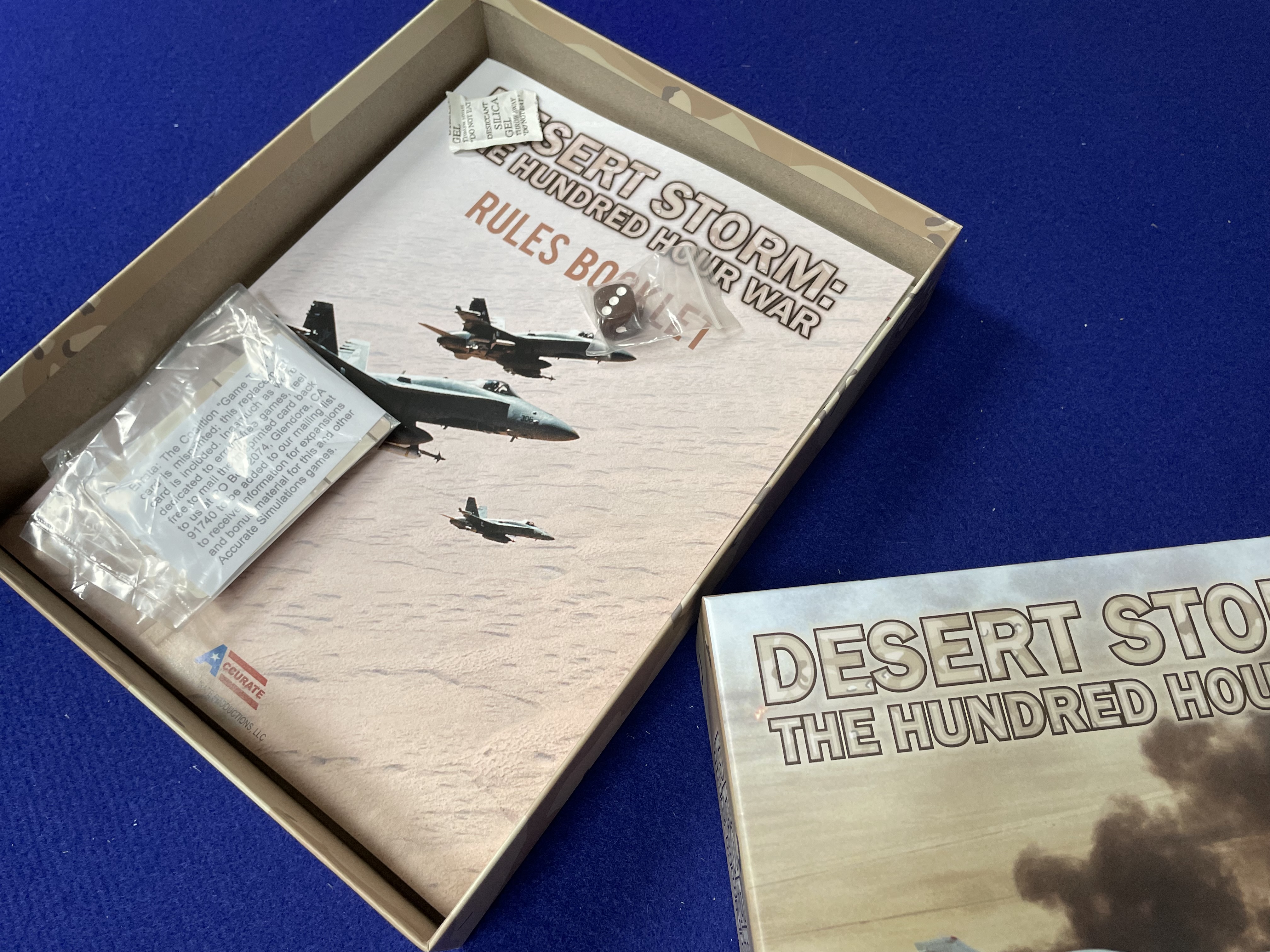

“…a traditional wargame.”
The introduction to Desert Storm: The Hundred Hour War describes the game this way:
Desert Storm: The Hundred Hour War is a unique wargame that emphasizes the geopolitical events that publicly framed the context of the Persian Gulf War. Unlike any previous war in history, the Persian Gulf War was broadcast worldwide virtually as it unfolded, and so both sides attempted to leverage world opinion towards their own aims. Saddam Hussein, the leader of Iraq, attempted to undermine support for the war by vowing to inflict grievous losses to Coalition forces. But, world leaders insisted that Saddam Hussein must not be permitted to control a fourth of the Middle East’s entire oil reserves.
Nevertheless, Desert Storm: The Hundred Hour War is a traditional wargame. Players must position their forces, plan their maneuvers, and then undertake combat operations. However, both sides possess advantages and disadvantages: the Coalition’s technological superiority is offset by the necessity to avoid heavy losses, and Iraq’s numerical superiority is offset by an inadequate air force. To win, both players must develop a comprehensive strategy that balances’s every dimension of warfare, a yet achieve victory on the battlefield.
1.0 Introduction
When Accurate Simulations says Desert Storm: The Hundred Hour War is a “traditional wargame” they really aren’t kidding. The game is very hex & counter with stacking rules (two friendly units max, see 4.1 Land Stacking and 4.3 Air Stacking) and a turn sequence including a very traditional Air Phase (Mission-Return to Base)-Move-Fight-Advance-Refit sequence (see 5.0 Sequence of Play). Air combat is a simple roll-under-or-equal to hit (7.1 Resolving Air-to-Air Combat) which is the same basic one-die resolution mechanism used for Bombing (see 8.1 Resolving a Bombing Attempt). Land movement pays different movement cost per the terrain (9.0 Land Movement and 9.1 Road Movement). There is a rule for Zones of Control (see 9.2 Zones of Control). Amphibious and airmobile units are also accounted for (9.4 Sea Hexes and Amphibious Units; 9.5 Airmobile Movement).
Land combat in Desert Storm: The Hundred Hour War uses traditional game mechanisms, albeit without the use of a Combat Results Table (CRT). Instead of a CRT, land units again use the roll-under-or-equal die roll with terrain die roll modifiers to hit (11.2 Land Combat Attack Procedure). Importantly, a unit that is hit gets a Defense Roll and a chance to reduce the attacking unit (11.3 Land Combat Defense Procedure). There are also rules for retreat (11.4 Retreating from Land Combat) and advance after combat (11.5 Advance after Combat).
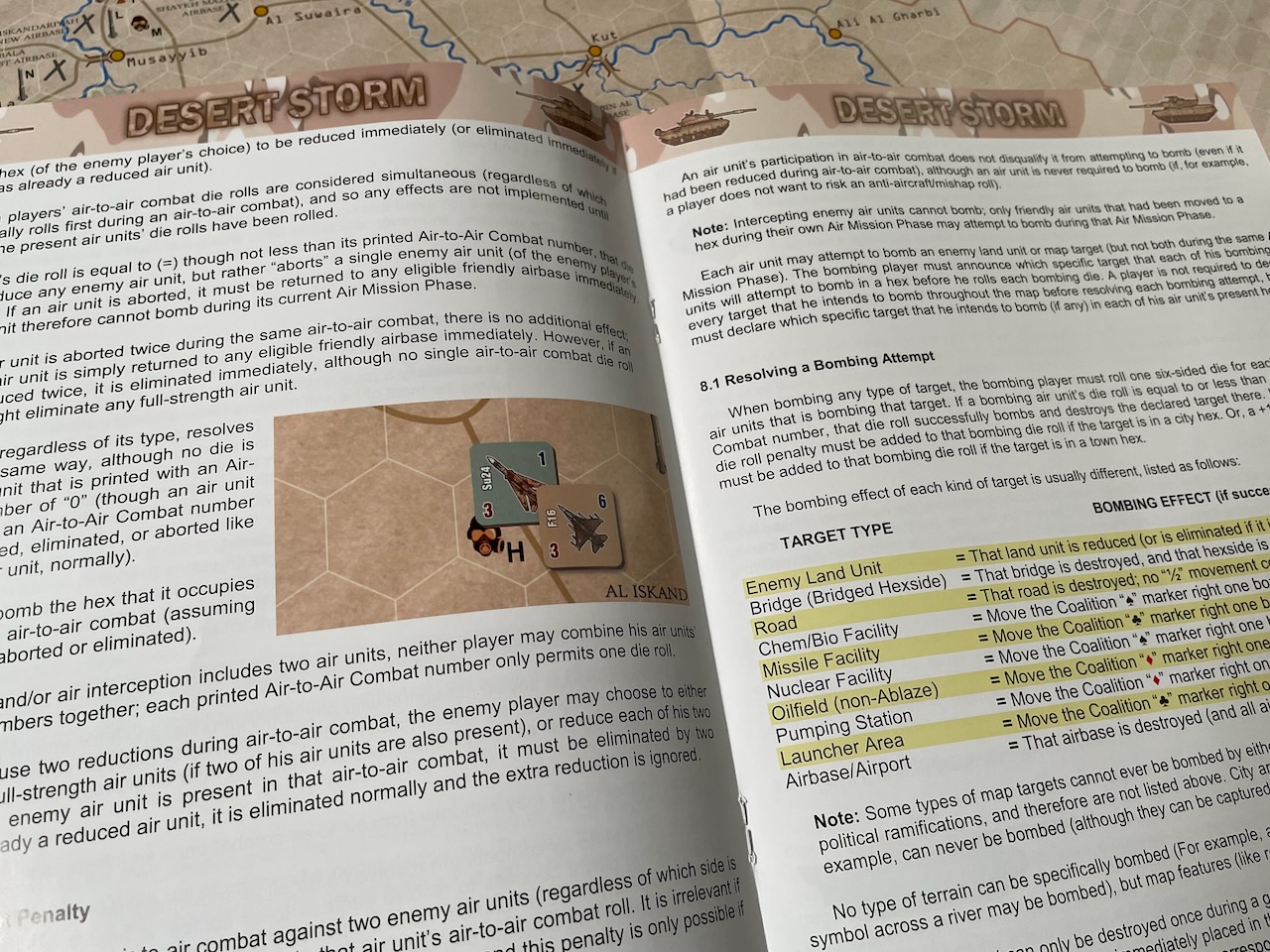
The traditional wargame of Desert Storm: The Hundred Hour War is so traditional that it very easy to learn and fast to play. In some ways the rules are excellent for playing with gamers who maybe are exploring or thinking about playing wargames.
Suits of Victory
Where Desert Storm: The Hundred Hour War is decidedly NOT a traditional wargame is in determining victory. Instead of accumulating victory points, players play for suits. No, not suits to wear but suits on playing cards which are called Event cards in Desert Storm.
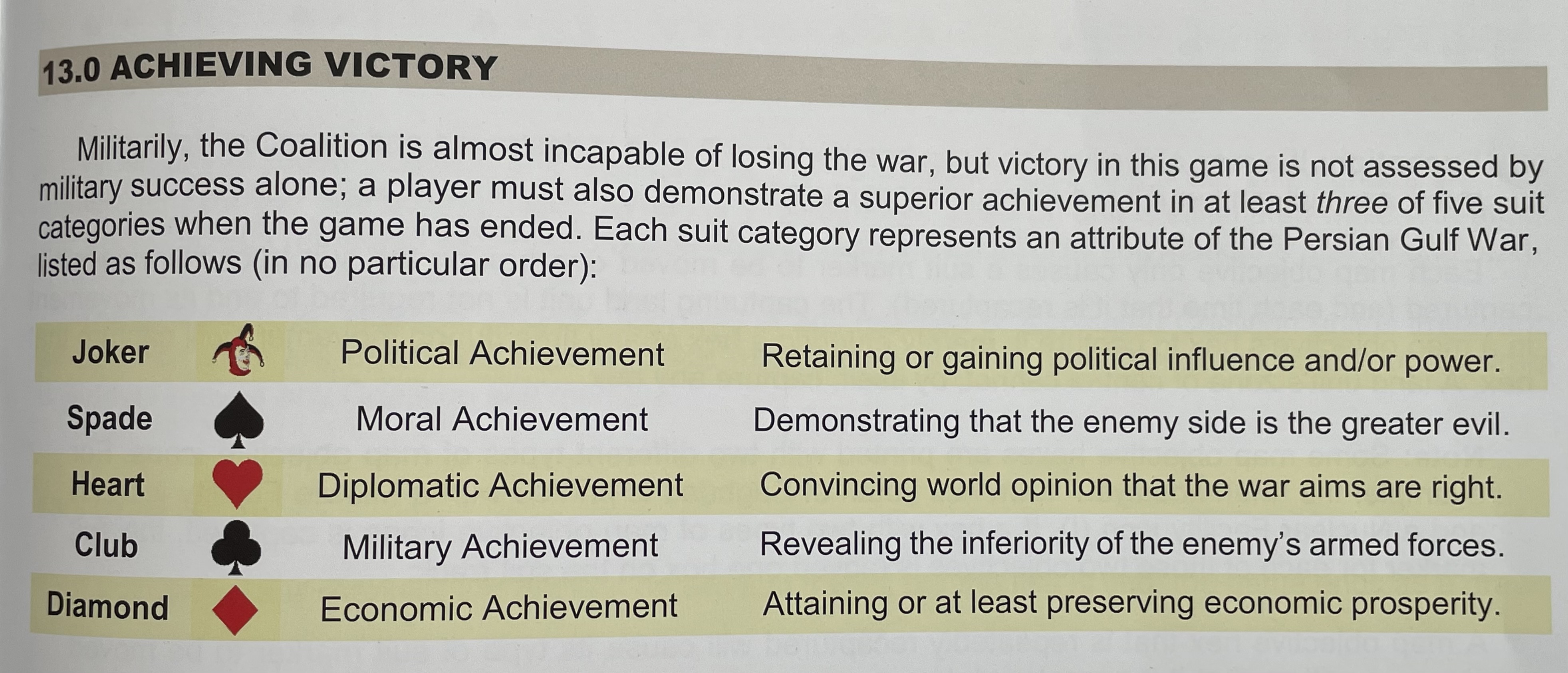
The Event cards in Desert Storm seemingly riff off the 2003 Iraq Most Wanted Playing Cards. For the older DESERT STORM conflict there was a set of older Topps trading cards.
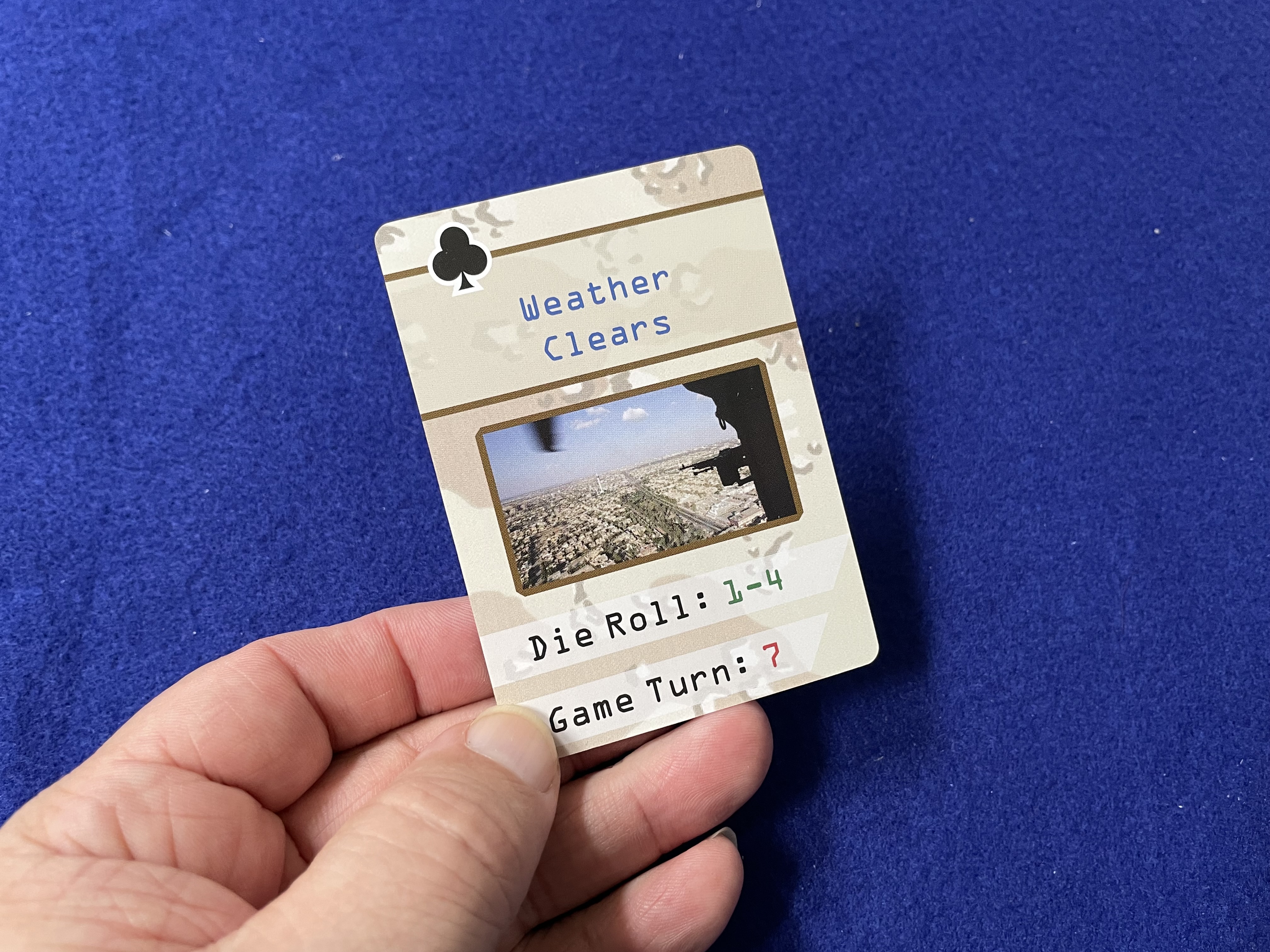
Each player’s turn in Desert Storm: The Hundred Hour War starts with an Events Phase where each player plays one of their Event cards. For each turn in the game, players have three double-sided Event cards of which two are randomly drawn. The player must decide which two of the four events will be played in each player’s turn of the game turn.
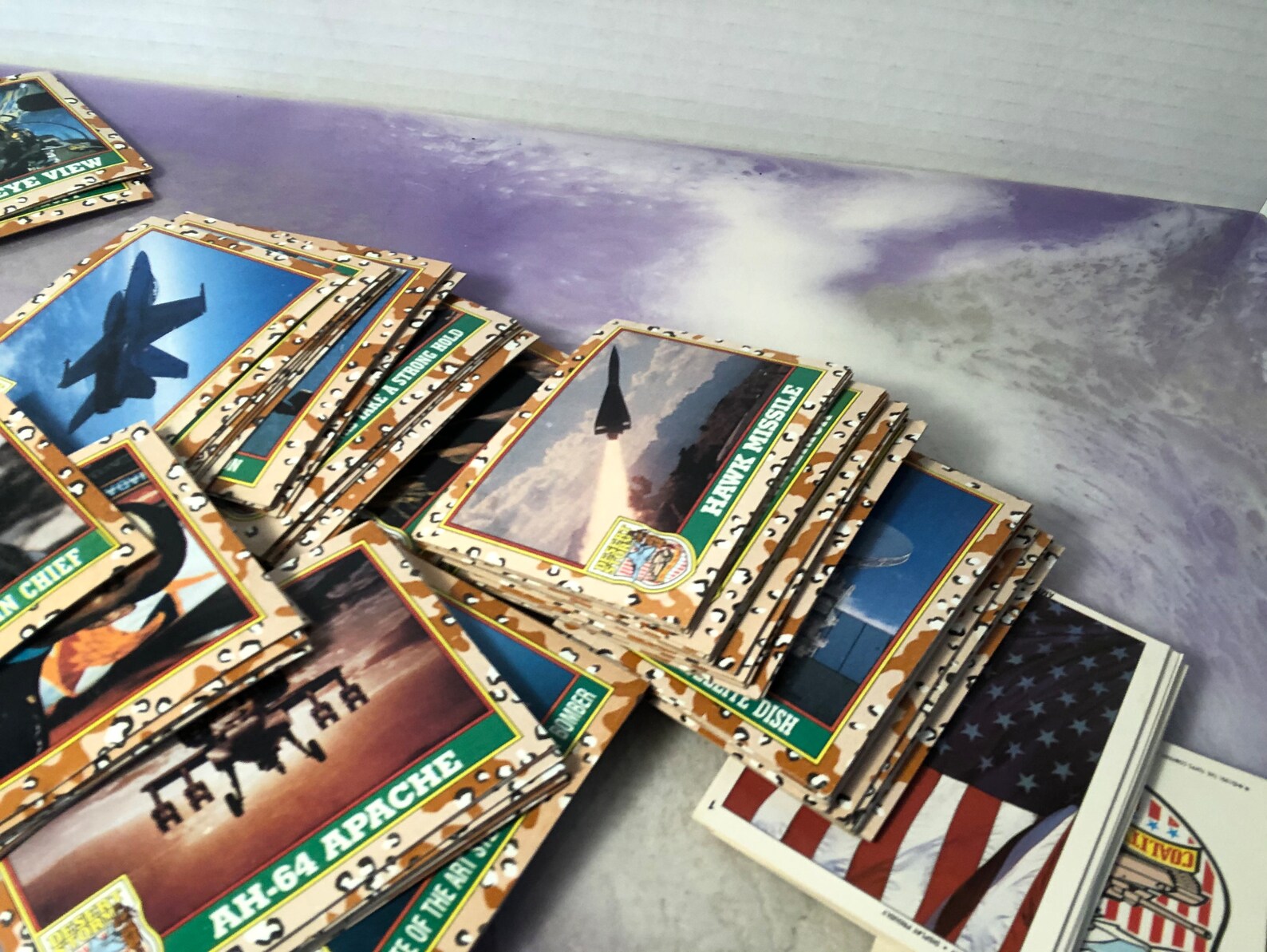
The Event cards represent national and geopolitical influences upon the course of the war. Each event is an actual historical incident that either negatively or positively impacted public perception of the war. All of the various events are represented as card suits (Joker, Spade, Club, Heart, or Diamond) to symbolize a unique dimensions of the war.
6.1 Event card suits
As the design note to rule 6.1 states: “The representative theme of these events has no specific effect on game play; they merely serve to provide players with a realistic sense of the five dimensions of war in the 20th Century, particularly during Operation Desert Shield and Operation Desert Storm.” [Hmm…hang onto that thought…]
When playing an Event card in Desert Storm, players roll a single die; if the roll is within the designated range on the card they advance that suit track one box. The second note in rule 6.4 The Effect of an Event explains why:
Note: The suit track is essentially a race amongst both side’s suit markers. Each player must try to win the game by having the most of his suit markers farthest along the suit track (towards each “End” box) before the last game turn is completed. No particular type of suit is more valuable than any other type of suit because the goal is to have the most suit markers with the highest position. Of the five different suit markers for each player (Joker, Space, Heart, Club, and Diamond), whichever player has at least three if his own markers closest to the end of the suit track at the conclusion of the last game turn has achieved a victory and won the game.
Second Note, 6.4 The Effect of an Event
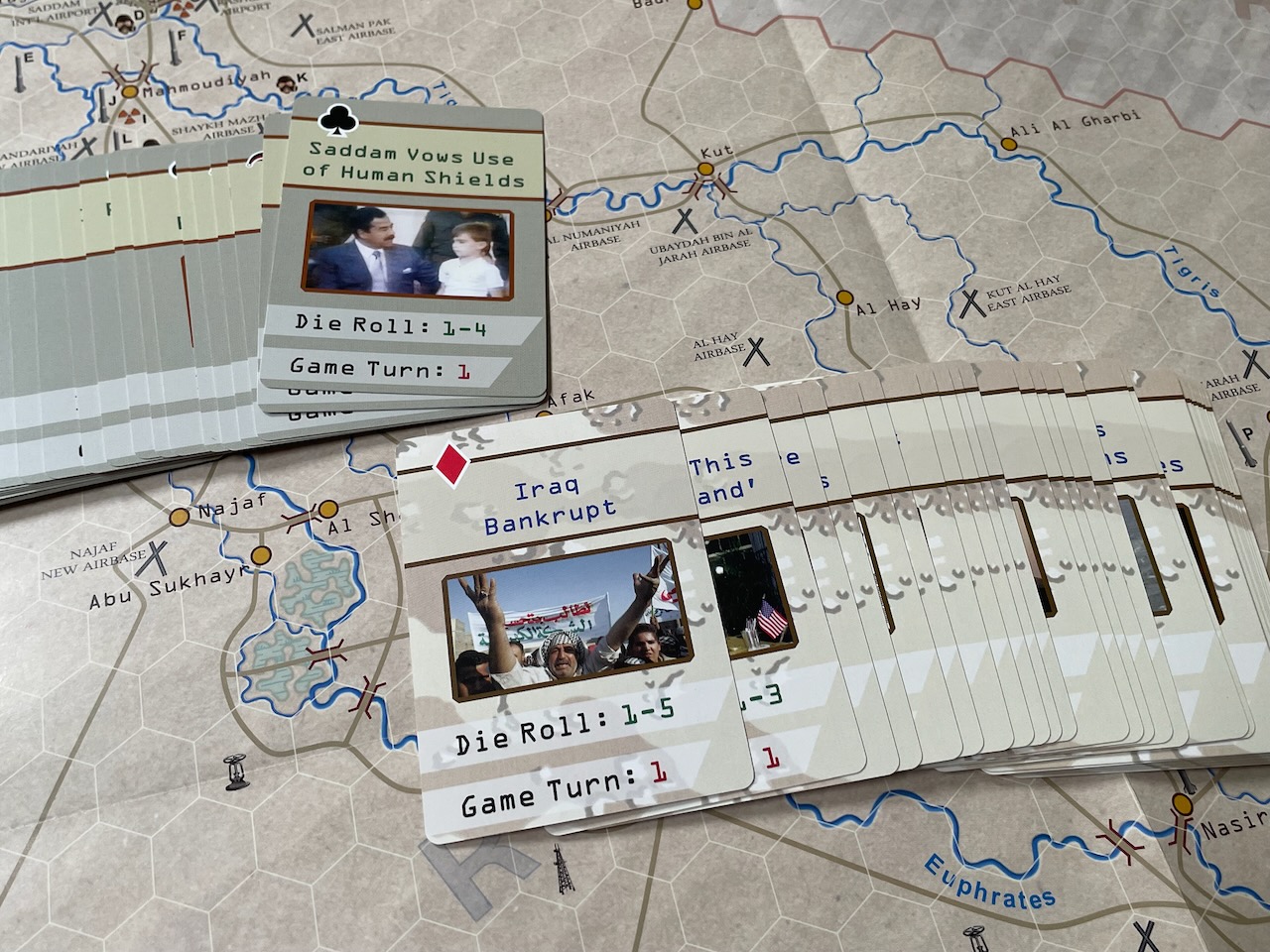
If the Event cards was the only way to move the suit track then Desert Storm: The Hundred Hour War would never land on my table to start with. Fortunately, there are four (4) ways to move a marker on the suit track, as defined in rule 13.1 Suit Markers:
- “When an Event card is played, if that event’s die roll is successful (see 6.3).”
- “When any map objective hex is captured by a land unit (see 13.2).”
- “When any map objective hex is successfully bombed (see 13.3).”
- “When any Coalition game piece is reduced or eliminated (see 13.4).”
The Grognard in me can easily understand how different suits are objectives for the campaign. I am glad they are there even if the rule is buried in the back of the rulebook almost like an afterthought.
That said, the Event cards in Desert Storm: The Hundred Hour War are, to be frank, kind of dull in play. In the Event phase when picking which cards to keep I find players tend to look at the suit track and choose the card with the suit they need. Two obvious strategies are possible; keep cards for tracks you are behind on to catch up or keep cards for tracks you are well ahead on to stay ahead. Neither strategy is particularly engaging as players focus on the suits and die rolls—the actual event text becomes inconsequential and often ignored. The only real saving grace of the suit track is the need to consider it with regards to objective hexes to be captured or bombed. I have not done a deep look to see if the objective hexes are balanced amongst suits.
If the war was a hundred hours why did we fly combat missions for nearly 50 days?
As interesting as the gameplay of Desert Storm: The Hundred Hour War is, I cannot call it a definitive wargame on the subject. For me, this highly playable game is tightly focused on the ground war only a light touch of the air war; the naval aspects for the most part abstracted out and other warfighting domains like information operations are (very loosely) portrayed though the event cards.
What’s in a name?
In the Player’s Aid interview, designer Eric Harvey talked about the hundred hours in the title and how it really doesn’t really mean what is says:
Grant: What did you want the subtitle of “The Hundred Hour War” to say to players about the game?
Eric: Though the game actually covers the months leading up to the war (and then the war itself, of course), I thought that the subtitle “The Hundred Hour War” sounded interestingly contradictory, as if to say, “How could a war only last a hundred hours?” The fact that the war only lasted a hundred hours says something about the conflict, it seems.
Poorly tailored suits
I appreciate the design effort behind the Event cards in Desert Storm: The Hundred Hour War but I am not sure the design objective (“provide players with a realistic sense of the five dimensions of war”) is achieved. Part of the difficulty I have is the lack of connection between theme and artwork. In a game where suits supposedly are representative of the five dimensions of warfare, the only place that is seen is in the written rule book. The suit track on the game map has the suit and graphic. Maybe I assume too much of players because I know a spade from club from a diamond from a heart. When I look at the suits, however, what I see is tracks where Diamond is “Economic” and Heart is “Diplomacy” and Spade is “Moral” and Club is “Military” and the Joker is “Political.” But no, I need to remember a different association.
The more times I looked at the suit track in Desert Storm the more I see how it is not “right” to me. I fully recognize this confusion stems from my preconceived biases of what each suit should represent and it is not the arrangement in the game.
| Suit | Game | Me |
| Joker | Political | Political |
| Spade | Moral | Military |
| Heart | Diplomatic | Moral |
| Club | Military | Diplomatic |
| Diamond | Economic | Economic |
While I am personally confused, and maybe even a bit disappointed by, the suits and Event cards in Desert Storm, I can also see some value if one leans into the simple “traditional” wargame approach. The Event cards form another “game” over the combat game in the design of Desert Storm. I can find contentment in the design if I remember to tell myself this is an easy-to-play, easy-to-teach, game that is evocative—not a simulation of but evocative—of the many dimension of war.
Army puts a fat thumb on the scale
Desert Storm: The Hundred Hour War is a heavily abstracted game. One area of abstraction that leaves me scratching my head is the timescale of the game. A distance scale is given – 10 miles per hex, as well as a unit scale (“Division-scale”) but there is no time scale for a given turn. The rulebook itself is nebulous:
- “The game simulates a war between two sides, the Iraqi side versus the Coalition side.” (2.0, p. 3).
- “Event cards represent the historically newsworthy events of the war as they unfolded before and throughout the war…” (2.0, p. 3).
- “Each of the ten game turns is divided into two distinct player turns.” (5.0, p. 9).
Rule 9.7 of Desert Storm is the Coalition reinforcement schedule. Given the game starts with Coalition units already deployed game turn 1 can safely be assumed to be sometime after August 2, 1990. My own USS America is a reinforcement that arrives in Game Turn 2 which was January 15, 1991.
The Event cards in Desert Storm also give hints. One of the Coalition Game Turn 3 cards is “Coalition Begins Day Bombing” which was January 17, 1991. I note, however, the Iraqi Turn 4 Event card “Intense AAA Over Baghdad” seems out of sync. “Bush Declares Saddam Defeated” is a Coalition Turn 8 card but “Powell Proposes a Ceasefire” is a Iraqi Turn 9 card.
Perhaps it is best just to say Desert Storm: The Hundred Hour War is a game with ten turns and leave it at that. Like so much of this game, it seems better to try not to read too much into the design.
Saddam’s Nukes
There is an interesting map note just below the suit track on the game map for Desert Storm: The Hundred Hour War. The note reads: “Map Note: Nuclear weapons production facilities (e.g Facility 190, Facility 416, etc.) that were not known to U.S. intelligence in 1990 are not included on this map.”
Iraq’s WMD program had its nuclear portion reduced after the 1981 Israeli air strike on the Osirak reactor. Yet, as would be publicly disclosed on the 2004 WMD Commission Report, Iraq had a serious nuclear weapons program during DESERT STORM:
Post-Gulf War. Following the Gulf War, based on a variety of sources of intelligence including reporting from defectors, the Intelligence Community learned that Iraq’s nuclear weapons program went “far beyond what had been assessed by any intelligence organization” in 1990-1991.10 Before the Gulf War, in November 1990, the Community had assessed that, because analysts had not detected a formal, coordinated nuclear weapons program, Iraq likely would not have a nuclear weapon until the late 1990s.11 Thus after the war the Intelligence Community was surprised to discover the breadth of Iraq’s nuclear weapons program, including the wide range of technologies Iraq had been pursuing for uranium enrichment, which in turn indicated that Iraq “had been much closer to a weapon than virtually anyone expected.”12 This humbling discovery that Iraq had successfully concealed a sophisticated nuclear program from the U.S. Intelligence Community exercised a major influence on the Intelligence Community’s assessments throughout the early 1990s and afterwards.
Unclassified Version of the Report of the Commission on the Intelligence Capabilities of the United States Regarding Weapons of Mass Destruction, 53-54
I really don’t like being a wargamer that comes across as that snide person that always tells game designers “I could of done this better” but I have to wonder why mention the “unknown” facilities and then do nothing with them? Maybe give the Iraqi player two facilities that are hidden somewhere on the map? As it is, the map note is Chekhov’s gun but without a bang.
Where are the carriers?
I totally understand the the naval aspects of Operation DESERT STORM are not necessarily conducive to exciting wargaming. I guess I am lucky that I am in the game, even if it is as a single F-18 counter. That single counter was very busy in ways not portrayed in the game. During the first part of the war USS America one of three aircraft carriers in Battle Force Yankee in the Red Sea. We usually did a six-day rotation; two days of daylight Alpha Strikes (most of the airwing), two nights of Alpha Strikes, then two days in “Gas Alley” to get more fuel, beans, and bullets. For most flight crews this meant one major mission each day. For Prowler squadrons even “down days” in Gas Alley saw us flying combat missions in support of our allies (like the RAF) that didn’t have dedicated electronic warfare strike support. Just before the “Hundred Hours” kicked off America transited to the Arabian Gulf to be the fourth carrier in Battle Force Zulu. When the ground war started we flew “cyclic ops” where the deck basically operated in a 45-minute (later 1 hour 15 minute) cycle each of which consisted of ready, launch, and recovery of aircraft. Here the flight crews might fly multiple times in a given day for the focus was on sortie generation. None of that, of course, is reflected in the Desert Storm game. Not that it need be; the game is so heavily abstracted it won’t (shouldn’t?) but it is nonetheless interesting in my mind how my memories and the abstraction clash.

Grognard expectations
As a Grognard who is a veteran of both the Gulf War and the U.S. military as well as wargamer for over 40 years now, perhaps I am expecting too much from Desert Storm: The Hundred Hour War. I don’t know who wrote the ad copy for the publisher’s blurb on the Accurate Simulations website, nor who submitted the subtitle for the BoardGameGeek entry, but Desert Storm is not “A comprehensive simulation of Desert Storm based on newly declassified documentation.” Even so, the easy-to-learn, relatively quick-play of Desert Storm: The Hundred Hours War will find the game landing on my table but not as an exploration of the topic but as simply a fun, competitive play.
While Desert Storm: The Hundred Hour War is easy to learn and somewhat fun to play, I hesitate to call it a simulation of the war as the viewpoint of the game is relatively narrow and the game mechanisms used don’t convey the theme in a powerful manner.
RockyMountainNavy, September 2023
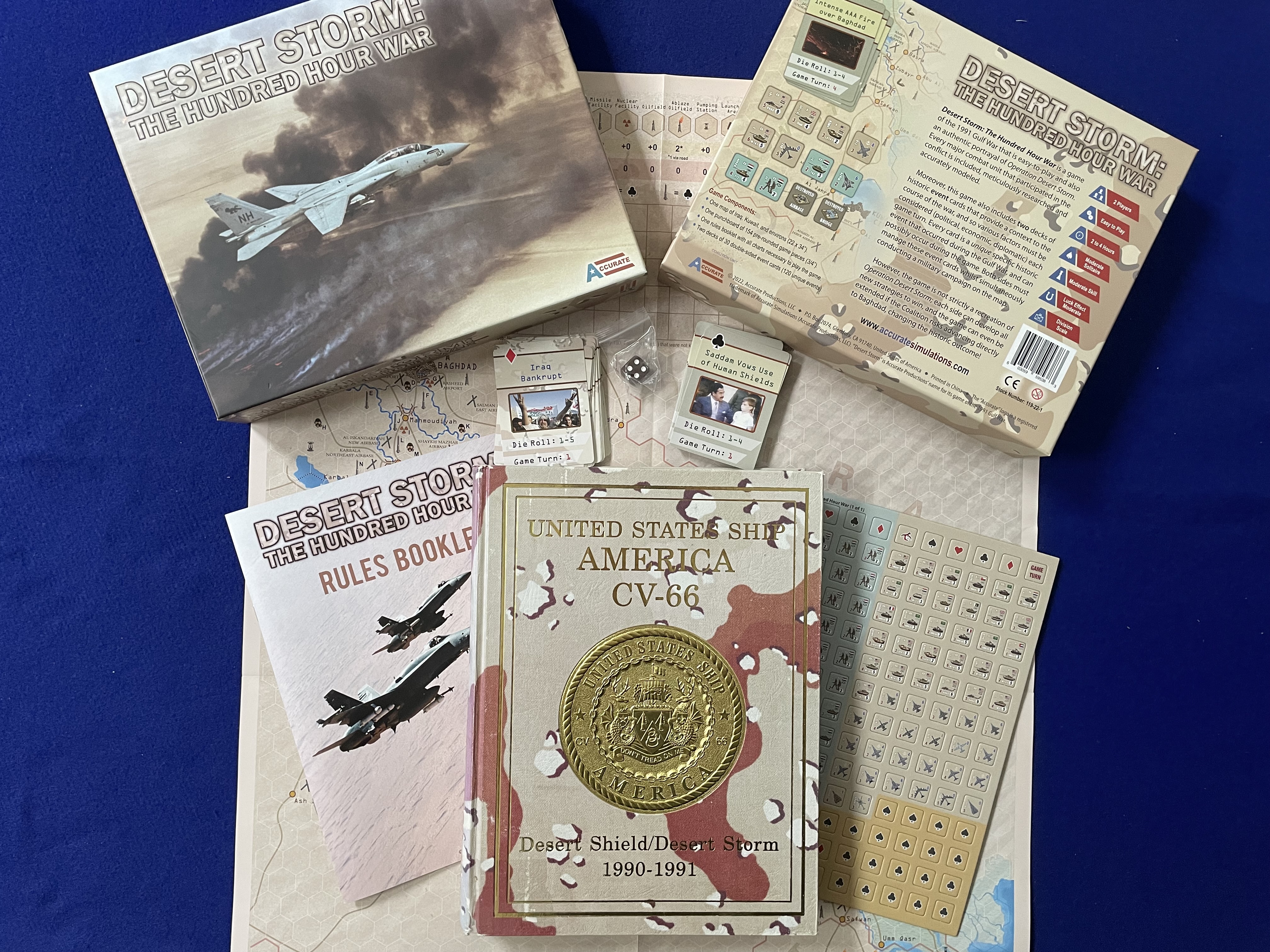
Feature image courtesy RMN
The opinions and views expressed in this blog are those of the author alone and are presented in a personal capacity. They do not necessarily represent the views of U.S. Navy or any other U.S. government Department, Agency, Office, or employer.
RockyMountainNavy.com © 2007-2023 by Ian B is licensed under CC BY-SA 4.0 
 Rocky Mountain Navy Gamer
Yeah, their pre-1991 nuclear program was real, extensive, and only a few years away from a bomb. Have heard that Osirak was actually counterproductive-in exchange for taking out one reactor that wasn’t really ideal for making weapons material, they inspired Saddam to build a big, dispersed nuclear program full of stuff that was.
(But what do you expect from the guy who was the primary inspiration for the character Magneto? 😛 )
Thanks. Interesting stuff 🤔